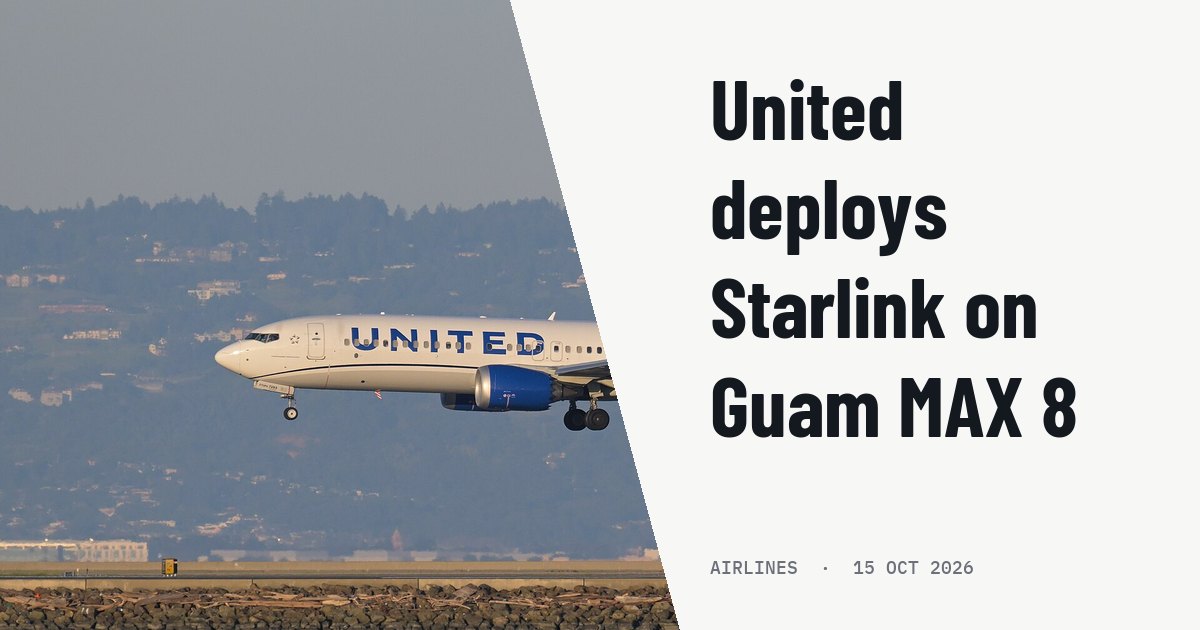
United Airlines announced on October 13, 2026, the installation of Starlink satellite connectivity on its Boeing 737 MAX 8 aircraft, starting with two airframes stationed in Guam. The carrier intends to equip its full fleet before the close of 2027, with the satellite network currently active on roughly 47% of its daily operations.
Concurrently, the operator concluded the replacement of its Boeing 737-800 narrowbodies in the region ahead of its initial year-end schedule. A dedicated subfleet of ten Boeing 737 MAX 8 jets now operates all regional flying out of Antonio B. Won Pat International Airport (GUM), serving 15 destinations across Micronesia and Asia, including the Island Hopper service and routes to Japan.
Configured with 164 seats, these aircraft feature forward Economy rows convertible for medical stretcher transport to accommodate regional evacuation missions across remote Pacific sectors. The low-Earth orbit constellation provides high-speed broadband coverage across extensive oceanic routes where conventional inflight networks encounter operational limits.
Why it matters for your training
Fleet modernization and high-bandwidth satellite connectivity directly impact oceanic dispatch parameters, inflight data access for crew operational tools, and specialized regional mission profiles such as medevac flights.