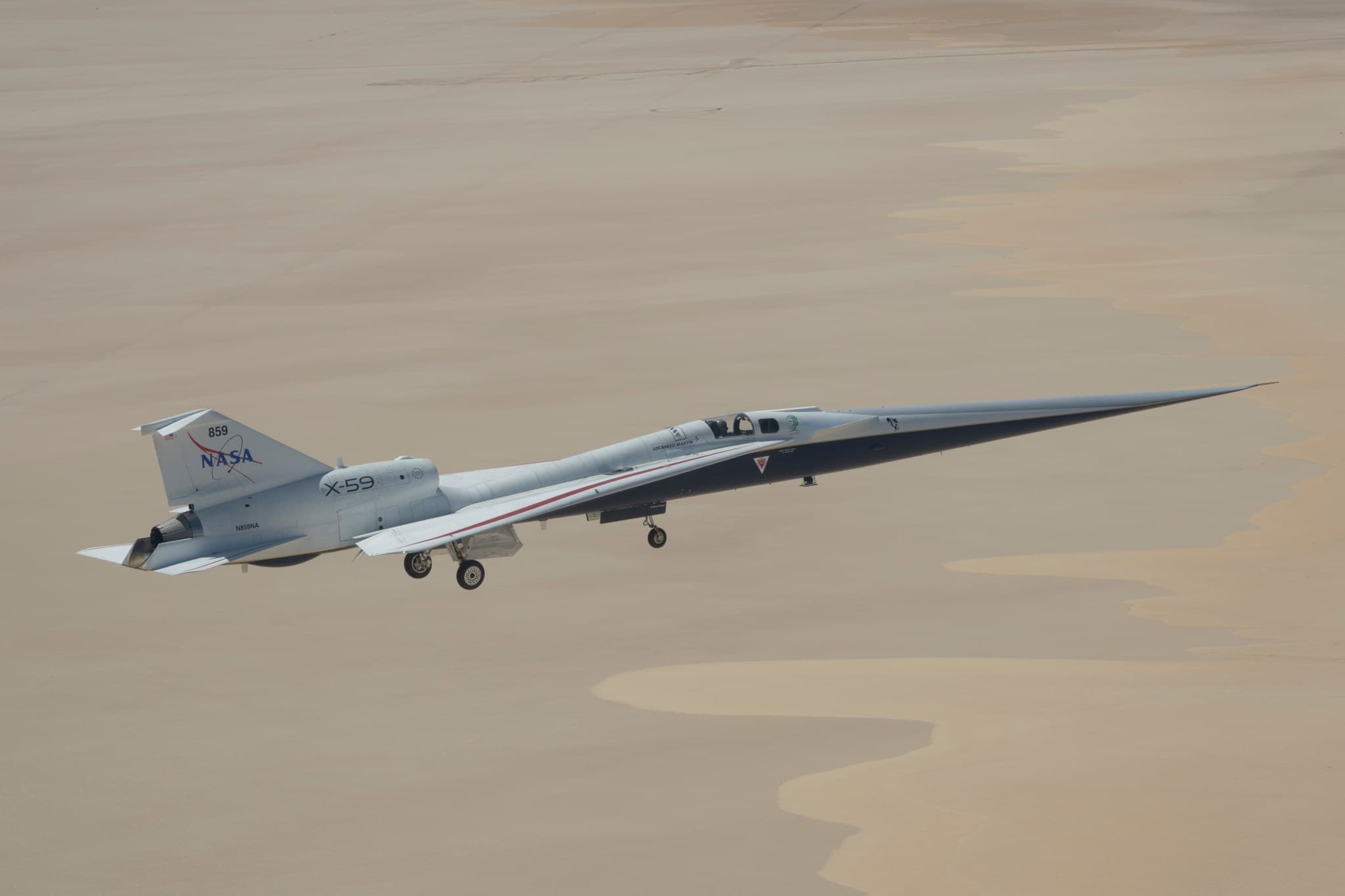
NASA's X-59 quiet supersonic research aircraft is on the verge of a historic milestone: its first supersonic flight, scheduled for early June 2026. After completing 14 flights since its maiden voyage in October 2025, the X-59 has already reached Mach 0.95 at 43,000 feet. Now, it will push past Mach 1 (over 630 mph) at the same altitude, followed by a mission-conditions flight at Mach 1.4 (925 mph) and 55,000 feet. The ultimate goal of the Quesst mission is to demonstrate that supersonic flight can be quiet enough to fly over land without disturbing communities, potentially overturning current bans on supersonic overflight.
For ATPL students, this development is directly relevant to future aircraft design and operational planning. The X-59's unique shape and systems, such as the eXternal Vision System (XVS) replacing the forward windshield, represent a shift in how supersonic aircraft may be certified. Understanding the physics of sonic booms and the concept of a "sonic thump" versus a traditional boom is essential for pilots who may one day fly quiet supersonic jets. The aircraft's flight envelope expansion—from subsonic to supersonic—mirrors the careful testing pilots must conduct when introducing new types into service.
ATC students should pay close attention to how supersonic operations affect airspace management. If the X-59 proves that supersonic flight can be quiet, regulations could change, allowing supersonic speeds over land. This would require ATC to handle faster aircraft, manage new noise abatement procedures, and integrate supersonic traffic with subsonic traffic. The X-59's test flights, including those with a chase plane and shock-sensing probes, provide a real-world example of how data collection shapes future airspace rules.
The X-59's progress also highlights the importance of envelope expansion in aviation. Every flight expands the known performance boundaries, from gear retraction to high-altitude handling. For students, this is a case study in how test pilots and engineers systematically validate an aircraft's capabilities before it enters operational service. The Quesst mission's Phase 1 focuses on airworthiness, but later phases will involve flying over communities to gather public feedback—a reminder that aviation innovation is as much about public acceptance as it is about technology.