**A New Era for Sydney's Airspace**
After more than fifteen years of political debate, planning, and construction, Western Sydney International Airport (Nancy-Bird Walton) will welcome its first passengers on 25 October 2026, with a Jetstar inaugural flight to the Gold Coast operated by an Airbus A320. Designed as a curfew-free airport west of the metropolis, WSI is intended to relieve the growing congestion at Sydney-Kingsford Smith (SYD), which operates under strict noise limitations, while opening new connection possibilities to Asia, the Gulf, and the Pacific.
**Location and Capacity**
Situated at Badgerys Creek, roughly 60 kilometres west of Sydney's city centre, Western Sydney International is the first major airport built in Australia in over fifty years. The infrastructure sits at the heart of a federal investment programme worth AUD 18 billion, aimed at supporting the economic development of Western Sydney. In its initial phase, the airport is designed to handle about 10 million passengers per year—roughly a quarter of SYD's current traffic—with progressive expansion possible as demand grows. The terminal, described by CEO Simon Hickey as a "next-generation terminal," underwent a year of testing before opening, following seven years of construction.
**SYD vs WSI: Curfew, Codes, and Operational Constraints**
Sydney-Kingsford Smith Airport (SYD) is subject to a strict nightly curfew, limiting take-offs and landings to the 06:00–23:00 window to reduce noise for residents. In contrast, Western Sydney International has been designed as a 24/7 airport, giving airlines greater flexibility to schedule late flights, especially to Asia and Gulf hubs. The two platforms are distinguished by their IATA codes: SYD for the existing airport and WSI for the new one. This distinction will be critical for connecting passengers—a flight labelled "SYD" does not lead to the same terminal or transport network as one arriving at or departing from "WSI."
**A 24/7 Platform Focused on Asia and the Gulf**
The absence of a curfew at WSI opens the door to late departures, particularly on long-haul routes to Southeast Asia and the Middle East, allowing airlines to optimise connection waves at their hubs. Singapore Airlines has already announced daily flights between Western Sydney and Singapore starting 23 November, with departures just before midnight to take advantage of the night slot. Air New Zealand is another international pioneer, confirming three weekly Auckland–Western Sydney rotations from 26 October, becoming the first international operator out of WSI. Transport Minister Catherine King remarked, "With Air New Zealand and Singapore Airlines ready to fly from Western Sydney International, the fastest-growing region in New South Wales is already becoming a springboard to the world."
**Jetstar Leads, QantasLink Supports**
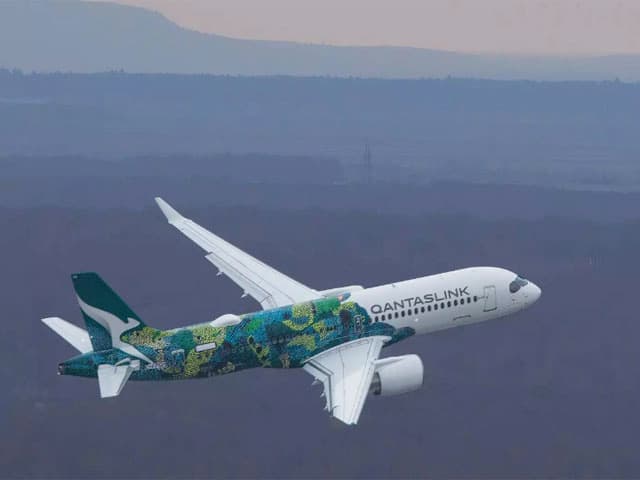
On the domestic side, Jetstar will be the first airline to operate commercial flights from Western Sydney, with inaugural flight JQ362 scheduled for 11:00 on 25 October to the Gold Coast in an Airbus A320. The low-cost carrier plans up to 14 weekly flights between WSI and Melbourne, four weekly rotations to the Gold Coast, and three to Brisbane, effectively setting up a low-cost mini-hub west of Sydney. The Qantas Group has signed a five-year agreement with WSI's operator and plans to base up to 15 narrow-body aircraft (10 for Jetstar and five for Qantas/QantasLink) in the early years of operation, with flights to Melbourne, Brisbane, and the Gold Coast. According to specialised Australian press, initial Qantas-branded operations will be mainly handled by QantasLink, the group's regional arm, with Qantas services to major capitals ramping up later.
**Cargo: WSI as Qantas's Future Freight Hub**
Beyond passengers, Western Sydney International is set to become a key link in Australian air freight. Cargo operations are scheduled to begin as early as July 2026, several months before passenger traffic starts, with a gradual ramp-up. For Qantas, WSI is expected to become a strategic freight hub, as group CEO Vanessa Hudson explained: "The new airport will become a key freight hub for Qantas, with cargo operations starting in the coming weeks." This cargo positioning, combined with 24/7 operations, allows optimisation of night rotations—a major advantage for connectivity to Asian markets and e-commerce logistics.
**Transfers Between SYD and WSI: A Key Watchpoint**
For travellers, the main source of complexity lies in the distance between the two Sydney airports—about 45 to 50 minutes by car under normal traffic conditions. Connections involving a change of airport—for example, an international arrival at SYD followed by a domestic flight from WSI—will require a substantial time margin, especially since public transport options remain limited at opening. The future Western Sydney Airport metro line, intended to link WSI to the metropolitan rail network, is still under construction and will not be ready for the airport's opening.