US export curbs slow COMAC C919 output as deliveries lag
Tighter Washington export rules on aerospace components restrict COMAC C919 production rates, with roughly a dozen deliveries recorded in 2026.
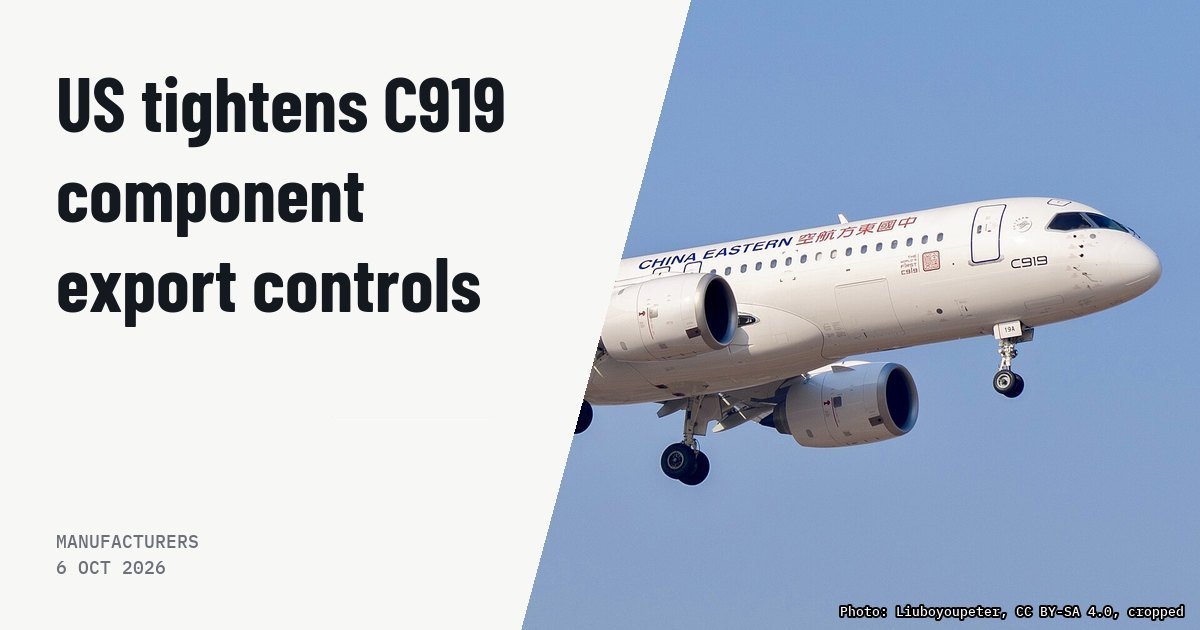
COMAC faces persistent industrial bottlenecks for its C919 narrowbody program following stricter export controls enacted by the United States Department of Commerce. Washington has decelerated approval procedures and restricted export volumes of critical aerospace hardware to prevent Chinese manufacturers from building component reserves.
The single-aisle twinjet remains heavily reliant on Western suppliers for key systems. Powerplants are supplied as the CFM International LEAP-1C, a product of GE Aerospace and Safran, alongside imported avionics, electrical equipment, flight controls, and landing gear. China is developing the domestic CJ-1000A engine, but it is not yet operational for production airframes.
Industrial output remains constrained: COMAC has delivered approximately a dozen C919 aircraft in 2026, following 15 deliveries in 2025 despite plans for higher ramp-up figures. Current operators remain limited to state-owned carriers: China Eastern Airlines, Air China, and China Southern Airlines. While EASA continues technical evaluations to validate the aircraft type certificate outside China, bilateral trade talks between Donald Trump and Xi Jinping also encompass an unfinalized Chinese agreement from early 2026 covering 200 Boeing aircraft.
Why it matters for your training
Monitoring C919 delivery rates and Western component access provides essential context on supply chain vulnerabilities and fleet diversification for future flight crews.
Sources
Article rewritten with the help of AI from the cited sources.