**A New Threat to Cockpit Voice Recorder Confidentiality**
In a move that has sent shockwaves through the aviation safety community, the U.S. National Transportation Safety Board (NTSB) has temporarily shut down public access to its online investigation docket system. The reason? Investigators discovered that members of the public had successfully used artificial intelligence tools to reconstruct approximate audio from a cockpit voice recorder (CVR) spectrogram image that had been published as part of the ongoing investigation into the crash of UPS Flight 2976.
This incident marks the first time that AI has been used to bypass the strict legal protections surrounding CVR data in the United States. Federal law prohibits the public release of cockpit audio recordings due to their highly sensitive nature, which includes pilot conversations, ambient sounds, and alarms. The NTSB had always relied on this legal framework to publish only written transcripts or summary reports. But the publication of a single spectrogram image—a visual representation of sound frequencies over time—opened a backdoor that AI tools could exploit.
**The Crash of UPS Flight 2976**
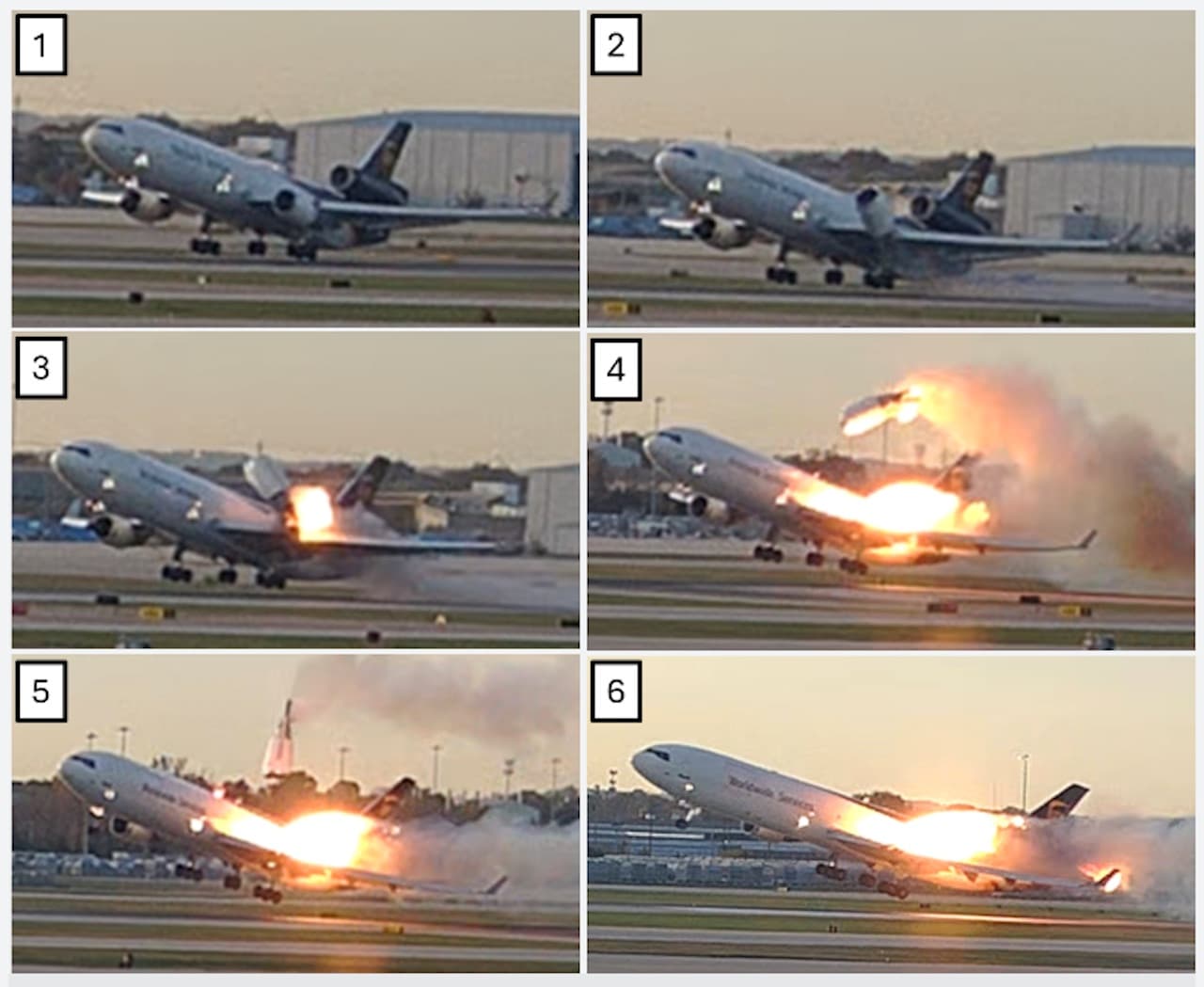
On November 4, 2025, a 34-year-old McDonnell Douglas MD-11F cargo aircraft, registration N259UP, operating as UPS Flight 2976, crashed shortly after takeoff from runway 17R at Louisville Muhammad Ali International Airport (SDF). The aircraft was bound for Honolulu, Hawaii, but never climbed above approximately 30 feet. It struck industrial buildings south of the airport, killing all three crew members and eleven people on the ground. Twenty-three others were injured in the ensuing fire and fuel tank explosions.
The NTSB investigation (reference DCA26MA024) quickly identified a catastrophic structural failure: the left engine and its pylon detached from the wing during the takeoff roll, causing a fireball and debris that damaged the other two engines. With no thrust and severe imbalance, the aircraft failed to climb and crashed beyond the runway end. Inspections revealed fatigue cracks in the pylon attachment system, particularly at the aft pylon structure. The FAA subsequently issued enhanced inspection requirements and temporarily grounded MD-11 aircraft and similar types with shared pylon designs.
**The Spectrogram Incident**
During the investigation, the NTSB published a spectrogram image from the CVR in the public hearing docket as an illustration of cockpit noise and alarm analysis. This is standard practice—the agency never releases the actual audio. However, internet sleuths with expertise in signal processing and AI realized that modern image-to-audio reconstruction tools could partially invert the spectrogram to recover an approximation of the original sound. They submitted the image to AI models, which produced audio containing background noise, alarms, and—most controversially—fragments of pilot conversations.
When the NTSB became aware of this, it removed the spectrogram image from the docket and, in an unprecedented step, temporarily shut down the entire online docket system. In a public notice, the agency stated: "Advances in image recognition and computational methods have allowed individuals to reconstruct approximations of cockpit audio recordings from spectrogram images published in NTSB investigations, including the ongoing investigation of last year's crash of UPS Flight 2976 in Louisville, Kentucky." The NTSB emphasized that it does not publish cockpit audio recordings and that federal law prohibits their release due to the highly sensitive nature of cockpit communications.
**What This Means for ATPL and ATC Students**
This event is a watershed moment for aviation training. For ATPL students, it underscores the critical importance of understanding CVR regulations and the legal framework that governs cockpit data. For ATC students, it highlights how technology can challenge established procedures—and why human judgment remains irreplaceable. The incident also raises questions about how future investigations will balance transparency with confidentiality. As AI tools become more powerful, the aviation industry must adapt its policies to protect sensitive data without hindering the investigative process that improves safety for everyone.
The NTSB is expected to review its data publication protocols, and this case may lead to new international standards for the handling of CVR data in the age of AI. For now, the lesson is clear: in aviation, even a seemingly innocuous image can have far-reaching consequences.