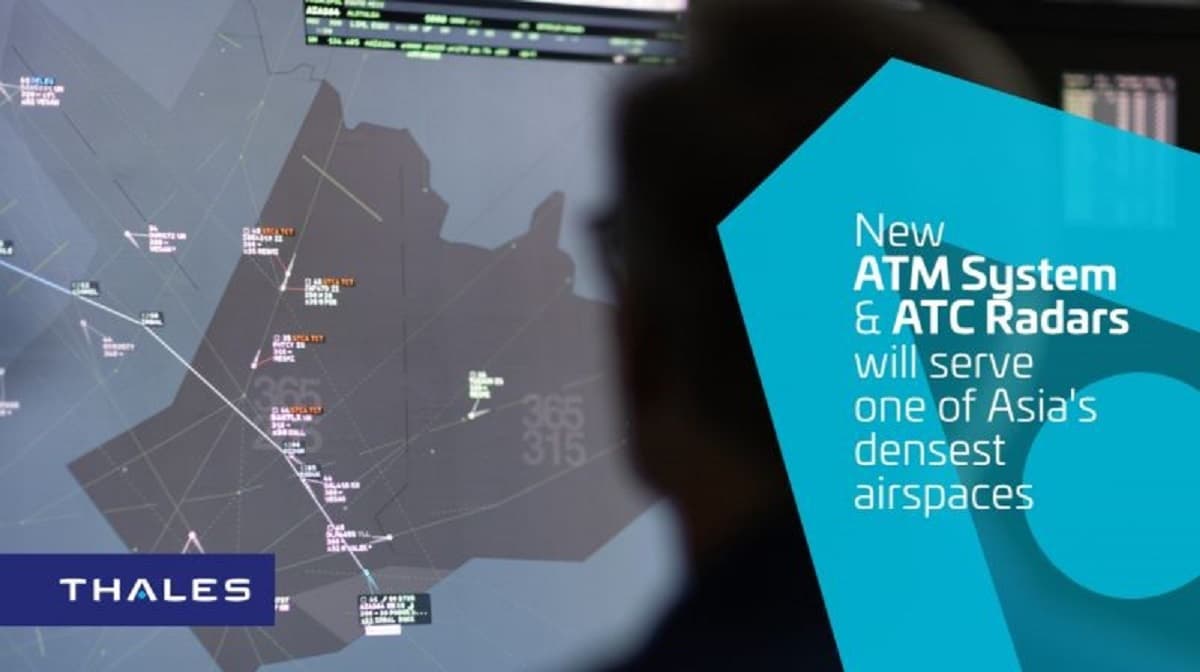
**Thales has secured two landmark contracts to modernize air traffic management (ATM) in Singapore and Mongolia, reinforcing its global leadership in air navigation solutions. These projects highlight the growing role of artificial intelligence (AI) and cybersecurity in ATM, a trend that directly impacts the training and daily work of air traffic controllers and pilots.**
**In Singapore, the Civil Aviation Authority (CAAS) has selected Thales to deploy NexGen, a next-generation ATM system, by 2030. This system, designed for one of Asia's most congested airspaces, will handle up to one million aircraft movements per year. It integrates AI-driven decision-support tools for controllers, optimizing arrival and departure flows in real time. Thales will also install two 24/7 air traffic control radars, ensuring reliable detection even in adverse weather. The open architecture promises to reduce delays, fuel consumption, and carbon emissions, while allowing future integration of third-party solutions. Singapore's long-standing partnership with Thales, spanning over 50 years, includes R&D centers in avionics, digital identity, and defense, providing a solid foundation for this ambitious upgrade.**
**In Mongolia, Thales has won a contract with the National Civil Aviation Center (NCAC) to modernize the country's ATM infrastructure. The program involves a dual regional control center (ACC) architecture: upgrading the existing Ulaanbaatar center and equipping a new one in Sainshand. This redundancy ensures that each ACC can take over full traffic in case of failure, enhancing operational resilience and airspace capacity. Thales will provide advanced automation systems and cybersecurity services to protect critical infrastructure, with a focus on communication safety and technical robustness. The contract also includes a skills transfer component, partnering with ENAC (French National School of Civil Aviation), offering training in Mongolia and Toulouse for technical teams and controllers. Financing is structured between Bpifrance and the Trade and Development Bank of Mongolia (TDBM), showcasing international cooperation.**
**These projects underscore a strategic shift toward open, automated, and AI-enhanced ATM systems. For aviation professionals, this means a future where controllers rely more on intelligent tools to manage increasing traffic volumes safely and efficiently. The emphasis on cybersecurity is particularly relevant, as ATM systems become more connected and vulnerable to cyber threats. For ATPL and ATC students, understanding these technologies is no longer optional—it's essential. Training programs must evolve to include AI literacy, cybersecurity fundamentals, and familiarity with modern ATM architectures like NexGen. The dual-ACC concept in Mongolia also highlights the importance of redundancy and resilience, principles that are critical in safety management. As Thales expands its footprint in Asia, the demand for skilled professionals who can operate and maintain these advanced systems will grow, presenting new career opportunities for those with up-to-date training.**
**In conclusion, Thales's recent contracts are not just business wins; they are a glimpse into the future of air navigation. The integration of AI, cybersecurity, and resilient architectures will define the next generation of ATM. For students and professionals in aviation, staying ahead means embracing these changes and preparing for a more automated, secure, and efficient airspace. The MyATPS platform is committed to helping you achieve that, with courses that cover the latest developments in ATM technology and safety.**