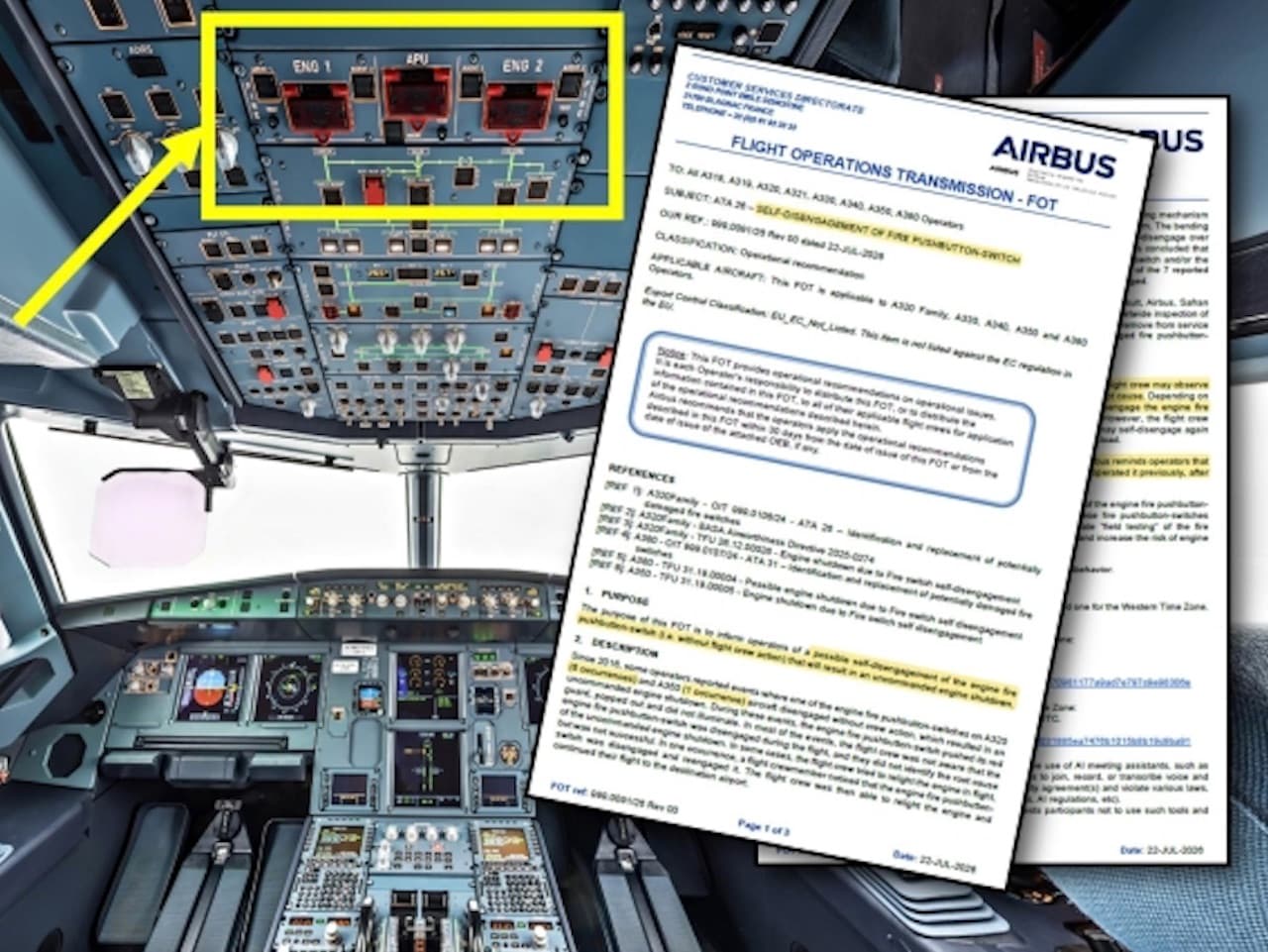
**A silent threat in the cockpit**
A seemingly minor mechanical flaw on the overhead panel of Airbus aircraft has been linked to at least seven uncommanded engine shutdowns in flight since 2016, according to an Airbus operational communication. Six cases involved the A320 family and one the A350. The issue centers on the engine fire pushbutton, a guarded red switch that crews use to isolate an engine in case of fire or severe damage. In these events, the button reportedly disengaged on its own, triggering engine shutdown without pilot input. The Italian newspaper Corriere della Sera reported that in most cases, crews did not immediately identify the cause, and some restart attempts failed. In one instance, a pilot noticed the button had popped out, re-engaged it, and the flight continued normally.
**Root cause: a deformed pin**
Investigations traced the problem to a degraded locking mechanism: a bent and worn retaining pin no longer held the button securely in place. Under vibration, the button could gradually release, and the system interpreted this as a deliberate action, isolating the engine. Safran, the component manufacturer, attributes the deformation to mishandling—such as a shock or drop—before installation, rather than in-service wear. The risk is described as "completely latent" by the British pilots' union BALPA, because no specific ECAM alert warns the crew before the button disengages. Pilots might first receive confusing or incomplete indications.
**Notable incidents and regulatory response**
The most documented case occurred on December 1, 2024, on an Air New Zealand A320neo flying from Wellington to Sydney. After an uncommanded engine shutdown, the crew declared Mayday and diverted to Auckland, landing safely. New Zealand's TAIC confirmed the switch activated without pilot action. A similar event on a British Airways A350-1000 in February 2026 was also reported, though no public report yet confirms the same mechanism. In response, EASA issued Airworthiness Directive 2025-0274R1, effective July 14, 2026, mandating inspections and, depending on serial numbers and findings, replacement of affected panels on A318, A319, A320, and A321 aircraft. The A350 is not covered by this AD, but Airbus issued an operator communication on July 22 covering A318 to A380 models, urging crews to consider this possibility when facing an unexplained engine shutdown.
**Critical crew procedure**
Airbus emphasizes a crucial rule: a fire button that has been deliberately pulled during an alarm or procedure must never be re-engaged. However, in the case of an unexplained engine shutdown, crews may consider re-engaging the button if operational conditions allow, before attempting a restart—but only within approved operator procedures. This nuance is vital for pilots to understand, as it could mean the difference between a manageable situation and a more serious emergency.