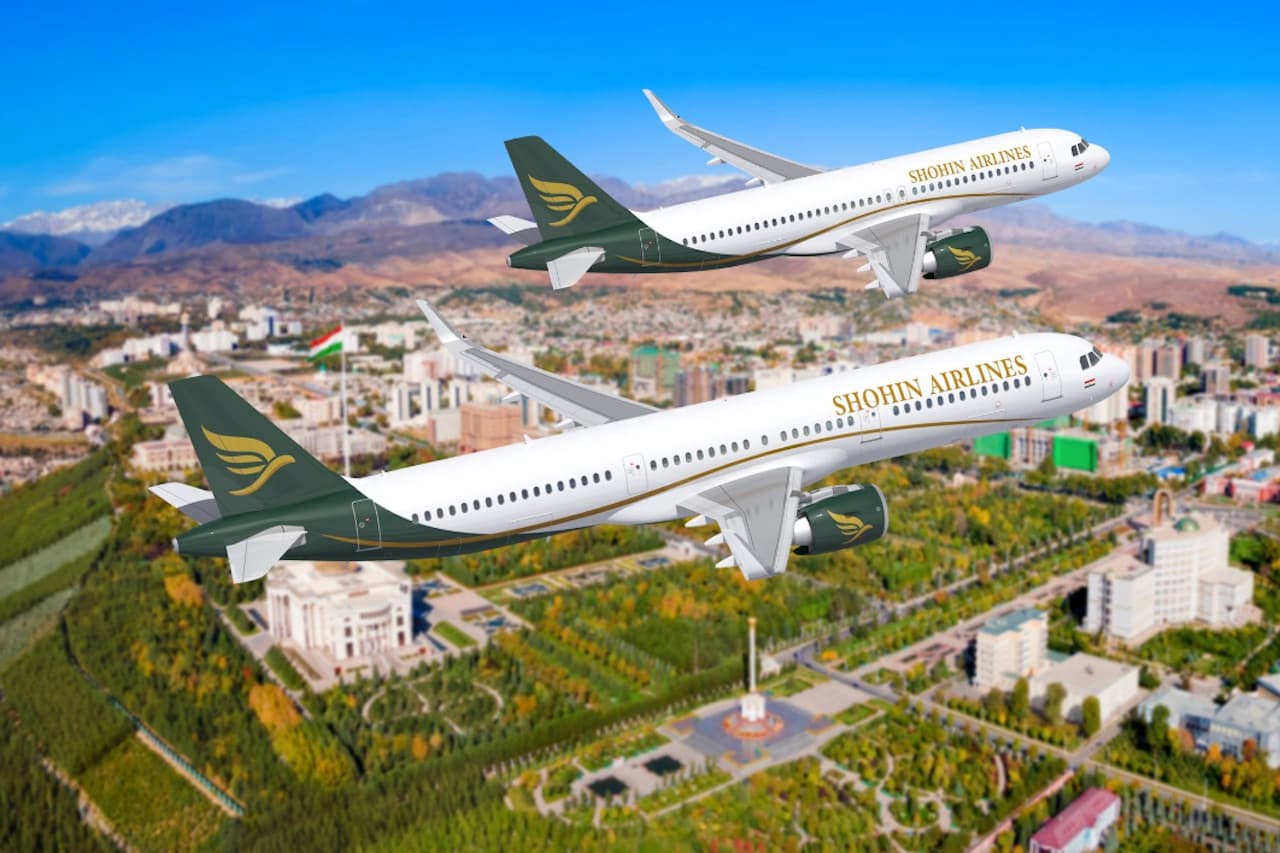
**A Bold Step for Central Asian Aviation**
Shohin Airlines, a private carrier registered in June 2025 and based at Dushanbe International Airport (DYU), has officially ordered four Airbus A320neo family aircraft during the Farnborough Airshow 2026. The order comprises two A320neo (176 seats) and two A321neo (196 seats), all in a two-class configuration. This marks the airline's first contract with Airbus and represents a significant milestone for Tajikistan's civil aviation sector.
**From Helicopters to Narrowbodies**
Initially operating specialized helicopter flights and preparing to introduce the L-410 NG turboprop for regional routes, Shohin Airlines is now transitioning to full-scale passenger transport. The airline benefits from substantial financial backing: European investment fund CFC s.r.o. plans to inject over $200 million into fleet development and infrastructure. Already assigned the ICAO code DSH and radio call sign "Shihin," the carrier is progressively structuring itself as a scheduled operator.
**Why This Matters for ATPL and ATC Students**
For ATPL students, this case illustrates the real-world process of fleet planning, aircraft acquisition, and route network design. Understanding how a startup airline selects aircraft based on range, capacity, and fuel efficiency is directly relevant to airline management modules. For ATC trainees, the introduction of new-generation aircraft like the A320neo into a relatively small airspace like Tajikistan's brings operational considerations: increased traffic density, performance-based navigation capabilities, and coordination with neighboring FIRs. The A320neo's advanced avionics and reduced noise footprint also affect approach procedures and airport compatibility.
**Market Potential and Challenges**
Dushanbe currently serves about 30 destinations, including Moscow, Istanbul, Dubai, Beijing, and Delhi. The diaspora-driven demand, especially to Russia and the Middle East, offers growth opportunities. However, Shohin Airlines will compete with established carriers from Russia, Turkey, and the UAE that already operate modern fleets on these routes. The national carrier Tajik Air, with its aging fleet of a 737-300, 757-200, 767-300, and Xian MA60, presents a less formidable competitor but still holds market share.
**A Green Commitment**
Airbus highlights that the A320neo family delivers at least 20% fuel savings and CO₂ reduction compared to previous generations, thanks to new engines and aerodynamic improvements. For students, this underscores the industry's push toward sustainability and the operational benefits of modern aircraft—a key topic in ATPL performance and environmental studies.
**Conclusion**
Shohin Airlines' order is more than a commercial transaction; it is a strategic bet on Tajikistan's integration into global air travel. For aviation trainees, it offers a live case study in airline establishment, fleet economics, and regional airspace dynamics.