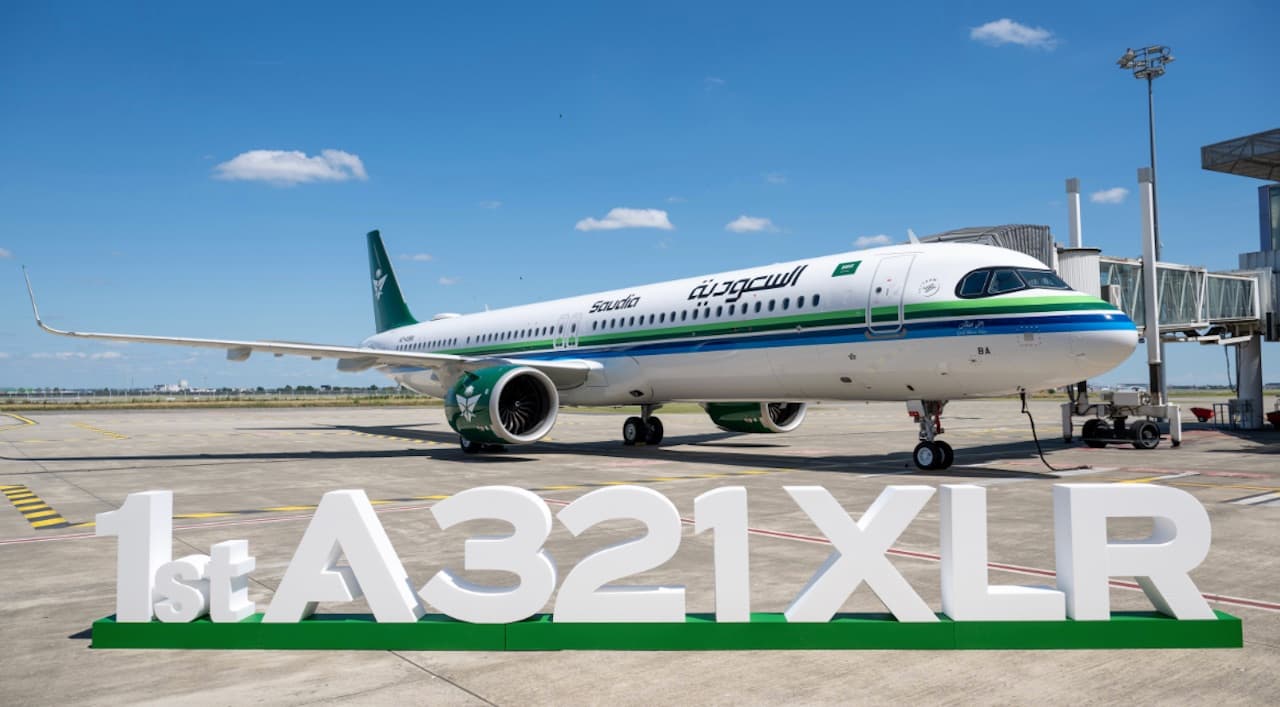
**A new long-range narrowbody enters the Middle East**
On 25 May 2026, Saudi Arabian flag carrier Saudia took delivery of its first Airbus A321XLR at the manufacturer's facility in Toulouse, becoming the first airline in both the Middle East and Africa to operate the type. The aircraft is the first of fifteen on order, part of a broader fleet modernisation programme aligned with the Saudi Vision 2030 strategy.
**Premium configuration for thin long-haul routes**
The A321XLR delivered to Saudia is configured with only 144 seats — 24 fully lie-flat business-class seats with direct aisle access and 120 economy seats. This low-density layout reflects the airline's intention to deploy the aircraft on routes where demand does not justify a daily widebody but still requires a premium long-haul experience. The cabin features the Airbus Airspace interior, including extra-large overhead bins, advanced ambient lighting, and enhanced acoustic insulation, effectively bringing a widebody feel to a single-aisle aircraft.
**First routes and network expansion**
Commercial operations are scheduled to begin on 23 May 2026 with the Jeddah–Vienna route, initially three weekly flights rising to four during the summer peak. Paris-Charles de Gaulle follows on 15 June, then Malé (Maldives) on 1 July. From October 2026, the network will expand to Barcelona, Milan, Brussels, Madrid, Geneva, and Dakar. With a range of 4,700 nautical miles (8,700 km), the A321XLR allows Saudia to serve destinations that were previously only reachable with widebody aircraft, offering greater frequency and flexibility.
**A 40-year partnership with Airbus**
This delivery strengthens a partnership that began in 1984 with Saudia's first A300. In May 2024, the Saudia Group signed a historic agreement for 105 A320neo-family aircraft, valued at $19 billion — the largest aircraft order in Saudi aviation history. Saudia now serves over 100 destinations across four continents.
**Why the A321XLR matters for aviation training**
The A321XLR is the latest member of the A320neo family, certified by EASA in July 2024 and first delivered to Iberia in October 2024. It offers a 30% reduction in fuel burn per seat compared to previous-generation aircraft, and all Airbus aircraft can currently operate with up to 50% sustainable aviation fuel (SAF), with a target of 100% compatibility by 2030. For ATPL students, understanding the performance characteristics of the A321XLR — including its takeoff and landing distances, fuel planning for ultra-long single-aisle sectors, and the implications of reduced crew rest requirements — will be essential. ATC trainees will need to consider how this aircraft type fits into traffic flows on routes traditionally dominated by widebodies, potentially altering wake turbulence categories and separation minima.