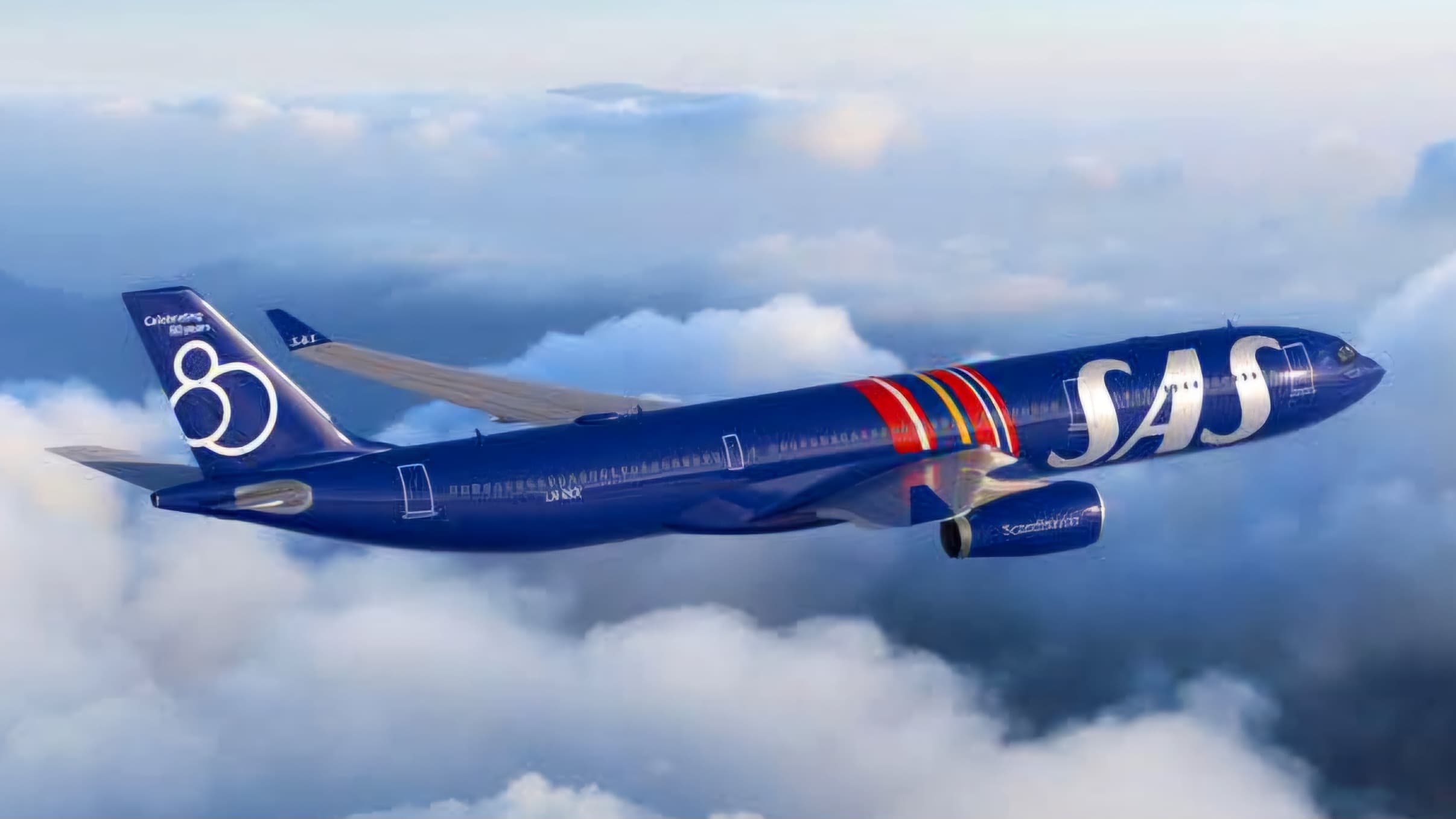
Just two years after emerging from a deep financial restructuring under Chapter 11 in the United States, Scandinavian Airlines (SAS) has announced the largest order in its history: up to 40 Airbus long-haul aircraft, with a catalog value exceeding $10 billion (approximately €9.3 billion). The deal, confirmed on June 30, marks a bold strategic pivot for the carrier, which is betting on a renewed long-haul presence centered on its Copenhagen hub.
While SAS has not specified the exact aircraft types in the initial announcement, industry observers expect the order to include the A330neo and/or A350, both of which are already part of the airline's fleet (8 A330-300s and 6 A350-900s). This fleet modernization comes on the heels of SAS's restructuring, which saw Air France-KLM become a reference shareholder, creating synergies within the European aviation landscape. The airline emphasizes that this investment represents the most significant fleet upgrade in decades, promising gains in fuel efficiency, noise reduction, and passenger experience.
For ATPL and ATC students, this development is a textbook case of post-crisis airline strategy. SAS's move illustrates how carriers leverage fleet renewal to regain competitiveness after financial turmoil. The choice of Airbus widebodies—likely the A330neo or A350—highlights the importance of understanding aircraft performance metrics, range capabilities, and operational economics, all critical topics in ATPL performance and flight planning modules. Additionally, the expansion of Copenhagen as a long-haul hub will require enhanced air traffic management (ATM) procedures, making it a relevant case study for ATC trainees studying hub operations and slot coordination.
The order also ties into broader industry trends: the shift toward more fuel-efficient aircraft to meet environmental targets, and the consolidation of European aviation through alliances and equity stakes. SAS's parallel order for 55 Embraer E195-E2 regional jets, announced earlier in 2025, shows a two-pronged strategy—modernizing both short/medium-haul and long-haul fleets. This dual approach is a valuable lesson for students on fleet planning and network optimization.
In summary, SAS's record order is not just a corporate milestone; it is a real-world example of how airlines navigate restructuring, fleet modernization, and hub development—all core concepts in ATPL and ATC training. Understanding these dynamics will help future aviation professionals anticipate operational changes and regulatory implications.