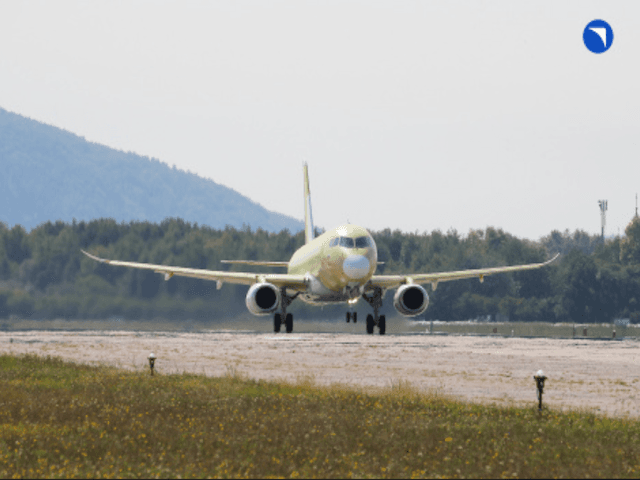
**Russia's PD-8 Engine Completes Certification Tests, Bringing SJ-100 Closer to Type Approval**
Russia has announced the completion of certification tests for the PD-8 turbofan engine, a domestically developed powerplant designed for the SJ-100, the import-substituted version of the Sukhoi Superjet 100. This milestone, achieved after over 6,500 hours of ground and flight testing, allows the Russian civil aviation authority Rosaviatsia to proceed with type certification, a prerequisite for the regional jet's entry into service, expected by the end of the decade.
**A Re-Russified Superjet**
The PD-8, developed by Aviadvigatel and assembled at UEC-Saturn, replaces the Franco-Russian SaM146 engine that previously powered the Superjet 100. It is derived from the larger PD-14 engine used on the MC-21 but adapted for the regional jet thrust class. The engine is a twin-spool turbofan producing approximately 78 kN of thrust, with a bypass ratio of 4.4 and a fully electronic control system of Russian origin. It will also power the Beriev Be-200 amphibious aircraft used for firefighting. This shift to domestic production is a direct response to Western sanctions imposed since 2014 and 2022, which restricted access to foreign components.
**Intensive and Extreme Testing**
Rostec, the state conglomerate overseeing UEC, reports that PD-8 prototypes accumulated over 6,500 hours of operation during development and certification, including nearly 1,450 flight hours on test Superjets and an Ilyushin Il-76LL flying testbed. The test program covered severe conditions such as natural icing flights in the Arkhangelsk region, bird ingestion, heavy rain, and water ingestion during takeoff. A fan blade containment test was conducted in late 2025, and a hail ingestion campaign took place in spring 2026 at an open-air test bed in Rybinsk to verify engine behavior under massive fan impact.
**17 New Technologies and Material Advances**
Russian authorities highlight the integration of 17 new technological solutions in the PD-8, including high-pressure turbine blades and nozzle guide vanes made from alloys more resistant to high temperatures than those used in the PD-14. The goal is to maintain thermal performance, improve durability, and optimize specific fuel consumption despite a simpler architecture without a gearbox compared to the SaM146. According to Fyodor Mironov, UEC's deputy sales director, the engine has demonstrated high reliability and safety, including in critical conditions. Altitude Addicts, a specialized media outlet, notes that the PD-8 incorporates 25 critical technologies, including a new high-pressure turbine stage and optimized turbine clearances for better efficiency.
**Certification Path and Implications**
Completion of testing allows Rostec to submit the certification dossier to Rosaviatsia, which is expected to issue the PD-8 type certificate in the near future. Internal documents presented to the Russian Ministry of Transport earlier in 2026 had targeted engine certification in April, with a slight delay now expected toward mid-year. The SJ-100's certification depends on this step, as the aircraft must be approved with the PD-8 configuration and all domestic systems. Rosaviatsia head Dmitri Yadrov mentioned an aircraft certification target around July 2026, though Russian authorities remain cautious after several schedule slips since 2025.
**MyATPS Angle**
For ATPL and ATC students, this development illustrates how geopolitical events directly influence aircraft certification timelines and fleet availability. Understanding the PD-8's certification process provides insight into the complexities of engine certification, including the rigorous testing required for type approval. It also highlights the importance of supply chain resilience in aviation, as sanctions can force rapid redesign and re-certification of critical components. This case study is valuable for future pilots and controllers who may encounter aircraft with non-Western engines in their careers, particularly in regions like Russia, China, or other markets pursuing indigenous aviation programs.