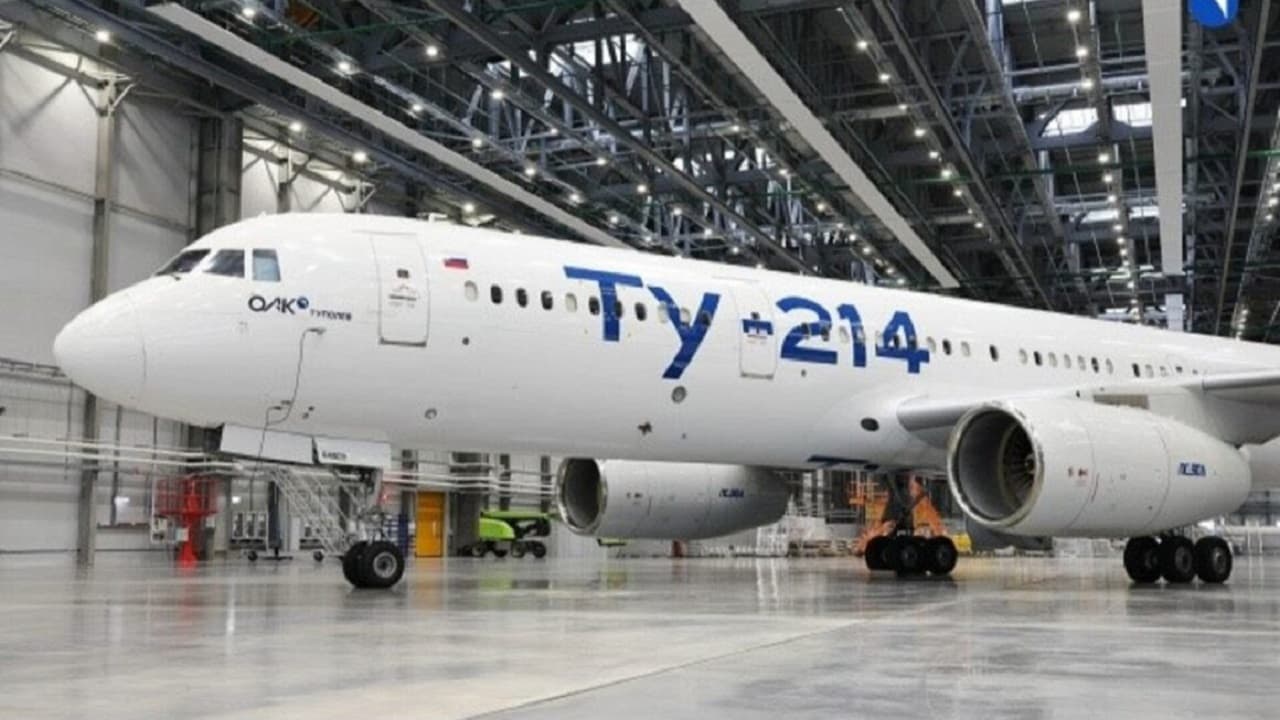
**Russia Restarts Tu-214 Deliveries: A Strategic Shift in Commercial Aviation**
Moscow has resumed deliveries of the Tupolev Tu-214, a twin-engine medium-range aircraft long confined to government and special missions. Now, amid Western sanctions, the Russian government is positioning the Tu-214 as a cornerstone of its commercial fleet. United Aircraft Corporation (UAC) has announced a gradual production ramp-up, targeting 20 aircraft per year by the end of the decade. This marks a significant pivot for an aircraft that was previously produced in very limited numbers.
**Technical Background and Positioning**
The Tu-214 is a heavier variant of the Tu-204, developed in the 1990s. It competes in the same category as the Airbus A321 and Boeing 757. With a length of 46.1 meters, a wingspan of 41.8 meters, and a maximum takeoff weight of about 110.7 tonnes, it can carry over 200 passengers in a high-density configuration. Its range of 6,500 to 7,200 km makes it suitable for domestic Russian routes and some regional international flights. Powered by two Aviadvigatel PS-90A engines, it cruises at around 850 km/h and typically operates at altitudes between 11,000 and 12,500 meters.
**From Marginal Production to Strategic Priority**
Before 2022, the Tu-214 was a niche aircraft. Only four were in commercial service (one with Aviastar, three with Red Wings), while 23 were used by government agencies. The invasion of Ukraine and subsequent sanctions cut off access to Western aircraft and spare parts, forcing Russian airlines to extend the life of their existing fleets and turn to domestic programs. The Tu-214, now modernized with fully Russian-made systems and certified locally, has become a key element of Russia's strategy to replace Airbus and Boeing aircraft that can no longer be supported.
**Production Ramp-Up and Challenges**
UAC plans to build four Tu-214s this year, eight next year, and eventually 20 per year by 2027-2028. The Kazan plant is reportedly ready for mass production. However, supply chain constraints for newly "Russified" systems—especially avionics and previously imported components—remain a challenge. For ATPL and ATC students, this case illustrates how geopolitical factors can reshape fleet planning and certification processes, a topic often discussed in aviation management modules.
**Commercial Prospects and Customer Base**
Current firm orders are modest: only four from UVT Aero. But letters of intent and preliminary agreements total around 140 aircraft, including 100 from S7 Airlines (deliveries expected from 2029) and 42 from Aeroflot. Red Wings, already an operator, will receive additional units from 2027. This gradual commercial rollout allows UAC to stabilize production and train civilian crews, while also testing the fully import-substituted configuration.
**Conclusion**
The Tu-214's revival is a textbook example of how sanctions and geopolitical pressures can force a country to develop indigenous aviation capabilities. For students training for ATPL or ATC careers, understanding such fleet dynamics, certification hurdles, and operational constraints is crucial—especially as similar scenarios may emerge in other regions.