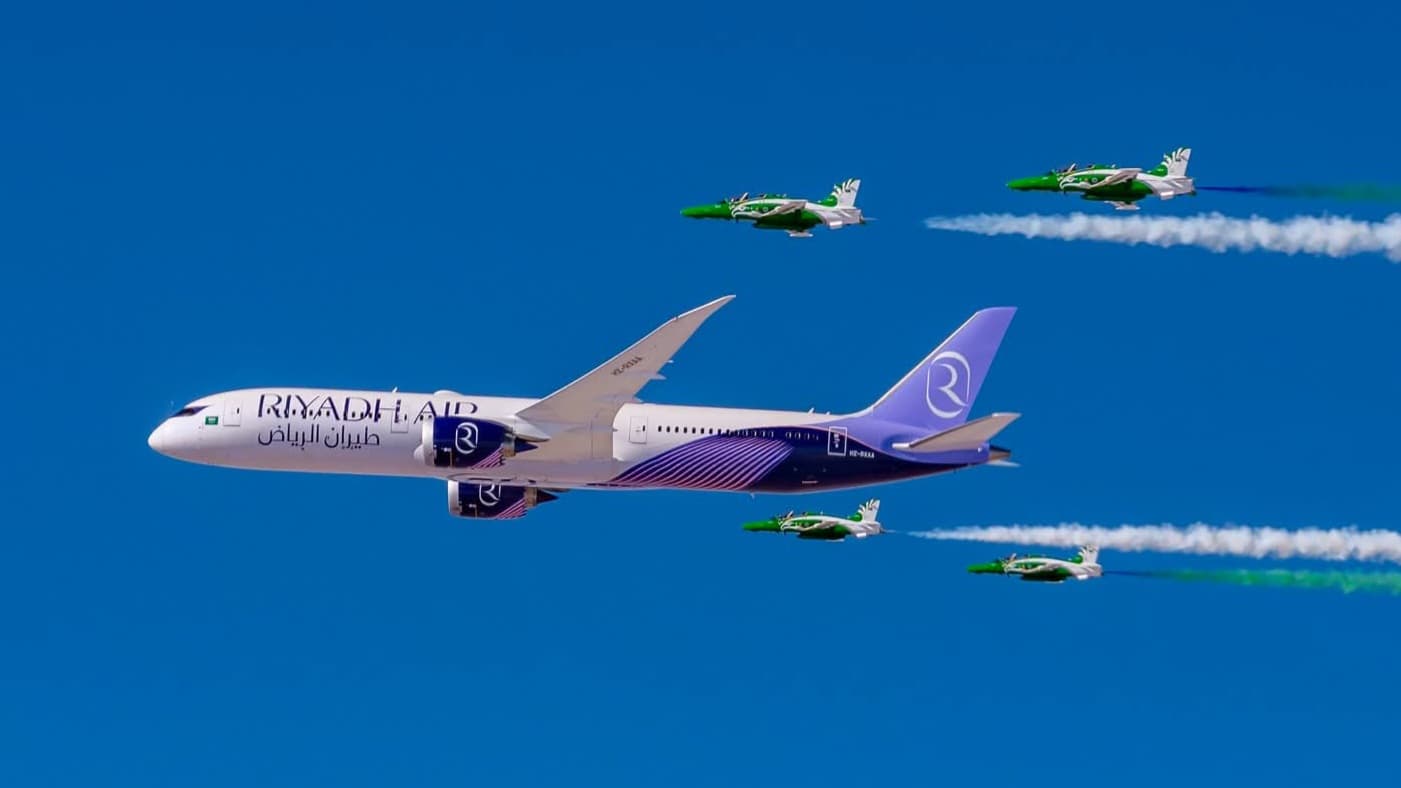
**Riyadh Air Takes Off: A New Gulf Hub Challenging Dubai and Doha**
Saudi Arabia's ambitious new national carrier, Riyadh Air, has finally launched its first commercial flight, connecting Riyadh to London-Heathrow with a Boeing 787-9 Dreamliner. The airline, backed by the Public Investment Fund (PIF) and central to the Vision 2030 economic diversification plan, aims to transform the Saudi capital into a global aviation hub capable of rivaling Dubai, Doha, and Abu Dhabi. Despite a volatile geopolitical environment and a crowded Gulf market, Riyadh Air is forging ahead with a massive fleet expansion and an aggressive route network.
**A Strategic Launch Amid Challenges**
The inaugural flight, RX401, departed King Khalid International Airport at 02:35 local time and landed at London-Heathrow around 07:30, marking the start of a daily Dreamliner service. CEO Tony Douglas, a former Etihad Airways chief, highlighted the four-year preparation process, which included overcoming Boeing delivery delays and certification hurdles. The airline initially planned a July 1 launch but advanced it to June 10 after receiving its first 787-9s earlier than expected. This reflects Boeing's improving production cadence after months of industrial constraints. The cabin features a refined design with lavender and mocha gold tones inspired by Saudi heritage, aiming to bring "glamour, refinement, and elegance" back to air travel.
**Massive Fleet Orders and Network Ambitions**
Riyadh Air has positioned itself as a mega long-haul customer, with firm orders for 39 Boeing 787-9s and 33 options, plus 25 firm Airbus A350-1000s with 25 options—making it the first Saudi operator of the European widebody. Additionally, it has ordered 60 Airbus A321neos for medium-haul routes from 2026, bringing its secured fleet to 132 aircraft. The airline plans to connect over 100 international cities within five years, starting with 22 destinations by March 2027. Initial routes include London, Jeddah, Dubai, Cairo, Madrid, and Manchester, all served by 787-9s. Frequencies range from daily to multiple flights per day on key Saudi corridors.
**A New Hub in a Crowded Sky**
Riyadh Air is a cornerstone of Vision 2030, which aims to triple Saudi air traffic to 330 million annual passengers by the end of the decade, connecting over 250 destinations. A new mega-airport, King Salman International Airport, is planned to handle up to 120 million passengers by 2030, with six parallel runways. Riyadh Air will be its primary long-haul operator, while Saudia retains its Jeddah base for religious traffic. The airline enters a market dominated by Emirates, Qatar Airways, and Etihad, but leverages a domestic population of 35 million and strong religious travel demand. The launch comes amid regional conflict, including missile and drone attacks on Gulf airports, adding complexity to operations.
**What This Means for ATPL and ATC Students**
For ATPL students, Riyadh Air's rapid expansion offers potential career opportunities in a new carrier with a modern fleet. ATC students should note the increased traffic density in Saudi airspace, requiring careful coordination with neighboring FIRs and management of new routes into a growing hub. Understanding the airline's network strategy and fleet mix is essential for future flight planning and airspace management.