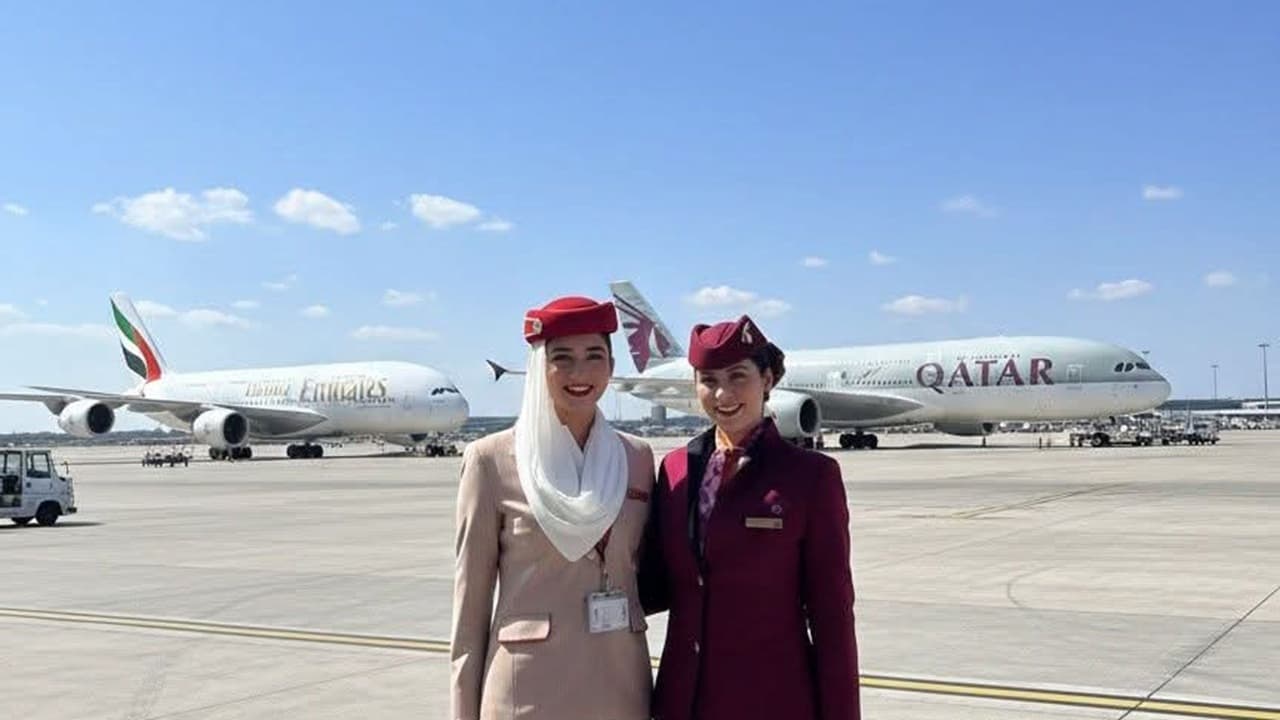
**A tale of two strategies**
Qatar Airways has decided not to pay annual bonuses to nearly all of its 60,000 employees this year, citing severe disruptions caused by geopolitical tensions in the Middle East. An internal memo seen by staff explains that the conflict involving Iran forced the airline to cancel tens of thousands of flights and incur revenue losses running into billions of dollars. The company says the move prioritises long-term stability during a period of ongoing uncertainty. Yet Qatar Airways posted a net profit of $1.94 billion for the 2025/2026 fiscal year ending 31 March 2026, with a record operating profit of $4.1 billion and 41.8 million passengers carried.
**A sharp contrast with Emirates**
In stark contrast, Emirates – based in Dubai – has awarded its 131,000 employees a bonus equivalent to 20 weeks of salary after achieving record profits for the same fiscal year. Chairman Ahmed bin Saeed Al Maktoum personally praised the “courage and incredible resilience” of his teams. While Qatar Airways chooses prudence to strengthen reserves, Emirates opts to reward generously despite facing the same regional challenges. This divergence illustrates fundamentally different corporate philosophies in the Gulf aviation sector.
**Why this matters for ATPL and ATC students**
For future pilots and air traffic controllers, these decisions are more than just headlines. They reflect how airlines manage financial risk and reward talent in volatile environments. A carrier that freezes bonuses may be conserving cash for fleet investments or route expansion – factors that affect hiring plans and career progression. Conversely, generous bonuses can signal strong profitability and a culture that values frontline staff, making such airlines more attractive employers. Understanding these dynamics helps students evaluate potential employers beyond base salary, considering long-term stability and reward philosophy.
**Broader industry implications**
The contrasting approaches also highlight the impact of geopolitical risk on aviation operations. Airlines in the Gulf region must navigate airspace closures, insurance cost spikes, and shifting demand patterns. For ATPL candidates studying route planning or ATC trainees learning about airspace management, real-world events like these demonstrate how non-technical factors – political tensions, economic policy, corporate strategy – directly influence daily operations and career security. The ability to read between the lines of airline financial reports and internal decisions is a valuable skill for any aviation professional.
**What to watch next**
As the Middle East situation evolves, both carriers will continue to adapt. Qatar Airways may restore bonuses once stability returns, while Emirates’ payout sets a high benchmark for employee expectations. For students tracking the industry, following these developments offers practical insight into airline management, labour relations, and the delicate balance between profitability and staff morale – all of which are part of the broader aviation ecosystem that ATPL and ATC graduates will enter.