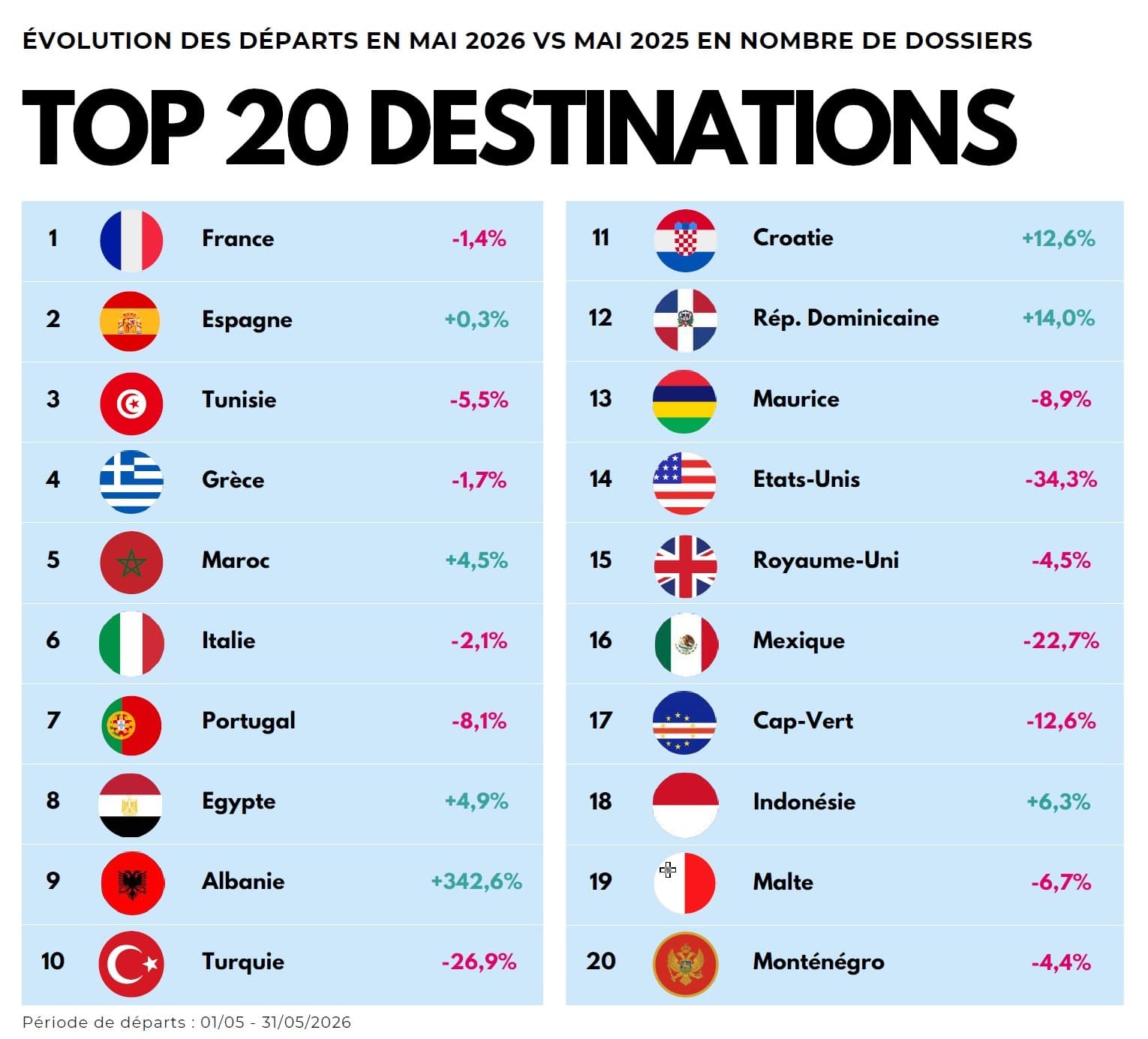
The latest figures from the French Travel Companies Observatory (EDV/Orchestra) paint a cautious picture for the organized travel sector in May 2026. Compared to May 2025, departures fell by about 2%, with total business volume down 1.3% despite a slight 0.4% increase in average spending per trip to €1,555. More worryingly, new bookings—a forward-looking indicator—plummeted 18% in volume and 21% in value, signaling a clear slowdown in consumer confidence. The average booking window shortened by four days to 63 days, and last-minute reservations (under 30 days) rose to over 20% of sales, up two percentage points year-on-year. This trend reflects growing traveler caution amid geopolitical uncertainties and economic pressures.
For ATPL and ATC students, this data is a real-world case study in how external factors—geopolitical tensions, currency fluctuations, or even pandemics—can reshape demand patterns overnight. Understanding these dynamics is crucial for pilots and controllers who must anticipate route changes, capacity adjustments, and operational disruptions. For instance, the sharp decline in long-haul bookings (down 40% in number of files and 38% in value) directly impacts airline network planning, crew scheduling, and airspace utilization. ATC professionals may see reduced traffic on transatlantic routes, while domestic and short-haul sectors could experience relative stability or even growth.
Geographically, the data shows a clear shift toward domestic and near-shore destinations. France itself saw a 6% rise in business volume for departures, driven by higher spending per trip (+8%) despite fewer bookings. In contrast, long-haul destinations suffered heavily: the United States dropped 34%, Mexico 23%, and Cape Verde 13%. Only a few long-haul spots like the Dominican Republic (+14%) and Indonesia (+6%) bucked the trend. Among Mediterranean destinations, Albania surged an astonishing 343% in departures, while Turkey continued its decline at -27%. These shifts are not just academic—they influence where airlines deploy aircraft, which airports see congestion, and how ATC sectors are staffed.
For aviation students, this article underscores the importance of monitoring travel industry data as a leading indicator of air traffic volumes. A sustained drop in long-haul bookings, for example, may precede route cancellations or fleet redeployments, affecting everything from fuel hedging to pilot rostering. Similarly, the rise in last-minute bookings suggests passengers are more flexible, which could alter demand forecasting models used by airlines and ANSPs. By connecting these dots, future aviation professionals can better understand the business environment in which they will operate.
In summary, the May 2026 organized travel data reveals a market in transition, with caution dominating consumer behavior. For ATPL and ATC trainees, this is a valuable lesson in how macroeconomic and geopolitical factors ripple through the aviation ecosystem. Staying informed about such trends will help them make smarter decisions, whether in the cockpit or in the control tower.