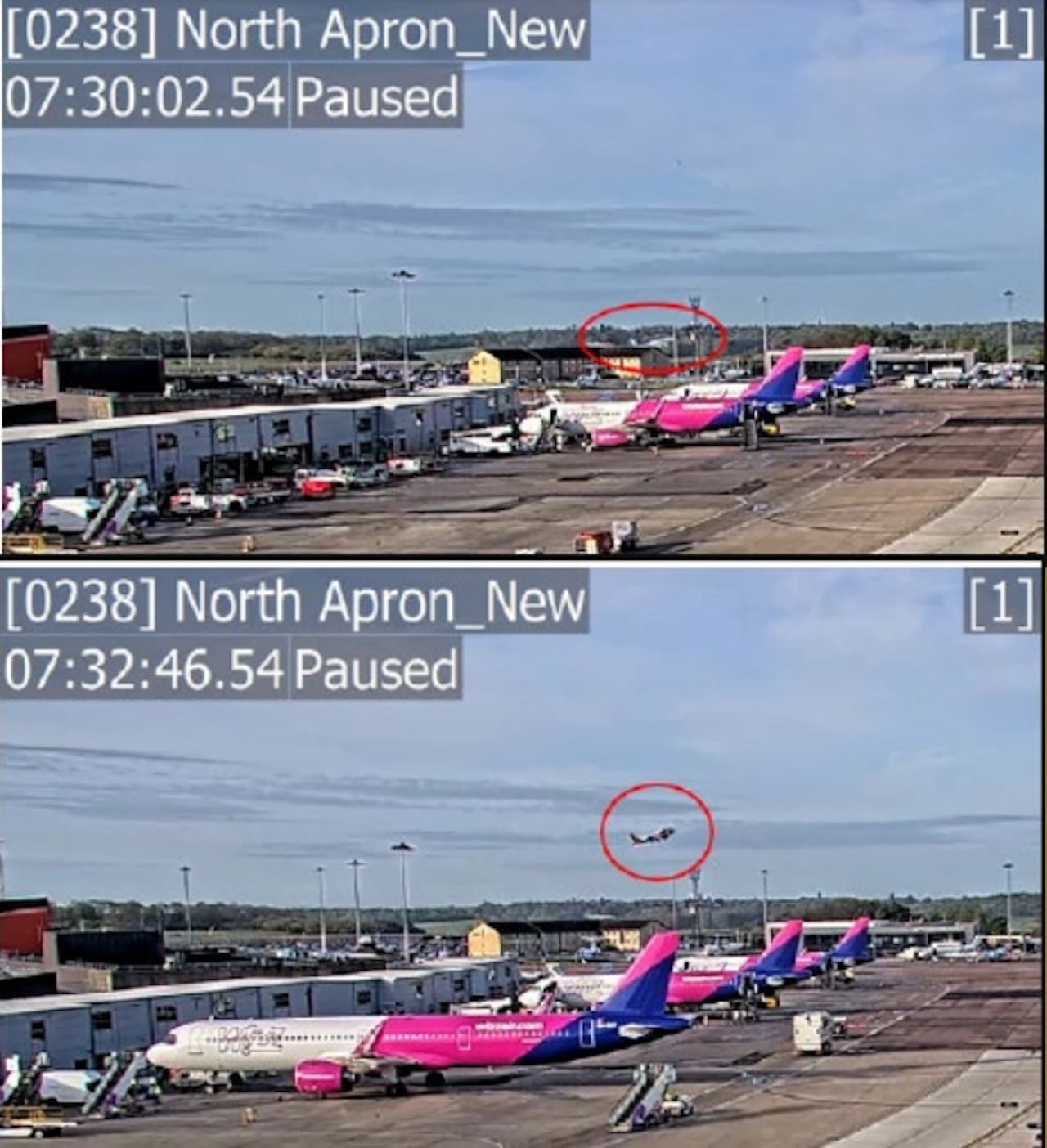
**A Boeing 737 MAX operated for Wizz Air came within seconds of disaster during takeoff from London Luton in April 2025, according to a report released in July 2026 by the UK Air Accidents Investigation Branch (AAIB).** The cause: a failure to recalculate takeoff performance after accepting a shortened runway from air traffic control. The aircraft lifted off with only 162 meters of runway remaining, clearing the end at less than 4 meters—far below the regulatory obstacle clearance minimum of about 10.7 meters.
**The incident involved flight W9 5411 from Luton to Athens, operated under wet lease by Ascend Airways, carrying 162 passengers and 6 crew.** Initially, the crew planned a full-length takeoff from Runway 25 (2,116 meters available). During taxi, they accepted ATC's offer to use an intersection departure, reducing the available distance to 1,771 meters. However, they did not update the Flight Management Computer (FMC) with the new takeoff reference speeds (V1, VR, V2) or the required thrust setting. The FMC retained the full-length takeoff parameters, resulting in a thrust setting of 82.1% instead of the required 85.2%. The aircraft accelerated more slowly over the shorter distance, leading to a dangerously low rotation speed of approximately 276 km/h.
**The AAIB report states: "The crew accepted a change to the planned takeoff point but did not verify that the takeoff performance had been correctly entered into the onboard computer."** Radar data showed an abnormally shallow initial climb, with the aircraft reaching only 274 meters altitude at about 0.8 nautical miles from the airport. The AAIB concluded that "this resulted in a lower than required power setting, an extended takeoff roll, and a slow initial climb." The flight continued normally to Athens, and no injuries were reported. Wizz Air emphasized that safety is its top priority and noted that Ascend Airways was responsible for crew procedures under the wet lease arrangement.
**For ATPL and ATC students, this incident is a textbook case of how procedural lapses can cascade into life-threatening situations.** Takeoff performance calculations are a core part of ATPL training—every student must master the factors (mass, weather, runway length, obstacles) that determine V-speeds and thrust settings. The reliance on FMC automation does not eliminate the need for manual cross-checks; in fact, it introduces new error pathways. This event also highlights the importance of clear communication between flight crew and ATC when runway changes occur. ATC students should understand that offering an intersection departure carries operational implications that the flight crew must manage correctly.
**The AAIB classified this as an isolated event with no technical failure, but the human factors are deeply relevant to aviation training.** The incident reinforces the need for robust standard operating procedures (SOPs) and crew resource management (CRM) to catch data entry errors before they become critical. For those studying for their ATPL or ATC license, this is a powerful reminder that every number entered into the FMC matters—and that shortcuts in performance calculations can have no margin for error.