**A Routine Flight Turns Into a NATO Alert**
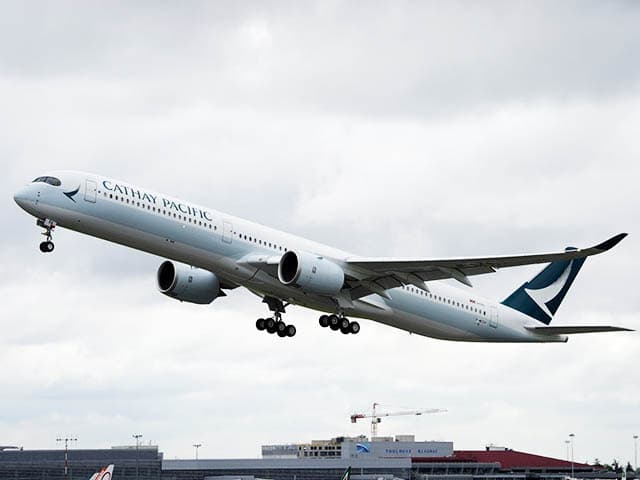
On Saturday, July 4, a Cathay Pacific Airbus A350-1000 (registration B-LXA) operating flight from Hong Kong (HKG) to London Heathrow (LHR) triggered a NATO Quick Reaction Alert (QRA) after a brief loss of radio contact with Romanian air traffic control. The aircraft, a long-haul twinjet, was over Romanian airspace when the communication failure occurred, prompting Hungarian air defense to scramble two JAS-39 Gripen fighters from Kecskemét Air Base. The Gripens intercepted the A350 near the Hungarian border, performed a visual identification, and signaled the crew. Shortly after, the pilots re-established radio contact, allowing the fighters to return to base. The flight continued to Heathrow, landing without incident at approximately 15:20 GMT after a 13-hour 40-minute journey.
**What Happened and Why It Matters for Aviation Students**
For ATPL and ATC trainees, this event is a textbook example of how NATO's QRA procedures work in practice. The alert was triggered when the A350 failed to respond to Romanian ATC while still in Romanian airspace. Hungarian Defense Minister Romulusz Ruszin-Szendi confirmed that the scramble order was given at 13:42 CET, and the Gripens were airborne by 13:51 — a response time of just nine minutes. This rapid reaction is standard for QRA, where fighters are kept on permanent standby to intercept any aircraft that becomes unresponsive or deviates from expected parameters. The goal is not to assume an emergency but to restore situational awareness for air defense, establish visual contact, and, if possible, re-establish radio communication. In this case, no diversion or emergency landing was needed.
**Communication Redundancy and Human Factors**
The A350-1000 is equipped with multiple communication systems — VHF, HF, and satellite communications (satcom) — designed to ensure redundancy. However, temporary losses can still occur due to frequency changes, coverage gaps, or cockpit workload. For ATPL students, this incident highlights the importance of strict adherence to communication procedures, including the use of standard phraseology and the need to monitor multiple frequencies. For ATC trainees, it demonstrates how controllers must manage unexpected communication failures, coordinate with military authorities, and follow established protocols. The fact that the crew re-established contact after the interception suggests that the visual signals from the Gripens may have alerted them to the issue, emphasizing the value of non-verbal communication in critical situations.
**Broader Implications for Airspace Security**
This event also underscores the integration of civil and military air traffic management. NATO's QRA is a defensive measure, not an aggressive one, and is activated for any aircraft — civil or military — that becomes unidentified or non-responsive. For students, understanding these procedures is essential, as they may encounter similar scenarios in their careers, especially when flying over or controlling airspace near sensitive borders. The incident also serves as a reminder that communication failures, while rare, can happen even on modern aircraft, and that both pilots and controllers must be trained to handle them calmly and effectively.
**Conclusion**
The Cathay Pacific A350 interception was a textbook QRA activation that ended without drama. For ATPL and ATC students, it provides a real-world case study in communication procedures, airspace security, and the importance of rapid response. It reinforces the need for rigorous training in standard operating procedures and the value of international cooperation in maintaining aviation safety.