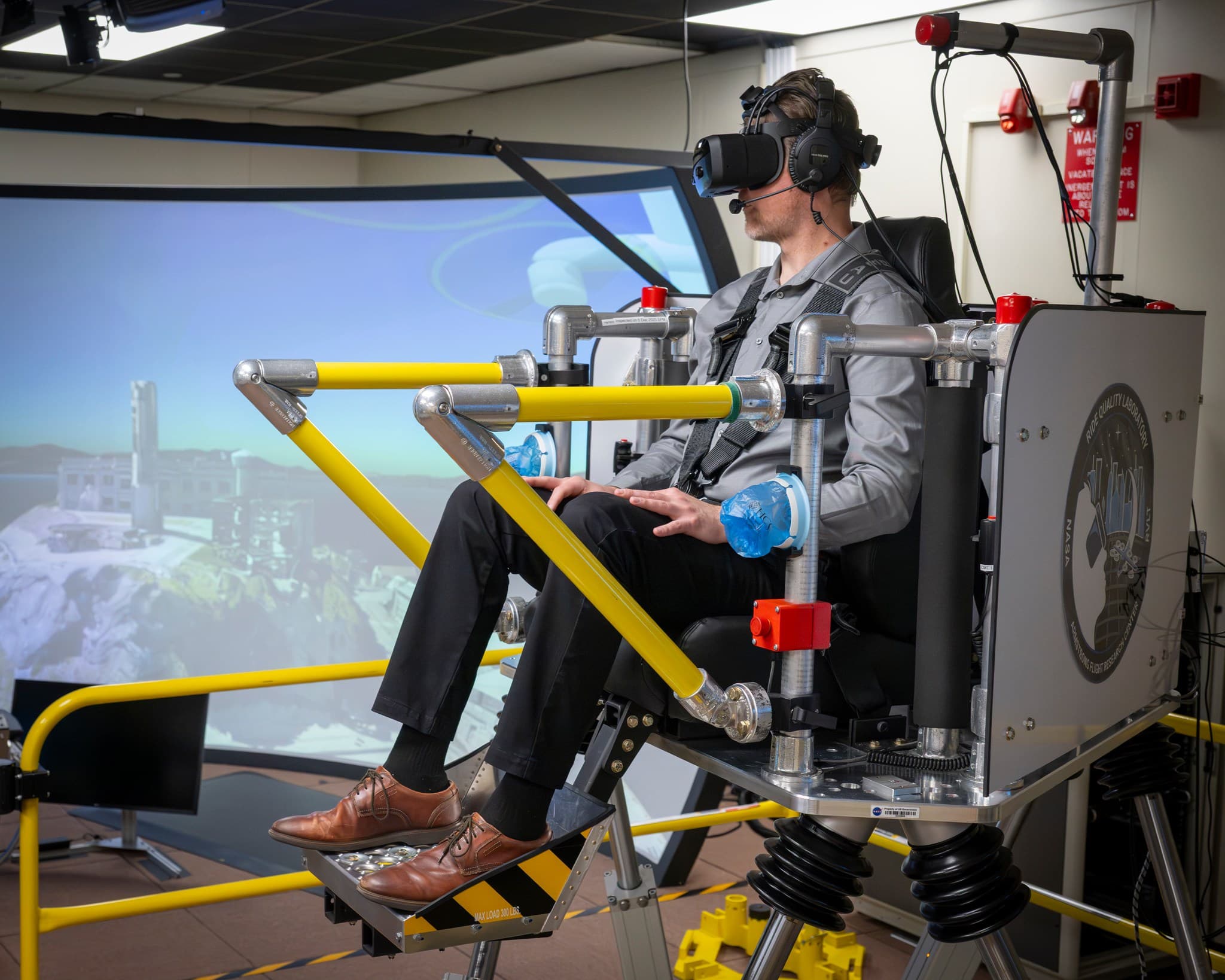
NASA has completed a landmark study on passenger comfort in air taxis — the small, vertical-takeoff-and-landing (eVTOL) aircraft expected to transform short-distance urban travel. Using a virtual reality motion simulator at the Armstrong Flight Research Center, researchers put volunteers through realistic flight scenarios over San Francisco Bay, measuring their reactions to sudden pitch, roll, yaw, and acceleration changes. The goal was to understand which motions make passengers uncomfortable enough to avoid flying again.
The study found that even moderate changes in aircraft attitude or speed can reduce comfort for some passengers, while others tolerate higher levels. Crucially, participants in 2025 were less tolerant of rough motion than airline passengers from 50 years ago, based on comparisons with earlier NASA ride-quality research. This shift in tolerance has direct implications for aircraft designers and operators: future air taxis must fly more smoothly to gain public acceptance.
For ATPL students, this research highlights the importance of understanding how aircraft dynamics affect passenger experience. While traditional airline flying prioritizes safety and efficiency, urban air mobility adds a new dimension — ride quality as a commercial requirement. Pilots will need to anticipate how gusts, landings, and maneuvers impact comfort, especially in densely populated urban environments where noise and motion sensitivity are higher.
ATC students should note that air taxi operations will likely require new separation standards and approach procedures to minimize passenger discomfort. Controllers may need to vector these aircraft along smoother trajectories, avoiding abrupt altitude changes or tight turns that could cause motion sickness. The NASA models linking motion to willingness to fly could eventually feed into real-time flight planning tools, giving controllers data to optimize routes for comfort.
The study, led under NASA’s Subsonic Vehicle Technologies and Tools project, is part of the agency’s broader advanced air mobility research. It provides a scientific foundation for designing air taxi flight profiles that balance speed, efficiency, and passenger well-being. For aviation trainees, this is a glimpse into the future: where piloting and controlling aircraft will require not just technical skill, but also an understanding of human factors in a new operational context.