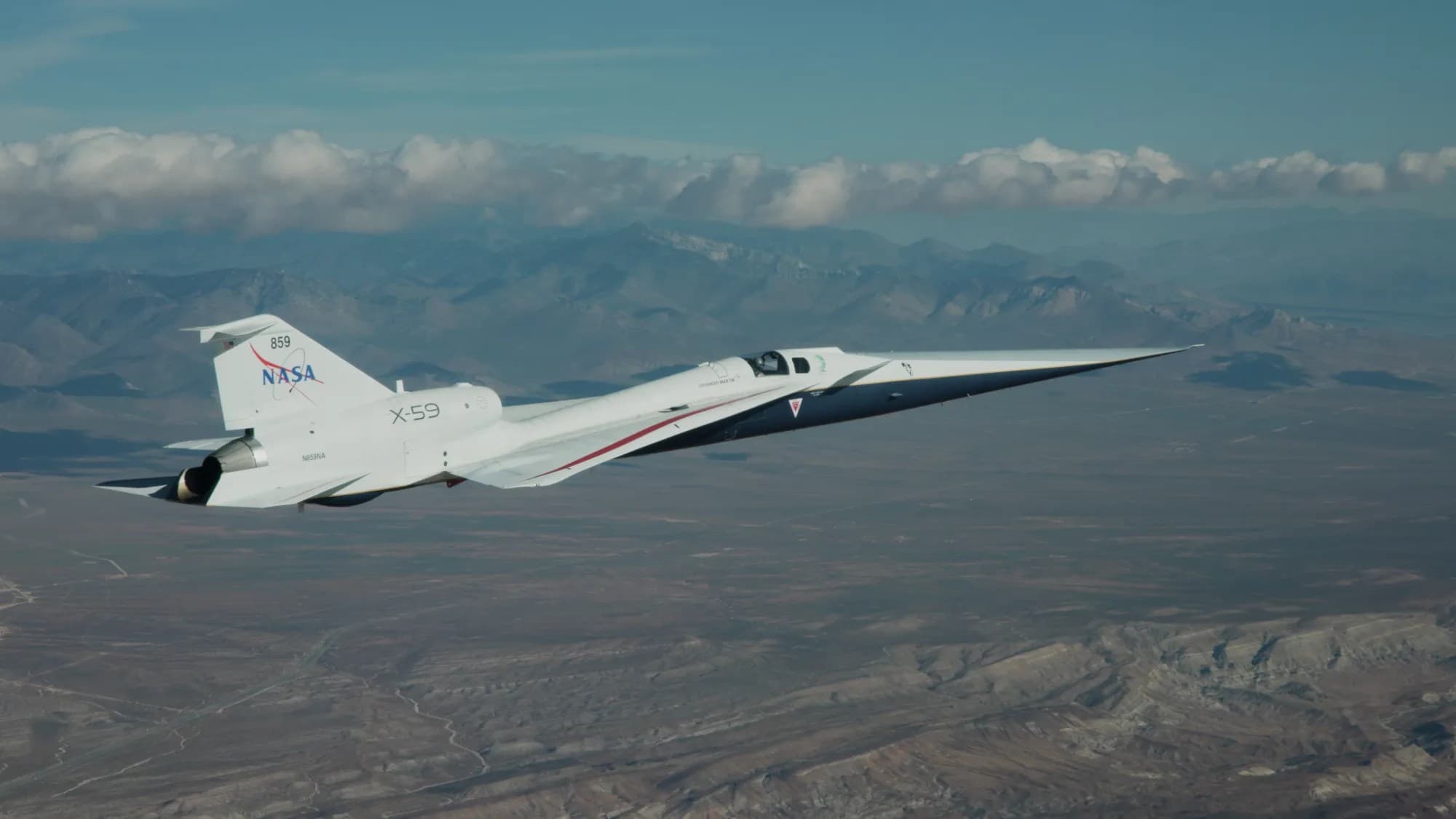
NASA's X-59 quiet supersonic research aircraft has successfully transitioned to flying with its wheels up, marking a pivotal milestone in its test campaign over the Mojave Desert in California. This achievement, captured in an image from April 14, 2026, represents the aircraft's highest and fastest flights to date, expanding its operational range and bringing it closer to supersonic flight. The X-59 is part of NASA's Quesst mission, which aims to demonstrate technology for flying faster than the speed of sound without generating disruptive sonic booms—a long-standing challenge in aviation that has limited commercial supersonic travel over land due to noise regulations.
From an aviation training perspective, the X-59's progress is more than just a technical feat; it signals potential shifts in aircraft design and operational paradigms that ATPL pilots and ATC students should monitor. The aircraft's unique features, such as its elongated shape and advanced aerodynamics, are engineered to minimize sonic booms, which could influence future regulatory frameworks for supersonic flight. As pilots, understanding these design principles is crucial for adapting to new aircraft types and flight profiles, especially if supersonic travel becomes more accessible in commercial aviation.
A key innovation in the X-59 is the eXternal Vision System (XVS), which replaces the traditional forward windscreen with a series of cameras connected to a cockpit display. This system addresses visibility challenges posed by the aircraft's design and offers a glimpse into the future of cockpit technology. For ATPL students, this highlights the evolving role of avionics and human-machine interfaces in modern aircraft. Proficiency with such systems will be essential, as they may become standard in next-generation aircraft, requiring updated training modules on synthetic vision and enhanced flight displays.
In upcoming test flights, NASA will focus on evaluating the X-59's controls, structural dynamics, and subsystems like hydraulics, fuel, and landing gear. These tests are critical for validating the aircraft's safety and performance under supersonic conditions. For ATC students, this underscores the importance of managing experimental aircraft operations, which often involve unique flight paths, speeds, and communication protocols. As supersonic aircraft integrate into airspace, controllers will need to adapt to faster decision-making and potential changes in separation standards, making this an area for ongoing education in ATM programs.
Overall, the X-59's milestones are not just about breaking speed barriers; they represent a concerted effort to make supersonic flight quieter and more sustainable. For aviation professionals in training, staying informed about such advancements is vital, as they could lead to new career opportunities, revised training curricula, and enhanced operational procedures in the years to come. By following developments like the Quesst mission, students can better prepare for a future where supersonic travel might become a routine part of the aviation landscape.