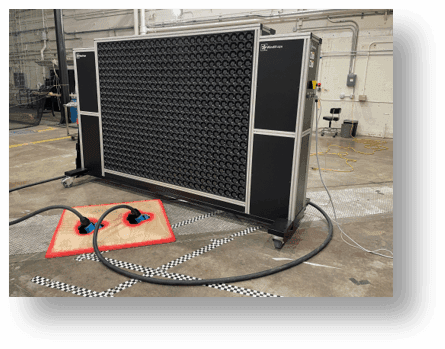
The NASA Unmanned Autonomy Research Complex (NUARC) is equipped with cutting-edge indoor testing facilities, designed to support the development and testing of unmanned aerial vehicles (UAVs) and other autonomous systems. One of the key facilities available at NUARC is the WindShaper, a large fan array that can generate arbitrary wind gradients and wind gusts. This system is ideal for researching dynamic low-speed and hovering flight, as it allows for the simulation of a wide range of wind conditions. The WindShaper consists of 1134 fans, arranged as 567 'wind pixels', and can produce wind speeds of up to 16 m/s (36 mph/31 kts). Each fan is programmable via Python scripting, enabling the replication of steady winds, gusts, and wind gradients. In addition to the WindShaper, NUARC also offers a WindProbe, a handheld mobile wind data collection system. The WindProbe utilizes the lab's OptiTrack motion capture system to extract the position and orientation of the 5-hole cone probe located on the probe tip, allowing for quick surveys of flows. These advanced facilities provide researchers and developers with the tools they need to test and refine their autonomous systems, and to advance the field of unmanned autonomy. For ATPL and ATC students, understanding the capabilities and limitations of these systems is crucial, as they will be working with autonomous vehicles and systems in the future. The development of these technologies has significant implications for the aviation industry, and students who are familiar with them will be better equipped to navigate the changing landscape of air traffic control and pilot training.