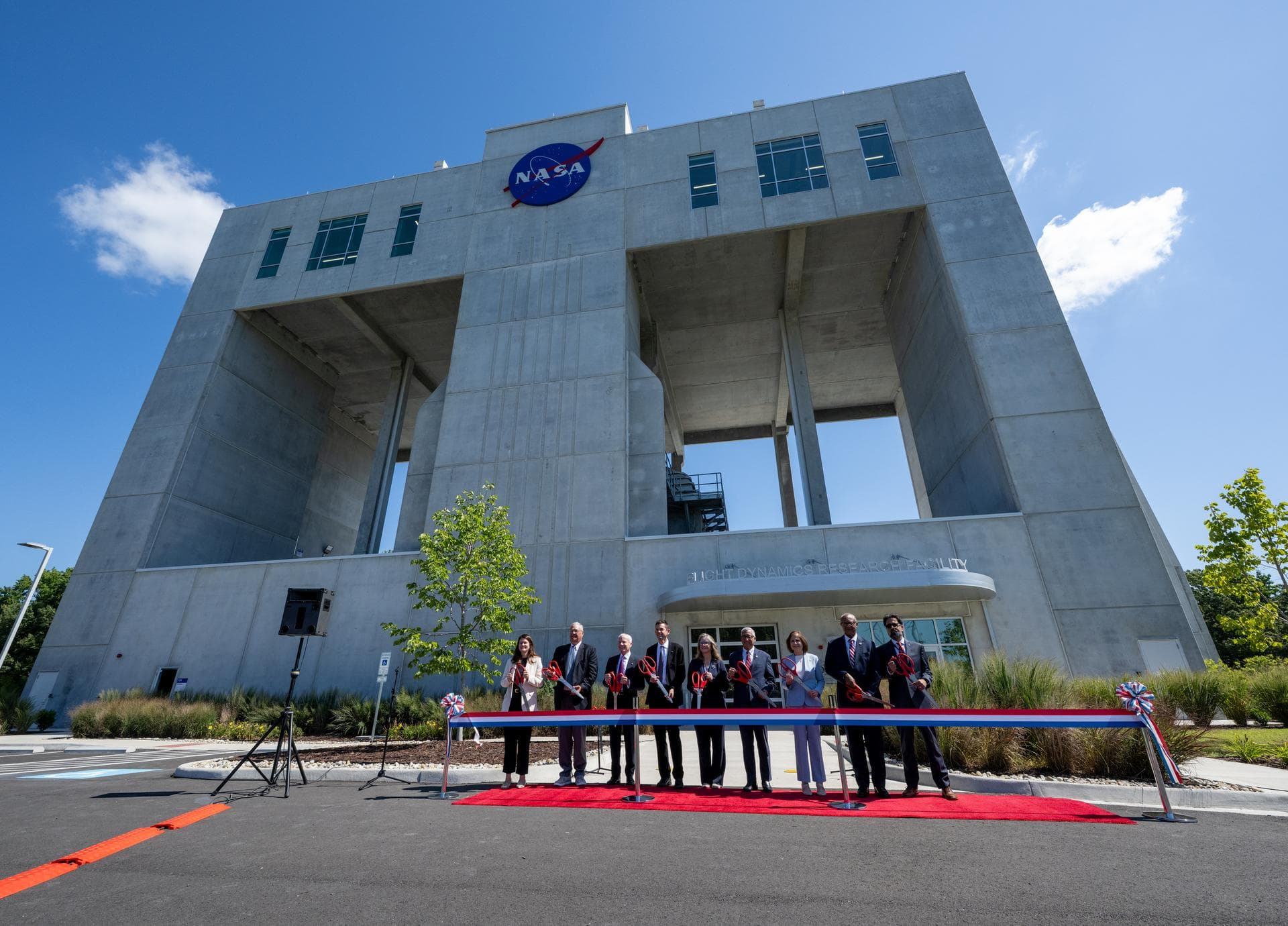
NASA recently inaugurated the Flight Dynamics Research Facility (FDRF) at Langley Research Center in Virginia, marking the agency's first major new wind tunnel in more than four decades. This state-of-the-art facility is set to transform how aircraft, spacecraft, and drones are tested, offering enhanced capabilities that will benefit both NASA and its partners across government, industry, and academia.
The FDRF replaces two aging wind tunnels—the 20-Foot Vertical Spin Tunnel and the 12-Foot Low-Speed Tunnel—combining and improving their functions in a single, energy-efficient building. With a 20-foot diameter test chamber, the facility allows for larger and more detailed scale models, improving data accuracy. Its top airspeed of 117 miles per hour is twice that of its predecessors, enabling free-flight tests of heavier models and simulations of full-scale vehicles at higher altitudes. This is crucial for studying the stability of aircraft and reentry capsules returning from space.
For aviation students, the FDRF represents a significant leap in testing capabilities. The facility's four 750-horsepower motors, each with an eight-bladed carbon fiber fan, allow for rapid and precise airspeed adjustments during tests. This flexibility is essential for research into autonomous flight, drones, commercial and military aircraft, and X-planes. The wind tunnel will also play a key role in NASA's Artemis program, helping to test entry, descent, and landing vehicle designs to reduce mission risk and ensure crew safety.
The opening of the FDRF underscores the synergy between aeronautics and space exploration. As NASA prepares for sustained lunar presence and potential missions to Mars, the facility will support the design of aircraft for other atmospheres. For ATPL and ATC students, understanding the principles of flight dynamics and testing is fundamental. This facility will generate data that informs future aircraft designs, safety protocols, and operational procedures, directly impacting the aviation industry.
In summary, the Flight Dynamics Research Facility is more than just a new building; it is a cornerstone for future aviation innovation. Its advanced capabilities will enable breakthroughs in aircraft safety and performance, benefiting pilots, air traffic controllers, and the entire aerospace sector. As students, staying informed about such developments is vital for anticipating the technological landscape you will operate in.