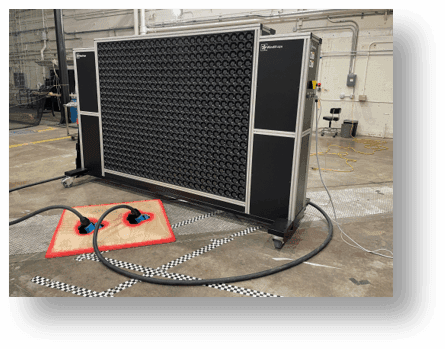
The NASA Unmanned Autonomy Research Complex (NUARC) is equipped with state-of-the-art indoor testing facilities, designed to support the development and testing of unmanned aerial vehicles (UAVs) and autonomous systems. One of the key facilities available at NUARC is the WindShaper, a large fan array that enables dynamic low-speed and hovering flight research. The WindShaper consists of 1134 fans, arranged as 567 'wind pixels', which can generate wind speeds of up to 16 m/s (36 mph/31 kts) and accelerate at 4 m/s^2, while decelerating at 2.5 m/s^2. Each fan is programmable via Python scripting, allowing researchers to replicate steady winds, gusts, and wind gradients.
The WindShaper is complemented by the WindProbe, a handheld mobile wind data collection system. The WindProbe utilizes the lab's OptiTrack motion capture system to extract the position and orientation of the 5-hole cone probe located on the probe tip, enabling quick surveys of flows. The combination of the WindShaper and WindProbe provides a powerful tool for researchers to study the behavior of UAVs in various wind conditions, and to develop and test new autonomous systems.
The availability of these indoor testing facilities at NUARC has significant implications for the development of unmanned autonomy research. By providing a controlled and repeatable environment for testing, researchers can accelerate the development of new technologies and systems, and improve the safety and efficiency of UAV operations. For ATPL and ATC students, understanding the capabilities and limitations of these testing facilities is essential for appreciating the complexities of UAV operations and the importance of wind conditions in flight planning and execution.
In conclusion, the WindShaper and WindProbe at NUARC represent a significant advancement in the field of unmanned autonomy research, and have the potential to drive innovation and improvement in the development and operation of UAVs. As the use of UAVs continues to grow and expand into new areas, the importance of these testing facilities will only continue to increase, and it is essential that ATPL and ATC students are aware of the capabilities and limitations of these systems.