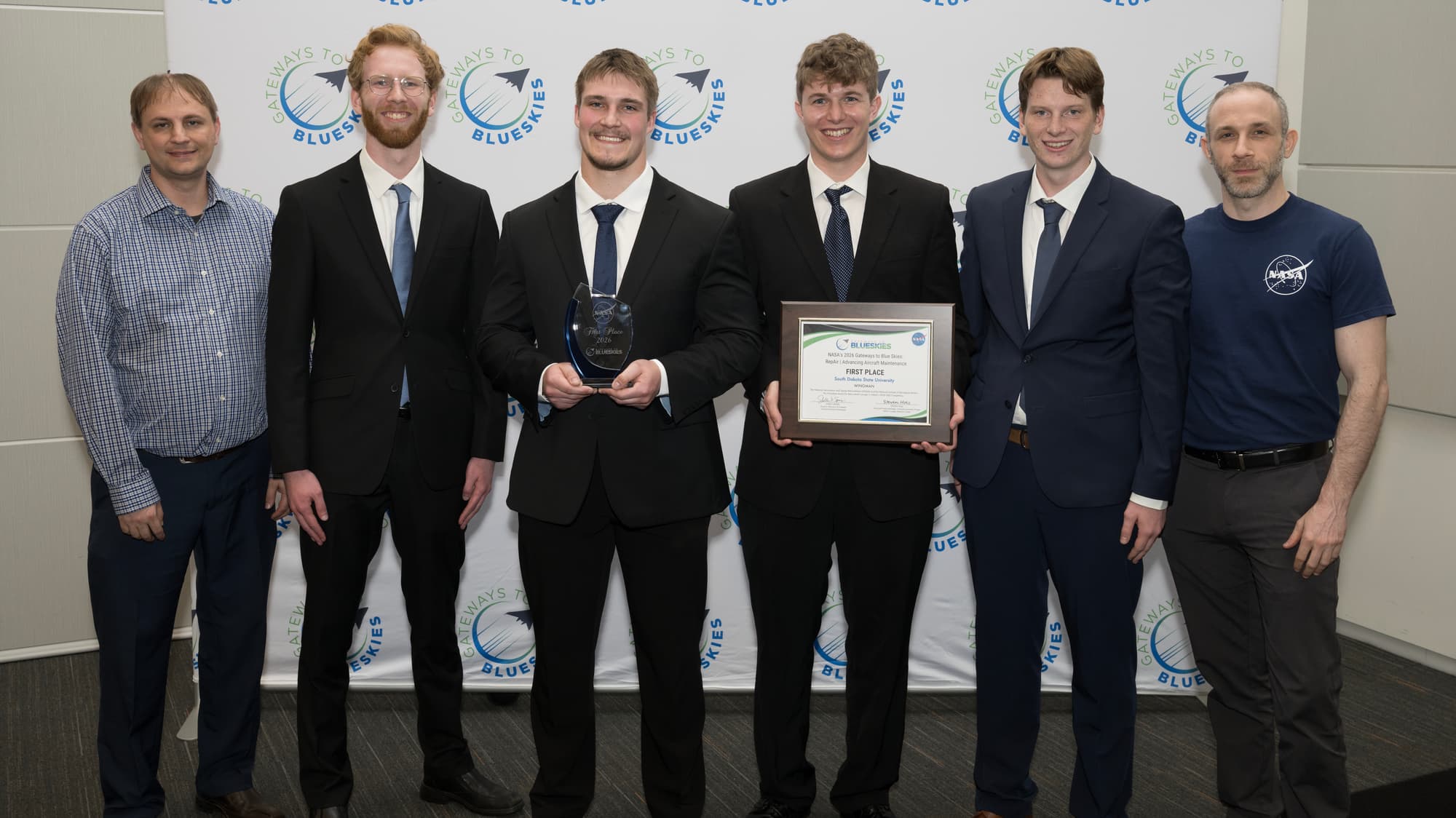
NASA’s fifth annual Gateways to Blue Skies competition has awarded first place to Team WINGMAN from South Dakota State University for their augmented reality (AR) safety glasses designed to assist aircraft mechanics. The competition, themed “RepAir: Advancing Aircraft Maintenance,” challenged student teams to develop innovative systems and practices that could transform commercial aircraft maintenance and repair by 2035. This event, held at NASA’s Langley Research Center, underscores a critical industry trend: the growing need for advanced tools to address workforce shortages and enhance safety in aviation maintenance.
For ATPL and ATC students, this competition is more than a university event—it’s a window into the future of aircraft operations. The winning concept, WINGMAN, proposes AR glasses with voice-controlled manuals, automatic documentation, and photo recognition. This technology could allow mechanics to perform line inspections hands-free, reducing errors and speeding up turnaround times. In an era where aircraft are kept in service longer, such innovations directly impact the reliability and safety that pilots and controllers depend on daily. Understanding these emerging tools is essential for future aviation professionals who will work alongside or manage such systems.
The competition also highlights NASA’s commitment to building a skilled aviation workforce. With a shortage of qualified maintenance workers, the industry is turning to technology to bridge the gap. For students pursuing ATPL or ATC careers, this means that proficiency in digital tools and data management will be as important as traditional skills. The WINGMAN project, for instance, integrates real-time data capture and AI-driven diagnostics—concepts that align with the next generation of aircraft like the Boeing 777X or Airbus A350, which rely heavily on digital maintenance logs and predictive analytics.
Beyond the winner, other finalists showcased cutting-edge ideas: the University of California, Irvine proposed Aishield for structural health monitoring, while the University of Georgia explored quantum sensing for inspection. These projects demonstrate the breadth of innovation in aviation maintenance, from materials science to quantum physics. For ATPL students, this signals a shift toward data-centric maintenance, where understanding system health indicators becomes part of flight planning and risk assessment. ATC students, meanwhile, will benefit from more reliable aircraft that require fewer unscheduled groundings.
In summary, the Gateways to Blue Skies competition is a valuable indicator of where aviation maintenance is headed. For those training as pilots or controllers, staying informed about such technological advances is not optional—it’s a professional necessity. The AR glasses concept, if adopted, could reduce human error and improve efficiency, directly enhancing the safety net that pilots and ATC rely on. As NASA continues to foster these innovations, the aviation community must prepare for a future where maintenance is smarter, faster, and more integrated with flight operations.