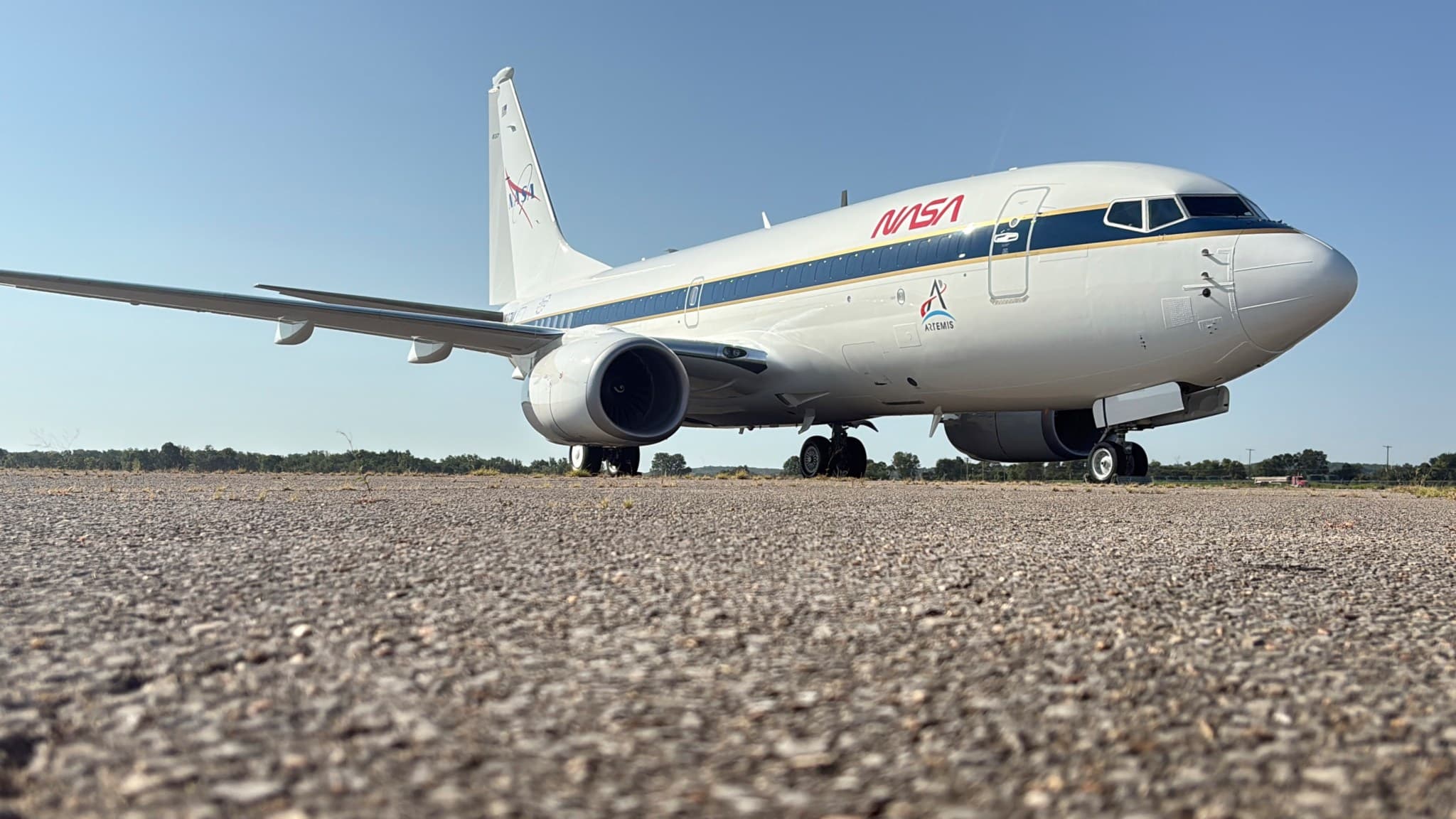
**A fresh coat of paint marks a new mission for NASA’s 737.**
NASA’s 737 aircraft received a new paint job this week in Oklahoma, signaling its transition from a military transport to a specialized research platform. The aircraft, which NASA’s Armstrong Flight Research Center took ownership of from the U.S. Air Force in June, is being modified to serve as a reduced-gravity test aircraft. The paint job is part of the ongoing modifications that will prepare the plane for its dual role in supporting Artemis lunar missions and advancing aeronautics research.
**Lunar gravity flights for Artemis suit validation.**
The primary mission of this aircraft will be to perform lunar-gravity parabolic flights. By flying a series of parabolas, the aircraft will create brief periods of reduced gravity, simulating the Moon’s gravitational pull (about one-sixth of Earth’s). These flights will be used to validate astronaut lunar suits and associated crew systems required for Artemis mission objectives. The flights will take place at NASA’s Johnson Space Center in Houston, with oversight from NASA Armstrong. This is a critical step in ensuring that astronauts are properly equipped to work on the lunar surface, and it provides a unique training environment for future lunar explorers.
**Beyond the Moon: systems integration research.**
In addition to its lunar gravity role, the aircraft will serve as a key asset for systems-integration research. It will be used for flight testing of autonomy, sensors, and other digital systems. This dual-use approach maximizes the value of the aircraft, allowing NASA to test cutting-edge technologies in a real flight environment. For aviation professionals, this highlights the growing importance of autonomous systems and sensor integration in modern aircraft, a trend that will shape the future of both commercial and military aviation.
**Why this matters for aviation training.**
For ATPL and ATC students, this news underscores the evolving landscape of flight testing and aircraft modification. Understanding how a standard airframe can be repurposed for research missions—and how parabolic flight profiles are planned and executed—offers valuable insight into advanced flight operations. Moreover, the emphasis on autonomy and sensors aligns with the increasing integration of these technologies in commercial aviation, which will be a key topic in future training and operations. As the industry moves toward more automated systems, professionals who understand the principles behind them will be better prepared for the challenges ahead.
**A step forward for Artemis and aeronautics.**
The repainting of NASA’s 737 is more than a cosmetic change; it represents a milestone in the preparation of a versatile research asset. As the aircraft undergoes further modifications and begins its parabolic flight campaigns, it will contribute directly to the success of Artemis missions and to the advancement of aeronautical science. For those in aviation training, this is a reminder that innovation often comes from adapting existing platforms to new purposes, a concept that will continue to drive progress in the industry.