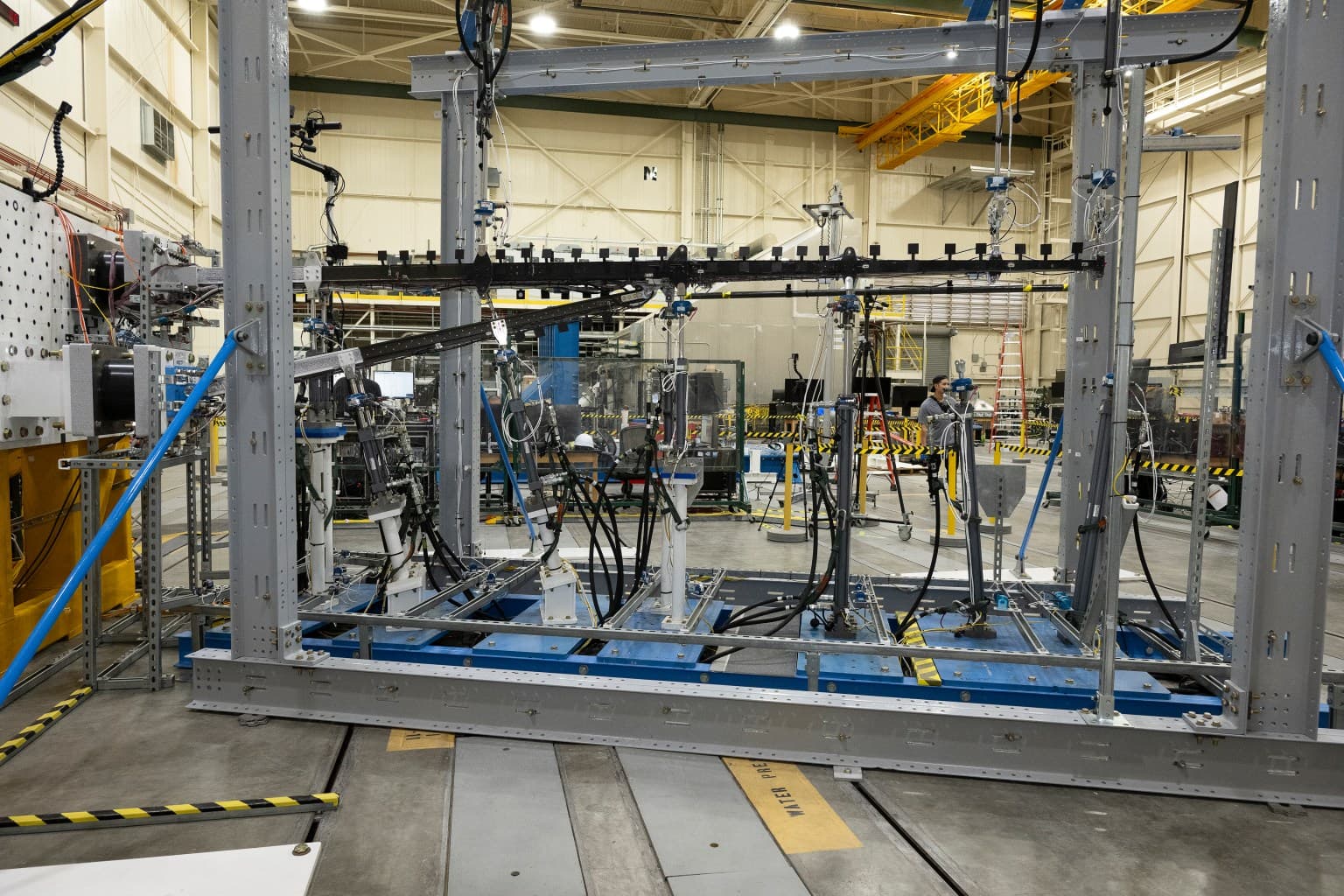
NASA’s latest structural test of the SWEET-15 wing—a 15-foot truss-braced composite design—has confirmed that ultra-thin, lightweight wings can withstand extreme loads, failing only at 127% of the design limit. For ATPL and ATC students, this isn’t just a lab curiosity; it signals a tangible shift toward the next generation of commercial aircraft, with direct implications for performance, handling, and airspace integration.
The SWEET-15 (Structural Wing Experiment Evaluating Truss-bracing) is a scaled model of NASA’s Transonic Truss-Braced Wing concept, which uses an aerodynamic strut to support a long, slender wing. This design reduces drag and could cut fuel consumption by up to 10% compared to conventional cantilever wings. During testing at NASA Armstrong’s Flight Loads Laboratory, engineers applied increasing loads while monitoring strain with fiber-optic sensors. The structure matched computer predictions perfectly, validating the new manufacturing techniques—including the use of the Integrated Structural Assembly of Advanced Composites robot at Langley.
For ATPL candidates, this matters because future airliners may feature significantly higher aspect ratios (longer, thinner wings) that change stall characteristics, gust response, and structural limitations. Understanding how composite materials behave under stress—especially beyond design limits—is directly relevant to performance calculations and emergency procedures. ATC students, meanwhile, should note that more efficient aircraft could alter climb profiles, cruise altitudes, and noise footprints, potentially requiring revised separation standards or departure procedures.
The deliberate test-to-failure revealed that the wing’s joints—particularly where the strut and jury strut attach—are critical failure points. This knowledge helps engineers design safer, more robust airframes. For pilots, knowing the structural margins of composite wings (which don’t show fatigue cracks like metal) is essential for pre-flight inspections and in-flight decision-making. ATC professionals will benefit from understanding that these aircraft may have different performance envelopes, affecting spacing and sequencing.
NASA’s Subsonic Flight Demonstrator project will now analyze the data to inform future full-scale designs. While SWEET-15 is a research article, its success moves truss-braced wings closer to certification. For students, this is a real-world example of how aeronautical research directly feeds into the aircraft they will one day fly or control. The combination of advanced composites, robotic manufacturing, and rigorous structural testing is the blueprint for tomorrow’s efficient aviation.