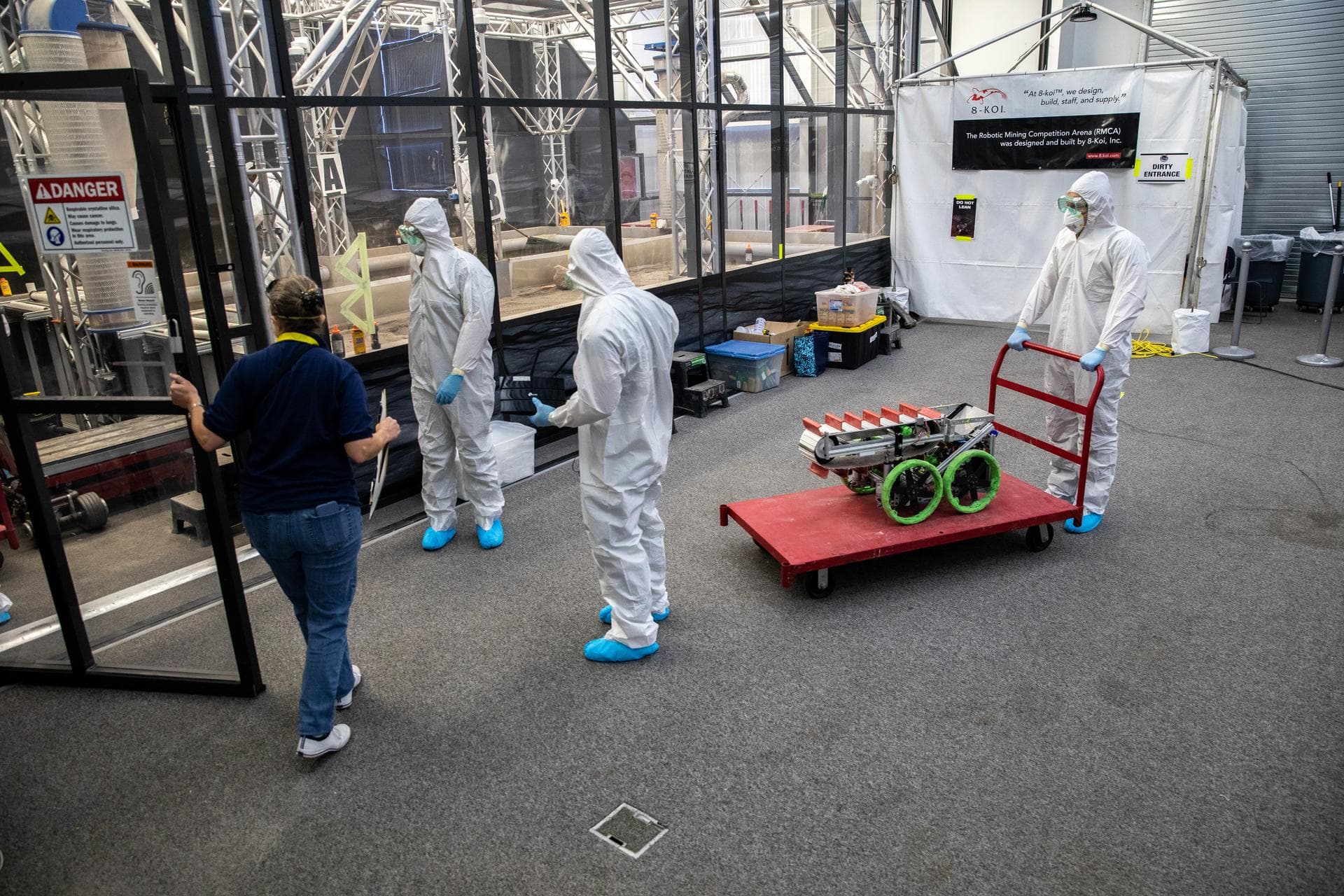
NASA has announced that its 2026 Lunabotics Challenge will take place from May 19 to 21 at the Kennedy Space Center Visitor Complex in Florida. Fifty college teams from across the United States will compete by designing, building, and operating remote-controlled robots capable of constructing protective berms from simulated lunar regolith. This task mirrors the real needs of the Artemis program, where such structures could shield equipment from debris, radiation, and cryogenic propellant hazards.
For ATPL and ATC students, the Lunabotics competition is far more than a space-themed engineering contest. It is a vivid demonstration of how systems engineering, autonomous operations, and human-machine teaming are evolving in high-stakes environments. The same principles apply to modern aviation: aircraft increasingly rely on automated systems, and air traffic controllers must understand how these systems interact to ensure safety. The challenge of designing a self-driving rover that can navigate unknown terrain and perform precise tasks under time pressure is directly analogous to managing an aircraft’s autopilot or handling unexpected weather deviations.
Moreover, the competition emphasizes teamwork and interdisciplinary collaboration—skills that are essential in both the cockpit and the control tower. Pilots and controllers must communicate effectively, share situational awareness, and make decisions under stress. The Lunabotics teams must do the same, integrating mechanical, electrical, and software engineering disciplines to produce a working prototype. For students pursuing an ATPL or ATC license, participating in or even following such challenges can provide a tangible sense of how engineering principles are applied in practice.
From a training perspective, the Lunabotics Challenge also highlights the growing importance of automation and robotics in aerospace. As the industry moves toward more autonomous flight operations and unmanned traffic management, understanding the capabilities and limitations of robotic systems becomes crucial. ATPL students will encounter concepts like sensor fusion, path planning, and fault tolerance in their studies; seeing these concepts implemented in a lunar rover competition can reinforce their learning. ATC students, meanwhile, will benefit from understanding how autonomous vehicles communicate and interact with human operators—a skill that will be increasingly relevant as drones and urban air mobility vehicles enter the airspace.
In summary, NASA’s Lunabotics Challenge is not just a robotics contest; it is a microcosm of the engineering and operational challenges that define modern aviation. For ATPL and ATC students, it offers a unique window into the future of aerospace, where automation, teamwork, and systems thinking will be paramount. Following the competition can inspire students to think beyond the cockpit or tower and consider the broader technological ecosystem that supports safe and efficient flight.