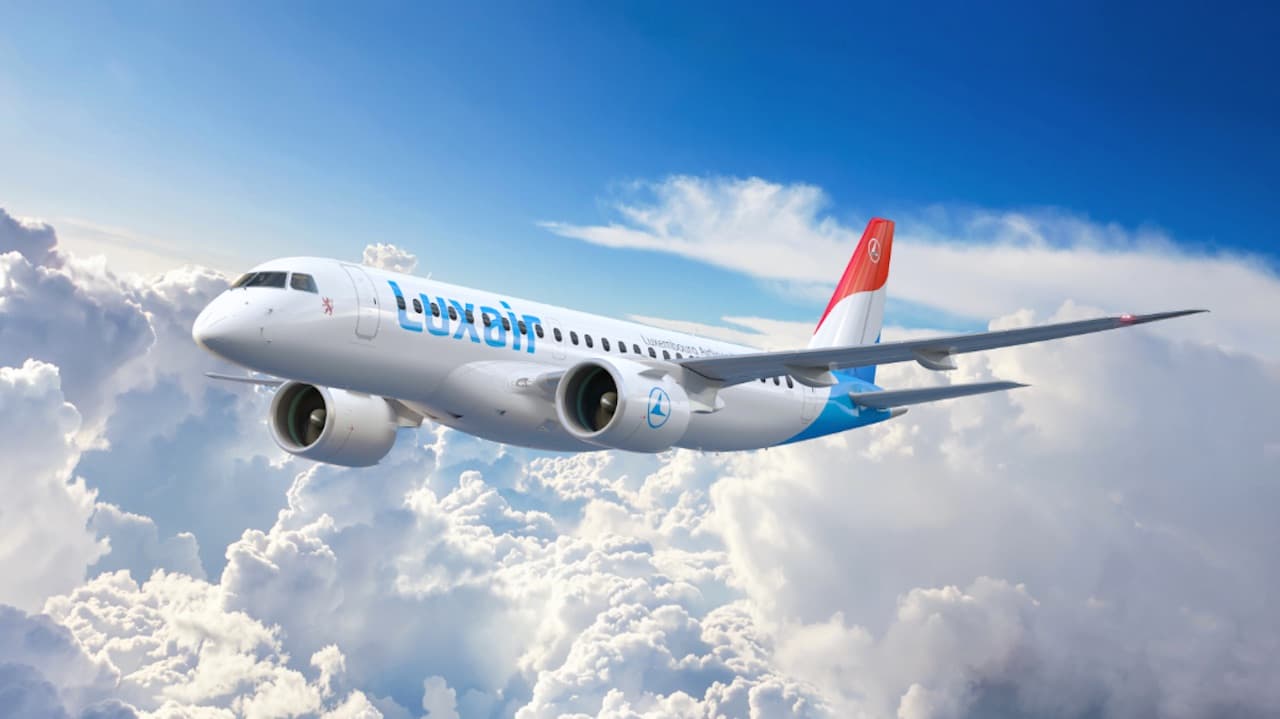
At the Farnborough Airshow, Luxair announced the conversion of options into firm orders for two Boeing 737 MAX 10 and three Embraer E190-E2 aircraft, while securing additional purchase rights for two more MAX 10 and one more E190-E2. This decision reinforces the Luxembourg-based carrier's long-term fleet strategy, which aims to balance capacity, efficiency, and passenger comfort across its expanding network of over 100 destinations.
For ATPL and ATC students, this news illustrates how airlines use fleet planning to match aircraft types with market demand. The 737 MAX 10, configured with 213 seats, targets high-density leisure and business routes, while the 100-seat E190-E2 serves higher-frequency, lower-density markets. Understanding these trade-offs is crucial for future pilots and controllers who will operate within such networks, where aircraft size and frequency directly affect slot coordination and airspace utilization.
Luxair's fleet now includes twelve 737 MAX aircraft (eight -8 and four -10) and nine E2 jets (six E195-E2 and three E190-E2), all powered by next-generation engines. The airline highlights a 20% reduction in fuel consumption and CO2 emissions compared to older models, as well as significantly lower noise footprints—up to 63% quieter for the E190-E2 versus its predecessor. These environmental gains are increasingly relevant for ATPL candidates studying performance and fuel planning, and for ATC trainees learning about noise abatement procedures.
The cabin configuration also matters: the MAX 10 features Boeing Sky Interior with 76 cm seat pitch, USB-C ports, and wireless entertainment, while the E190-E2 offers a premium 2-2 layout with up to 86 cm pitch. Such details influence passenger experience and airline branding, but also affect weight and balance calculations—a core ATPL subject. For controllers, knowing aircraft dimensions and performance helps in managing traffic flow and runway sequencing.
Beyond hardware, Luxair emphasizes a social model with competitive wages and work-life balance improvements negotiated with unions. This aspect resonates with aviation professionals who value career stability and quality of life. Overall, the Luxair order exemplifies how regional carriers modernize fleets to stay competitive while meeting environmental targets—a case study worth analyzing in any aviation management or operations course.