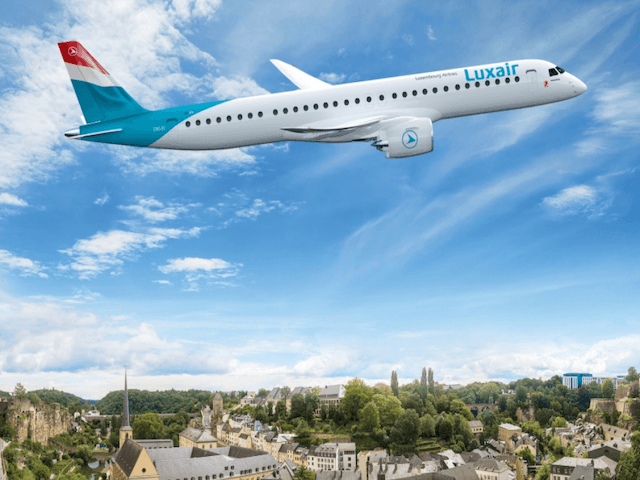
**Luxair's 2025 Milestone: The Embraer E195-E2 Enters Service**
Luxair's 2025 annual report highlights a pivotal year for the Luxembourg-based carrier, marked by the introduction of its first Embraer E195-E2. This next-generation narrowbody, capable of seating up to 132 passengers, is the centerpiece of a broader fleet modernization program aimed at replacing aging De Havilland Q400 turboprops. According to Embraer, the E195-E2 offers approximately 20% lower fuel consumption per seat compared to its predecessors, a critical advantage in an era of rising environmental scrutiny and fuel costs. The airline plans to add five more E195-E2s and four Boeing 737 MAX 8s to enhance capacity on dense routes and expand its network.
**Traffic Stability Amid Fewer Flights**
Despite operating 29,998 flights in 2025—down from 31,035 in 2024—Luxair carried over 2.6 million passengers, matching the previous year's level. This apparent paradox stems from a strategic capacity shift: the gradual phase-out of Q400s and increased use of larger Boeing 737s allowed the airline to serve the same demand with fewer rotations but more seats per flight. For ATPL students, this demonstrates how fleet composition directly impacts operational planning and load factors. Luxair's hybrid model, combining scheduled services with tour operator activities via LuxairTours, provided stability, with leisure destinations—especially in North Africa (Egypt and Morocco)—driving demand.
**Financial Pressures and Operational Challenges**
Financially, Luxair reported revenue of €786.2 million in 2025, down from €801 million in 2024, partly due to the exclusion of LuxairCARGO from May 2024. Operating profit remained positive at €9.2 million but declined slightly. The airline cited geopolitical tensions, rising operating costs, crew training demands for the new aircraft, and passenger compensation costs as key pressures. CEO Gilles Feith noted that introducing the E195-E2 required exceptional effort while maintaining service continuity. For ATC students, this underscores how fleet transitions affect scheduling, ground handling, and airspace demand—factors that controllers must anticipate.
**Early 2026: Continued Turbulence**
The first months of 2026 have already tested Luxair's resilience. Performance fell below budget due to maintenance and supply chain delays, fuel price volatility, and geopolitical instability, particularly in the Middle East. The airline temporarily suspended flights to Dubai from late February to May and participated in repatriation operations. To maintain its schedule, Luxair resorted to ACMI (Aircraft, Crew, Maintenance, and Insurance) charter capacity—a common industry practice for operational flexibility. This real-world example is invaluable for ATPL students studying airline economics and contingency planning.
**Long-Term Strategy: Modernization and Regional Premium Positioning**
Despite near-term headwinds, Luxair remains committed to its modernization strategy. The gradual introduction of E195-E2s and 737 MAX 8s aims to improve operational efficiency and passenger experience. The carrier positions itself as a regional premium airline, leveraging flexibility, service quality, and its tour operator integration. For aviation trainees, Luxair's journey offers a textbook case of how mid-sized European airlines navigate fleet renewal, environmental regulations, and market volatility while maintaining connectivity for a small nation.