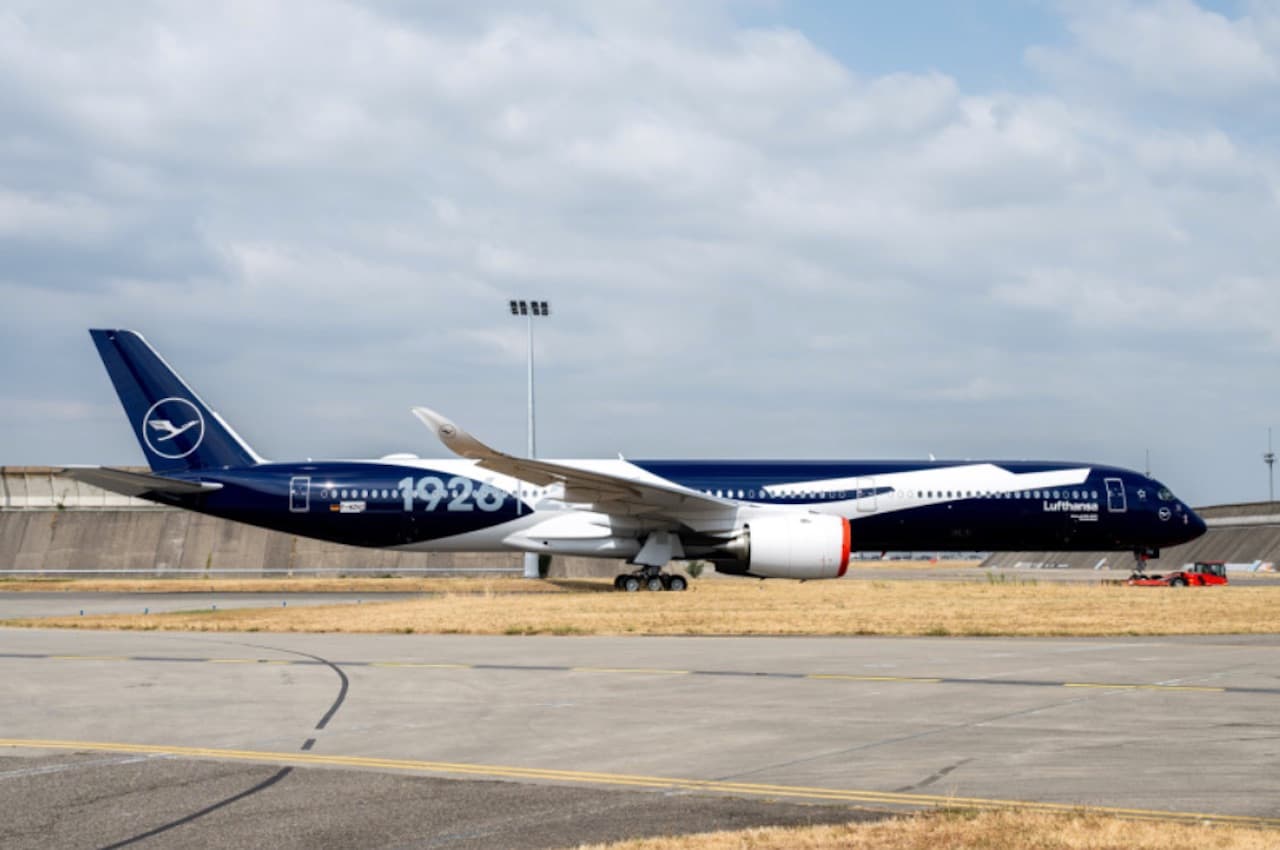
Lufthansa has reached a symbolic milestone at the Airbus plant in Toulouse, where its first A350-1000, registered D-AIFA, has been painted in a special “1926 | 2026” centenary livery. The aircraft, which will be based in Munich from autumn 2026, is also the 700th Airbus delivered to the Lufthansa Group since the partnership began in the 1970s. This makes it a double landmark: a new-generation widebody and a rolling ambassador for the airline’s 100th anniversary.
The A350-1000 is 73.80 meters long—exactly 7 meters longer than the A350-900 already operated by Lufthansa (31 in service, more on order). It will seat around 300 passengers in four classes: First, Business, Premium Economy, and Economy, though the detailed cabin layout has not yet been published. The aircraft is powered by Rolls-Royce Trent XWB-97 engines and will undergo flight tests, cabin fitting, and final acceptance inspections before delivery. Its entry into service is planned for autumn 2026 at Munich Airport, where it will join the long-haul fleet alongside existing A350-900s.
This delivery is part of Lufthansa’s broader fleet modernization strategy, replacing fuel-thirsty quad-jets like the A340-600 (5 still in service) and A340-300 (14 in service, to be retired by 2028). The A350-1000 offers significant fuel savings and lower CO₂ emissions, aligning with industry trends toward more efficient twin-engine aircraft. For ATPL and ATC students, this transition provides a concrete example of how airlines balance operational needs, environmental goals, and fleet economics. Understanding the performance characteristics of the A350-1000—its range, fuel burn, and noise footprint—is directly relevant to flight planning, performance calculations, and airport operations.
The centenary livery, featuring a giant stylized heron and the numbers “100” and “1926 | 2026”, required 432 liters of blue paint and 246 liters of white paint. D-AIFA will be the seventh aircraft in Lufthansa’s “anniversary fleet,” which already includes an A350-900, A380, Boeing 787-9, Boeing 747-8, and two A320neos. The livery has become a favorite among spotters and aviation enthusiasts, with dedicated tracking pages on platforms like Flightradar24. Jens Ritter, CEO of Lufthansa Airlines, noted that a new aircraft with a special livery is rare, and being the 700th Airbus delivery makes it even more special.
For students, this news underscores the importance of fleet planning and the operational impact of new technology. The A350-1000’s introduction affects route planning, crew training, and airport infrastructure—all topics covered in ATPL and ATC curricula. It also highlights how airlines use branding and livery to communicate heritage and innovation, a subtle but important aspect of aviation marketing and public perception.