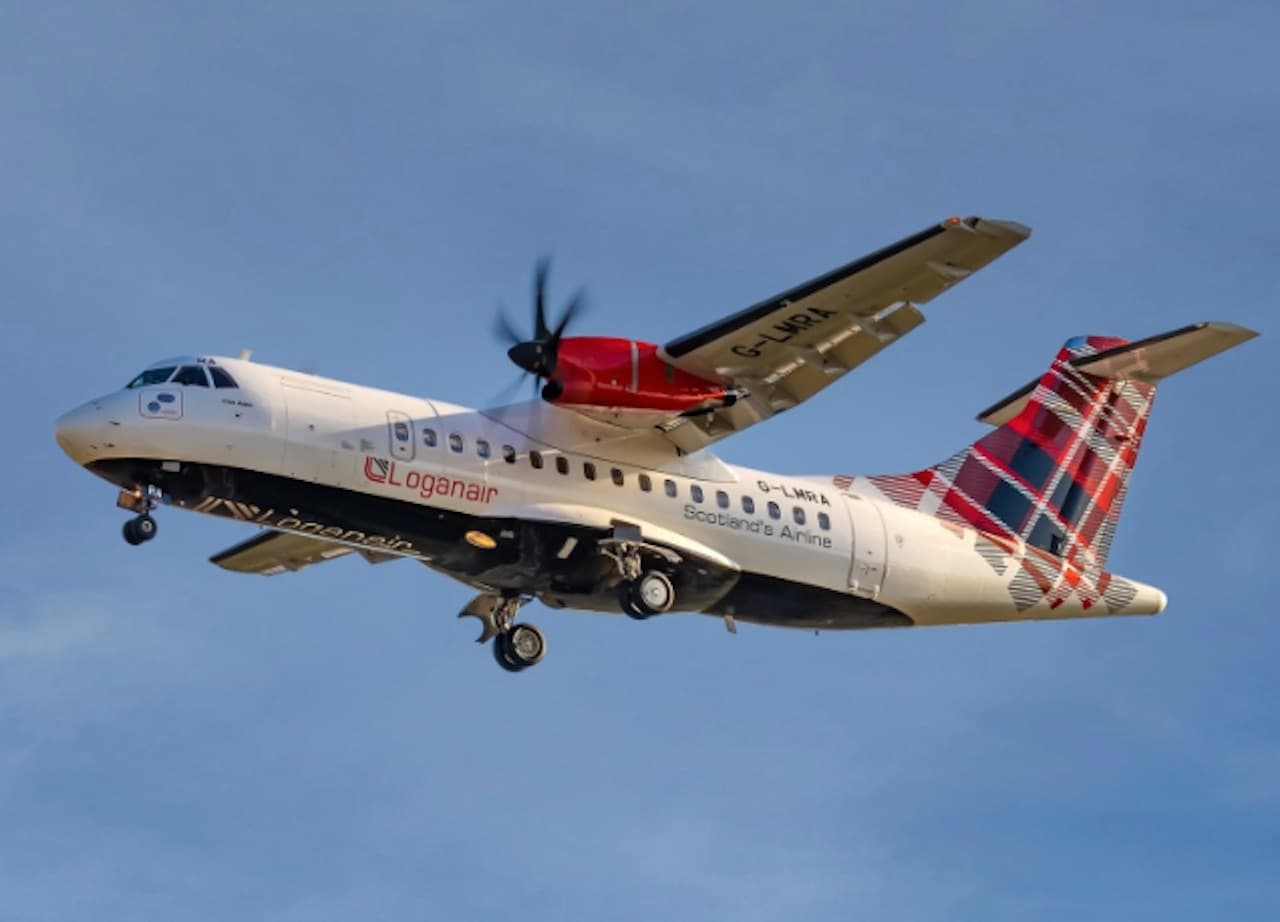
**Loganair Launches Jersey–Bordeaux Route: A First for the Channel Island and a Boost for Regional Aviation Training**
On June 19, Loganair inaugurated its first direct seasonal service between Jersey and Bordeaux, operated by an ATR 72-600. This twice-weekly route (Mondays and Fridays) runs until October 5, 2026, with fares starting at €89.99 from Bordeaux and £79.99 from Jersey. The move strengthens Loganair's presence at Jersey Airport while opening a new tourist flow between the Channel Island and southwestern France.
**Why This Matters for ATPL and ATC Students**
For aspiring pilots and air traffic controllers, this route is a textbook example of regional airline strategy. Loganair, a UK regional carrier, uses the ATR 72-600—a turboprop ideal for short-haul, low-density markets. Understanding the operational constraints of such aircraft (range, payload, runway requirements) is crucial for ATPL candidates studying performance and flight planning. ATC students can analyze how Jersey Airport manages point-to-point connectivity without relying on major hubs, a key concept in air traffic management for regional airports.
**Operational and Commercial Insights**
The ATR 72-600 (registration G-LMTA) is a workhorse for island and regional routes, offering low fuel consumption and intermediate capacity. This choice reflects Loganair's strategy of serving peripheral territories with efficient turboprops. Commercially, the airline includes a 21 kg baggage allowance and Avios loyalty points, appealing to leisure travelers. For Bordeaux-Mérignac Airport, the new service diversifies its network and attracts English-speaking tourists interested in gastronomy and wine tourism, as highlighted by airport director Simon Dreschel.
**Broader Network Expansion**
The Jersey–Bordeaux route is part of Loganair's summer 2026 expansion from Jersey, which also includes flights to Norwich (Saturdays, May to mid-September), East Midlands (daily, late May to end of season), and Paris-Charles-de-Gaulle (three times weekly). This demonstrates how regional carriers build seasonal networks to maximize aircraft utilization and meet demand. For ATPL students, this is a case study in route planning and fleet scheduling; for ATCs, it shows how seasonal traffic peaks affect airspace and slot coordination.
**Conclusion**
Loganair's new route is more than a tourism link—it's a practical lesson in regional aviation. By examining this service, ATPL and ATC students can deepen their understanding of turboprop operations, airport connectivity, and the commercial logic behind seasonal routes. Such real-world examples bridge the gap between theory and practice, preparing students for the challenges of modern aviation.