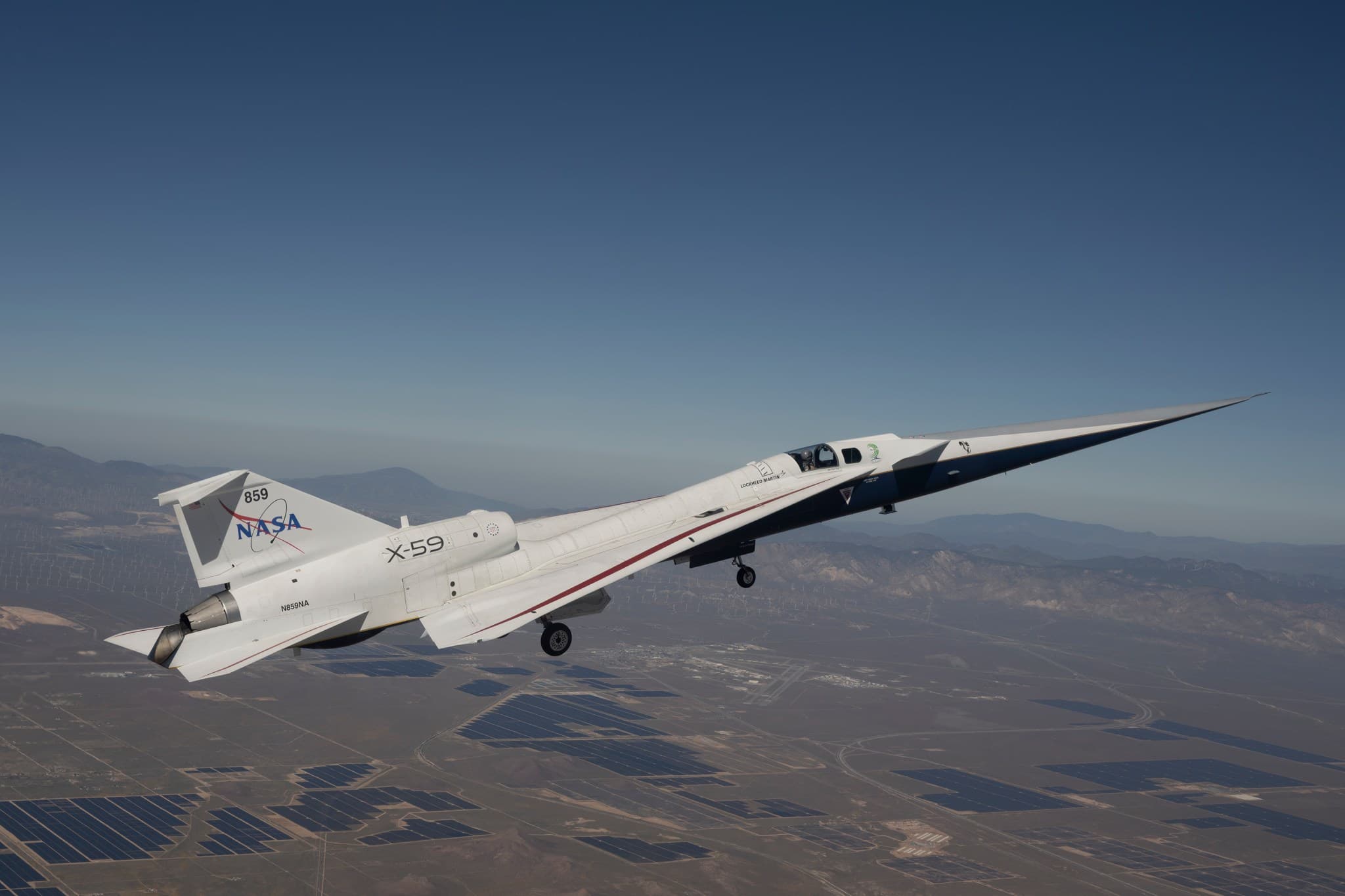
NASA's X-59 supersonic experimental aircraft completed its second flight on March 20, 2026, near the Armstrong Flight Research Center in Edwards, California. This flight marks the beginning of a series of dozens of test flights in 2026. Although the flight was cut short due to a technical issue, which turned out to be a false positive, the team was able to collect information that will shed light on future tests. The aircraft took off at 10:54 a.m. Pacific Time from Edwards Air Force Base, near the Armstrong Flight Research Center. A few minutes after takeoff, pilot Jim 'Clue' Less saw a vehicle system warning in the aircraft's cockpit. Following flight procedures, the aircraft landed at 11:03 a.m. after a call to return to base. 'Despite the early landing, it's a good day for the team. We collected more data, and the pilot landed safely,' said Cathy Bahm, project manager for NASA's Low-Boom Flight Demonstrator at the Armstrong Flight Research Center. 'We're looking forward to resuming flights as soon as possible.' The post-flight investigation revealed that the instrumentation on the indicator was incorrectly installed, resulting in a false positive for a problem. The team resolved the issue before the X-59's third flight. The X-59 is designed to fly at supersonic speeds, or faster than the speed of sound, while generating only a faint thunder-like noise instead of a loud sonic boom. The X-59 is at the heart of NASA's Quesst mission, which aims to make commercial supersonic flights over land a reality. The aircraft is expected to accelerate testing in 2026, demonstrating its performance and reliability through a process called envelope expansion, where it will fly increasingly faster and higher, toward supersonic speeds. This project is significant for the aviation industry, as it could pave the way for new types of faster and more efficient commercial flights. Aviation students, particularly those interested in supersonic aircraft, can closely follow the progress of this project and learn more about the challenges and opportunities associated with supersonic flight. The X-59 is an example of the innovation and creativity that characterizes the aviation industry. Aviation students can learn lessons from this project, particularly regarding the importance of safety, reliability, and performance in the design and development of aircraft.