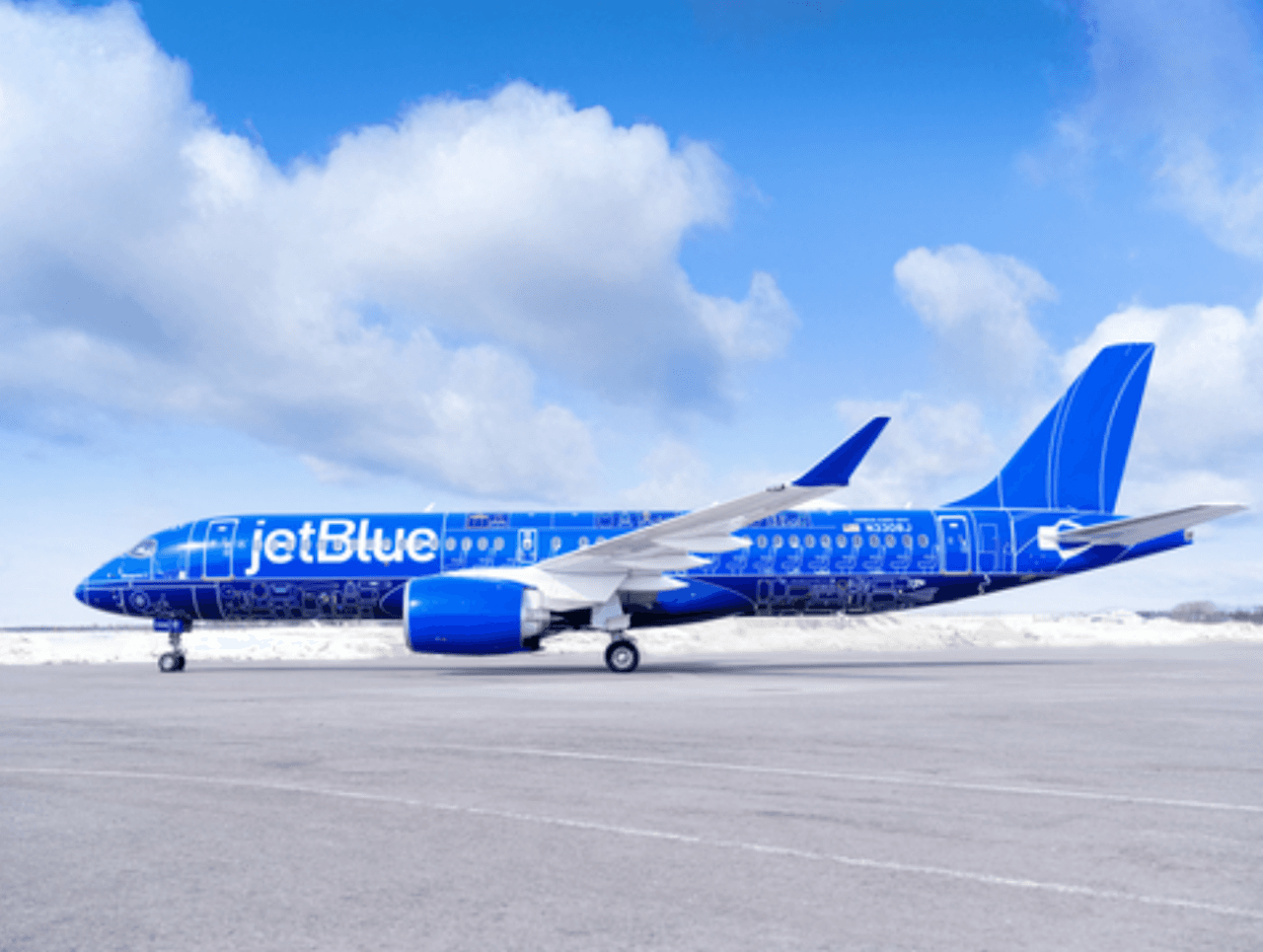
On May 15, 2026, JetBlue announced the commercial entry into service of 'Blueprint II,' a refreshed version of one of its most beloved special liveries, now applied to a brand-new Airbus A220-300. Originally introduced in 2017 on the Embraer E190, the 'Blueprint' design stood out for its transparent technical-schematic look, blending mechanical aircraft elements with everyday objects. Retired in 2024 as the E190s were phased out, it had achieved cult status among passengers and aviation enthusiasts alike.
**A richer, modernized livery**
With 'Blueprint II,' JetBlue reimagines the concept for the A220, now the backbone of its medium-haul fleet. The airline promises a more detailed and enriched design, incorporating symbolic elements tied to its history and network. Among the motifs visible on the livery: a giant teddy bear sitting in a passenger seat—a playful nod to customers—a crown evoking London, JetBlue's first European destination launched in 2021, a sextant in the cockpit referencing navigation history, and beach gear (fins, mask, snorkel, buoy) highlighting the importance of leisure destinations in JetBlue's network. The livery also includes numerous 'Easter eggs'—hidden details meant to be discovered by passengers and observers.
**The A220 at the heart of fleet strategy**
'Our aircraft liveries are an important expression of the JetBlue brand and the human experience we offer our customers,' said Marty St. George, President of JetBlue. 'Blueprint II pays homage to a design that has been appreciated for years, while celebrating personal journeys and the sense of discovery.' This initiative comes amid a fleet transformation. JetBlue completed the retirement of its Embraer E190s on September 9, 2025, becoming an all-Airbus operator. Its fleet now relies primarily on the A220-300 and A320/A321 families, the latter used on transatlantic routes to London, Paris, and Amsterdam. The A220 plays a key role, offering better fuel efficiency and a capacity suited for domestic routes and thinner international services.
**Why this matters for ATPL and ATC students**
For future pilots and air traffic controllers, this news goes beyond aesthetics. Understanding fleet composition—like JetBlue's shift from the E190 to the A220—is critical for operational planning, performance calculations, and type-specific procedures. The A220's advanced avionics and fly-by-wire system require specific training, and its fuel efficiency impacts range and payload decisions. ATC students should note how airline branding and fleet changes affect traffic patterns, slot allocations, and airport infrastructure. Moreover, the livery itself is a reminder that aircraft markings are not just decorative: they aid ground crew identification and can influence ramp operations. This real-world example shows how marketing, fleet strategy, and operational training intersect in modern aviation.