**A major milestone for the A330-300 P2F program**
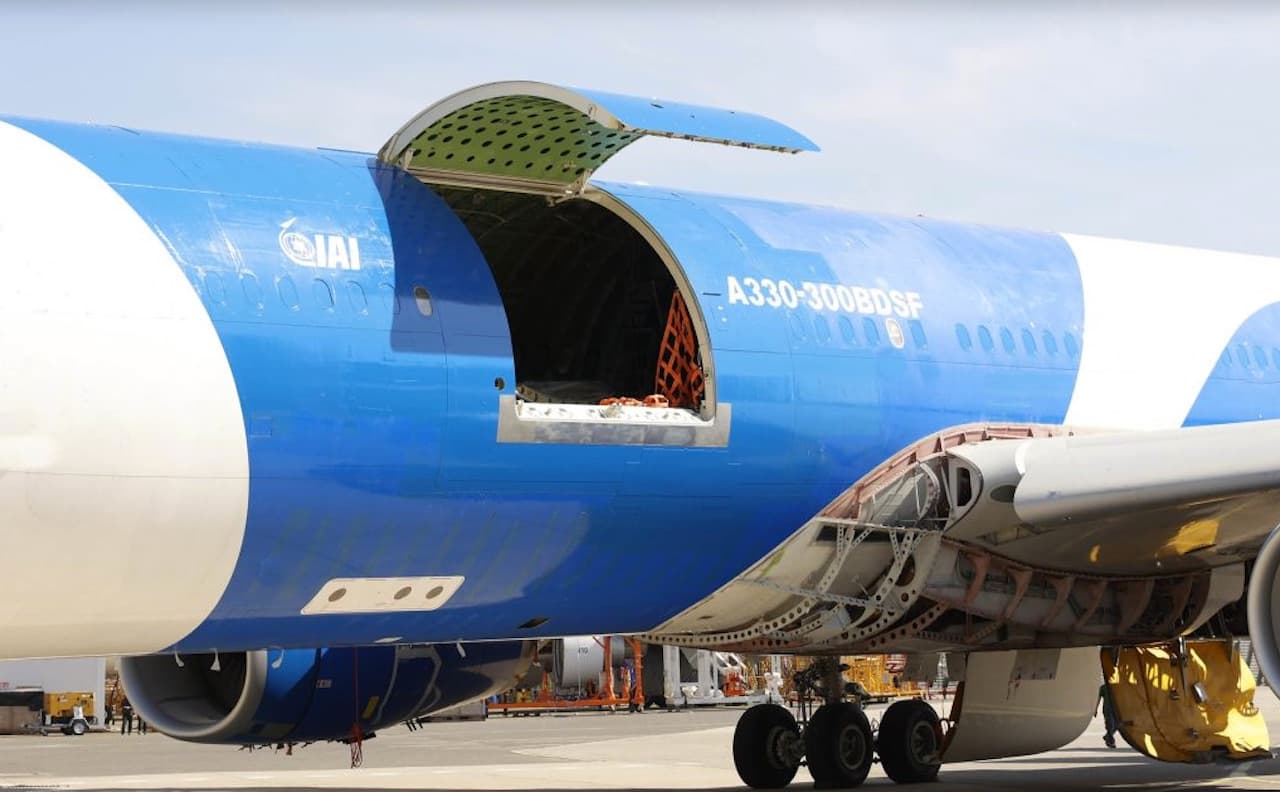
Israel Aerospace Industries (IAI) has announced a significant step in its passenger-to-freighter (P2F) conversion program for the Airbus A330-300. The prototype, identified as MSN1574, has been removed from the maintenance dock, marking the completion of primary structural work and the transition to ground and flight testing phases. According to the Israeli group, the first service entry of the A330-300BDSF is now expected within weeks, with a Supplemental Type Certificate (STC) targeted for the end of 2026. Boaz Levy, IAI's President and CEO, stated: "This milestone marks a new step in IAI's long-term vision to strengthen its presence in the air cargo market. By continuously evolving our technological and industrial capabilities, we can offer scalable and reliable solutions aligned with our customers' changing operational needs."
**Strategic positioning in the large P2F market**
IAI positions itself among a very select group of global players capable of performing complex P2F conversions on large aircraft, covering both Airbus and Boeing families. The group notably became the first manufacturer worldwide to obtain an STC for the Boeing 777-300ER passenger-to-freighter conversion, reinforcing its regulatory credibility with aviation authorities and major cargo operators. Yaacov Berkovitz, General Manager of IAI's Aviation Group, added: "This milestone demonstrates our ability to transform decades of experience and advanced expertise into lasting value for our customers. Our A330-300 P2F conversion has been designed to precisely meet market demand, offering a very competitive value proposition and strong commercial appeal."
**Technical characteristics of the A330-300BDSF**
The A330-300BDSF program targets the medium-haul and regional cargo segment, with capacity for up to 27 ULD pallets on the main deck and a total volume of approximately 560 m³. The prototype aims for a maximum payload of around 61 tonnes, with a range of about 3,500–3,600 nm (approximately 6,500–6,700 km) depending on load configurations. IAI emphasizes the advanced positioning of the main cargo door sill, which reduces loading/unloading times and optimizes ground operations. The solution relies on an automated handling system and optimized loading flow, elements that have become strategic for regular cargo operators and e-commerce platforms.
**A tight cargo market in the long term**
With continued growth in cargo traffic and e-commerce, cargo operators, airlines, and leasing companies are intensively seeking economical and quickly available P2F solutions. The large pool of aging A330-300 passenger aircraft provides an ideal reservoir to renew intermediate-generation cargo fleets, bridging the gap between 757/767s and brand-new B777 Freighters. IAI expects certification of its A330-300BDSF by the end of 2026, with actual deliveries potentially starting a few months after approval. The group has already signed framework agreements with players like Avolon, committing to up to 30 A330-300 P2F conversions between 2025 and 2028.
**A historical converter in the P2F market**
IAI claims over 45 years of experience in converting passenger aircraft to cargo, with recognized expertise across a wide range of civil models. The group is presented as one of the world's leading players in the sector, serving major cargo names such as Amazon, Gulfstream Aerospace, and DHL, according to its official communications. To date, IAI conducts advanced P2F programs on Boeing 767-200 and 767-300, as well as B737-700 and 737-800, while developing the A330-200 and A330-300. This portfolio diversity allows customers to combine narrowbody and widebody solutions around a single integrator, limiting supplier fragmentation and accelerating retrofit cycles.