**A landmark decision for UK aviation**
On 4 August, the Court of Appeal in London dismissed the last legal challenges against Gatwick Airport's Northern Runway Project, ending an eight-year saga of administrative procedures and judicial reviews. The project, valued at £2.2 billion (about €2.6 billion) and fully privately funded, will transform the existing northern runway—currently used only as a taxiway or for diversions—into a fully operational runway. This will allow daily simultaneous operations on two runways, increasing annual capacity to nearly 80 million passengers and adding up to 100,000 aircraft movements per year by the end of the decade.
The court rejected appeals from activist Peter Barclay and the group Communities Against Gatwick Noise Emissions (CAGNE), who argued that the government's approval was flawed, particularly regarding greenhouse gas emissions, non-CO₂ effects, the Jet Zero strategy, and wastewater treatment. The judges ruled that each ground of appeal was 'indefensible' and had no real prospect of success. They found no internal contradiction in the government's position that the project's climate impact, while 'moderately significant and adverse', would not prevent the UK from meeting its carbon budgets—provided compensatory measures are implemented elsewhere.
**What the project entails**
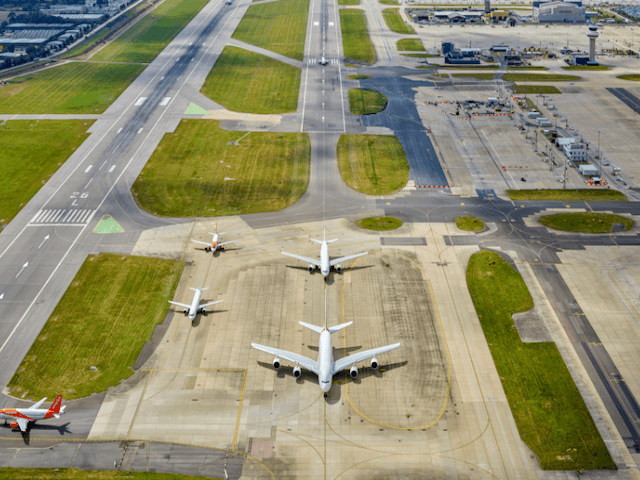
Unlike building a new runway from scratch, Gatwick's plan involves shifting the centreline of the existing northern runway about 12 metres north to meet separation standards for simultaneous operations. Currently, the two runways are too close together for normal joint use. The project also includes new taxiways, additional aircraft stands, hotels, offices, car parks, and upgrades to road and rail access. The first routine operations on two runways are expected around 2030.
**Impact on traffic and airlines**
Gatwick, the UK's second-busiest airport, handled 42.8 million passengers in 2025, a slight 1.1% dip from 2024, but with long-haul traffic up 3.3%. The airport serves 227 destinations with 57 airlines. With the new runway, capacity could reach 80 million passengers annually, up from the current 60–62 million potential. This means about 13 million extra passengers and up to 100,000 additional annual movements compared to the 261,000 flights recorded in 2024. The new capacity will primarily serve narrow-body aircraft on medium-haul routes, consistent with Gatwick's low-cost and leisure focus, with less than 5% transfer passengers versus about 23% at Heathrow.
**Why this matters for aviation training**
For ATPL and ATC students, this decision underscores the complex interplay between infrastructure expansion, environmental regulation, and operational planning. Understanding how runway separation standards, airspace design, and capacity calculations work is crucial. The legal and political dimensions also highlight the importance of regulatory frameworks like Jet Zero, which will shape future aviation operations. As Gatwick grows, it will create new opportunities for pilots and controllers, but also demand greater awareness of noise and emissions constraints. This case is a prime example of how aviation is not just about flying—it's about balancing growth with sustainability.