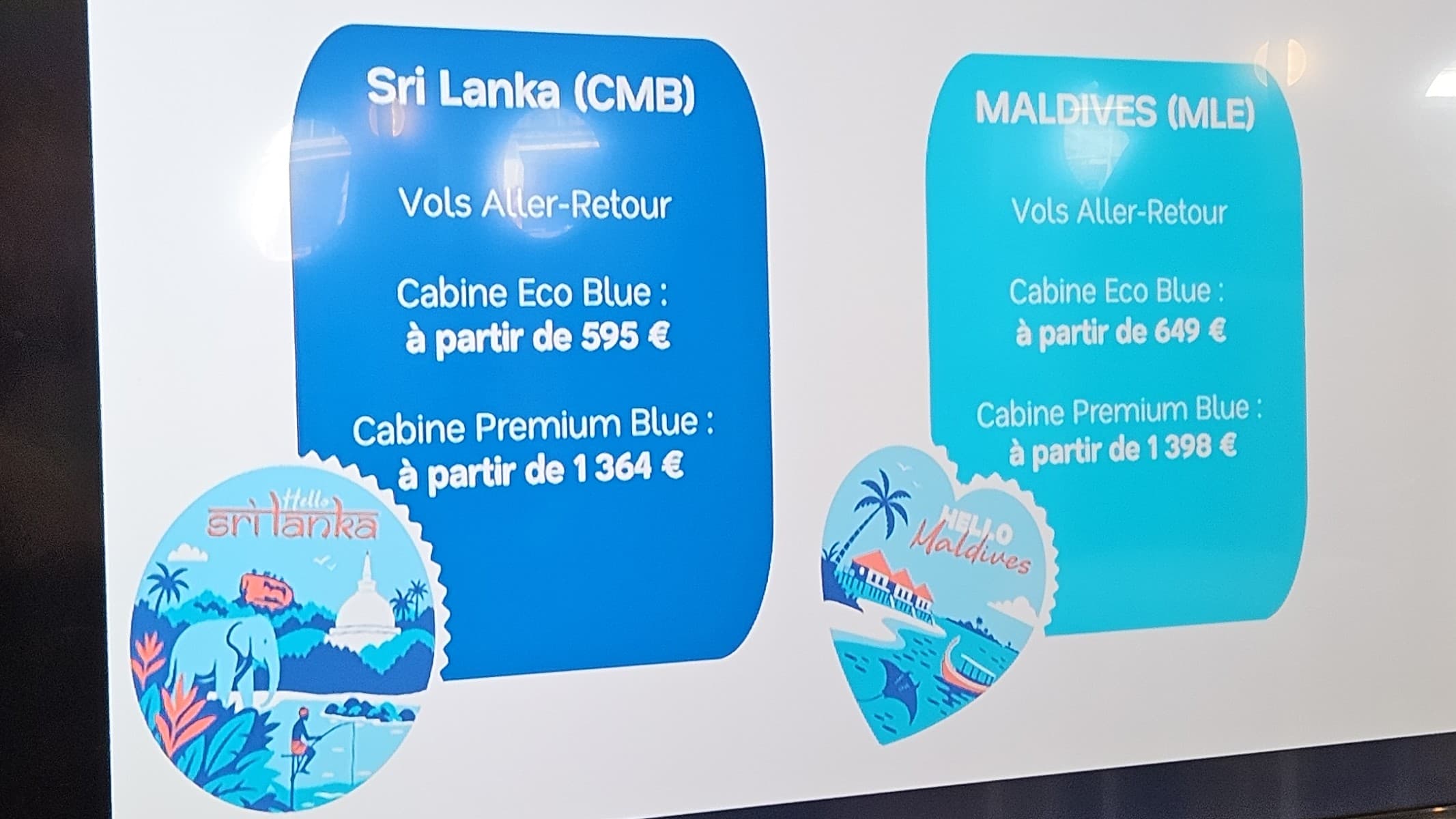
French Bee, the long-haul low-cost carrier of the Dubreuil group, is pivoting toward the Indian Ocean with a new triangular route connecting Paris-Orly, the Maldives, and Sri Lanka. The airline, which posted a net loss of €7 million in 2025 after a profitable 2024, aims to diversify its network and reduce dependence on the North American market, which has softened since the start of the Trump presidency. The seasonal service will run from December 19, 2026, to May 2, 2027, using an Airbus A350-900, with two weekly rotations initially, then evolving into direct flights from Colombo to Paris-Orly later in the season.
For ATPL and ATC students, this announcement is a textbook example of airline network strategy. The triangular routing—Paris-Orly → Malé → Colombo → Paris-Orly—is a clever way to serve two complementary tourist profiles: beach tourism in the Maldives and cultural/nature tourism in Sri Lanka. The schedule is built incrementally, starting with two weekly triangular rotations, then adding a direct Colombo–Paris leg, and finally shifting to two direct flights per week. This phased approach reflects real-world demand management and operational flexibility, key concepts in airline planning and dispatch.
From an ATC perspective, the route introduces new traffic flows into Malé (VRMM) and Colombo (VCBI), two airports that handle significant seasonal tourist traffic. Students should note the implications for slot coordination, airspace management, and the integration of low-cost carrier operations into busy holiday destinations. The use of the A350-900, an aircraft that was underutilized during the low winter season, demonstrates fleet optimization—a core topic in airline economics modules.
French Bee’s financial results also offer a cautionary tale. After a profitable 2024, the airline slipped back into the red in 2025, with a net loss of €7 million on revenues of €494 million (up 4% from 2024). The CEO attributes this to weaker US demand and rising fuel costs, which represent 25–30% of operating expenses. This highlights the vulnerability of long-haul low-cost models to external shocks—a theme often discussed in ATPL commercial knowledge and ATC economic regulation classes.
Finally, the airline’s decision to avoid Mauritius for now, despite earlier plans, underscores the importance of market analysis and risk assessment. For students, this case illustrates how airlines balance seasonal demand, fleet utilization, and geopolitical factors when designing networks. The triangular route to the Maldives and Sri Lanka is not just a commercial move—it is a strategic hedge against transatlantic uncertainty.