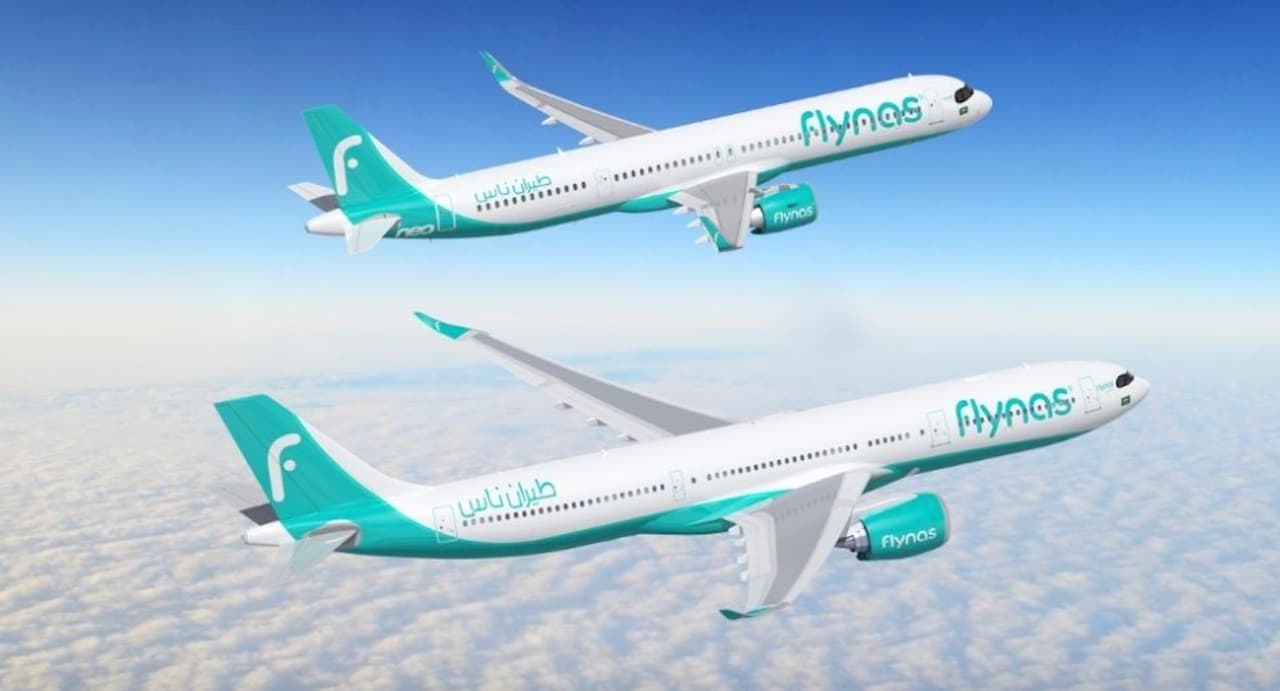
**Flynas expands its Airbus fleet with a new order**
On July 22 at the Farnborough Airshow, Saudi low-cost carrier Flynas confirmed an additional order for 25 Airbus aircraft, split between five A330-900s and twenty A321neos. According to Airbus, this order "further strengthens the strategic partnership between Airbus and flynas" and supports the airline's expansion on domestic, regional, and long-haul routes. With this new tranche, Flynas now has firm commitments for 20 A330neos and 56 A321neos, bringing its total Airbus order book to 235 firm aircraft out of a planned 280 orders. The airline's current all-Airbus fleet remains largely single-aisle, with 65 aircraft including four A330-300s, four A320ceos, and 57 A320neos.
**A fleet aligned with Saudi Vision 2030**
This order is not just about organic growth; it is part of Saudi Arabia's broader aviation strategy, which aims to make the country a global hub for tourism, transit, and pilgrimage. The General Authority of Civil Aviation (GACA) targets 330 million annual passengers and a network of over 250 destinations by 2030, in line with Vision 2030. Flynas plays a key role here, operating from multiple bases across the kingdom. CEO Bander Almohanna stated that the expansion will "support the continued growth of our six operational bases across the Kingdom and back the objectives of the Pilgrim Experience Program."
**A330-900 and A321neo: complementary aircraft**
Technically, the choice of Airbus is consistent. The A321neo, the largest member of the A320neo family, offers increased capacity and range on medium-haul routes while reducing fuel consumption and emissions by at least 20% compared to previous generations, according to Airbus. For Flynas, it is ideal for absorbing traffic growth on high-density routes from Saudi Arabia and its regional bases. The A330-900, meanwhile, gives the airline access to the long-haul segment with a next-generation twinjet. Airbus claims a range of up to 8,100 nautical miles (about 15,000 km) and a 25% reduction in fuel consumption and operating costs compared to previous-generation competitors. The aircraft is powered by Rolls-Royce Trent 7000 engines, a high-bypass turbofan designed specifically for the A330neo family.
**A low-cost carrier going upmarket**
The inclusion of the A330-900 in a low-cost carrier's order book is a notable marker. It reflects Flynas's evolving business model, which no longer limits itself to short- and medium-haul low-cost operations but now seeks to capture long-haul demand, including religious and tourist markets. This diversification is particularly striking given the airline's recent aggressive expansion of its A320neo fleet, which remains the backbone of its operations. Airbus, for its part, benefits from a particularly favorable commercial environment in Saudi Arabia, where air traffic development plans are accelerating. At Farnborough, Benoît de Saint-Exupéry praised the Saudi airline's loyalty and the relevance of both programs: "The A321neo and A330neo offer remarkable efficiency, performance, and passenger comfort, enabling airlines to grow sustainably while expanding their networks."
**Implications for ATPL and ATC students**
For ATPL students, this order highlights the growing demand for pilots trained on both narrowbody (A320 family) and widebody (A330) aircraft, as low-cost carriers increasingly operate mixed fleets. ATC students should note the impact on Saudi airspace: with Flynas expanding its six bases and the kingdom targeting 330 million passengers annually, traffic density will rise significantly, requiring advanced airspace management and coordination skills. The integration of long-haul operations by a low-cost carrier also introduces new operational challenges, such as crew scheduling and fuel planning, which are relevant to both pilots and controllers.