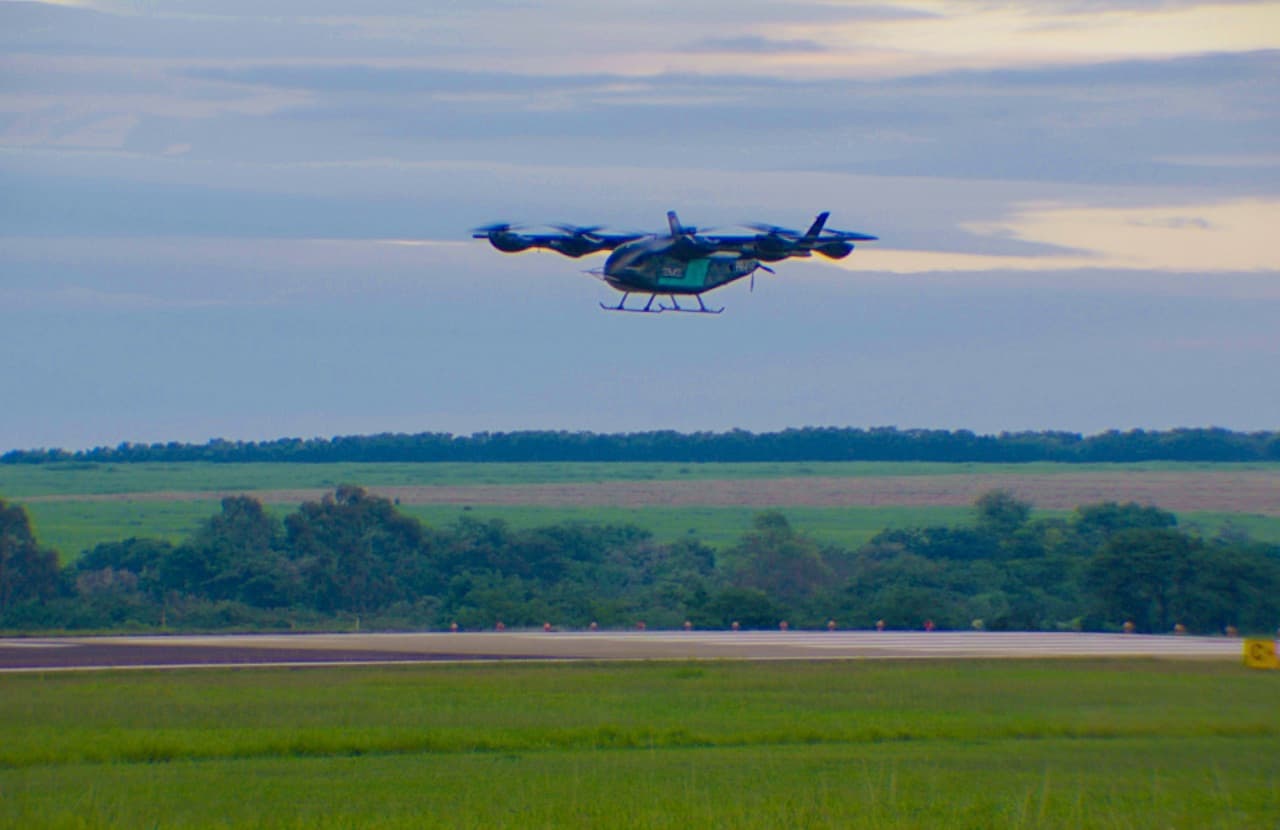
**Eve Air Mobility**, a subsidiary of Embraer, announced on July 22 two significant but convergent advances in the maturation of its eVTOL program, the Eve 100. First, Brazil's civil aviation authority, ANAC, opened a public consultation on updated airworthiness criteria specific to the aircraft. Second, Eve submitted a request to the European Union Aviation Safety Agency (EASA) for validation of the future type certificate in Europe. These announcements come alongside a partnership with the Florida Department of Transportation (FDOT) focused on the SunTrax Air testing site, aimed at preparing the operational integration of future eVTOL services.
**A certification dossier that is going global**
In Brazil, ANAC has opened a consultation until August 18 on a revised version of the airworthiness criteria applicable to the Eve 100. According to Eve, these adjustments aim for better harmonization with international approaches, including FAA guidance for hybrid-category aircraft—a key point for cross-recognition of technical requirements. The firm recalls that it formalized its type certificate application with ANAC in 2022, then initiated a parallel process with the FAA in 2023. Adding EASA to the mix confirms a certification strategy designed from the outset for multiple markets. Johann Bordais, CEO of Eve, praised "important demonstrations of the regular advancement of the Eve 100 certification process," while highlighting "close technical collaboration with ANAC" and "the commitment of major aviation authorities." On the ANAC side, its president Tiago Faierstein stated that "advanced air mobility is a strategic priority" and that Brazil intends to play a major role in "safe and harmonized" processes.
**Europe enters the loop**
The application filed with EASA marks an additional step in Eve's international validation strategy. In practice, the European agency does not certify a program from scratch: it validates a type dossier already established by the reference certification authority, following structured technical cooperation procedures. For Eve, this means opening initial technical exchanges and familiarization activities with EASA, before potentially heavier compliance demonstration steps. On the regulatory front, this sequence fits into an environment that has become clearer for eVTOL projects. The FAA published a dedicated advisory circular for hybrid aircraft in 2024, while EASA updated its special VTOL framework to bring transatlantic certification philosophies closer together.
**Florida as a testing ground**
In parallel, Eve Air Mobility announced a partnership with FDOT for an Advanced Air Mobility (AAM) initiative focused on SunTrax Air, Florida's testing center for advanced air mobility. The project aims to work on infrastructure, operational procedures, and airspace navigation—essential building blocks before commercial launch. SunTrax Air is presented by Florida as a research and validation hub designed to test technologies, operational concepts, and infrastructure associated with future eVTOL operations. "Florida recognizes its strategic role in the future of advanced air mobility," said Johann Bordais, adding that "successfully introducing a new mode of transport requires alignment between the aircraft, infrastructure, operations, and communities." Behind this formula lies one of the sector's major challenges: aircraft certification alone will not suffice without a network of vertiports, adapted ATM procedures, and local acceptance.
**An ambitious program continues**
Eve continues to present the Eve 100 as an aircraft destined for the global AAM market, with a certification dossier now articulated between Brazil, the United States, and Europe. The company has also strengthened its financing capacity over the past year, with new debt and capital contributions to support development through the certification phase. Eve claims approximately 2,700 commitments (letters of intent, conditional agreements, etc.) for its eVTOL from various operators worldwide. Of this total, the company has begun converting some intentions into about a hundred firm orders.