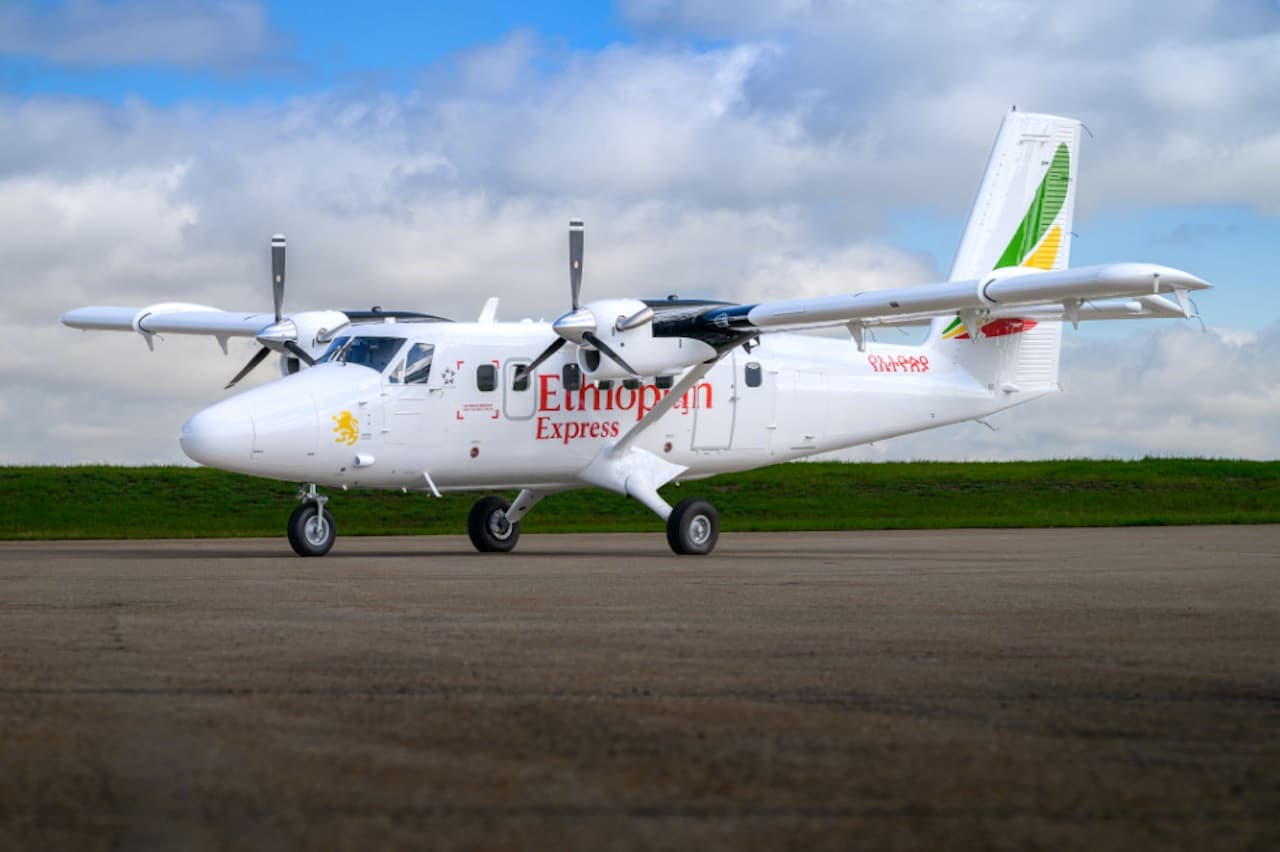
**Ethiopian Airlines Expands Domestic Reach with Twin Otter 300-G**
Ethiopian Airlines has taken delivery of its first DHC-6 Twin Otter Classic 300-G, a light turboprop renowned for its ability to operate on short and unpaved runways. The aircraft, delivered on June 22, 2026, in Addis Ababa, is the first of two ordered from De Havilland Aircraft of Canada. This acquisition is part of the carrier's strategy to strengthen its domestic network, particularly in remote regions and tourist destinations with limited ground infrastructure.
The Twin Otter 300-G is a modernized version of the legendary Twin Otter, retaining its STOL (Short Takeoff and Landing) capabilities while incorporating a Garmin G1000 NXi digital cockpit, lightweight seats, upgraded electrical systems, and improved payload capacity. It can carry up to 19 passengers or be configured for cargo and special missions such as aerial surveys, airport calibration, and medical evacuations. Ethiopian Airlines Group CEO Mesfin Tasew highlighted the aircraft's versatility, noting it will support charter flights, technical services, and public service missions.
**Why This Matters for ATPL and ATC Students**
For ATPL students, the Twin Otter 300-G represents a classic type rating opportunity. Its STOL performance and multi-role configuration are ideal for understanding operations in challenging environments, including high-altitude airports and short runways. ATC students will benefit from studying how such aircraft integrate into controlled airspace, especially when operating from non-towered or remote airstrips. The aircraft's advanced avionics, including the Garmin G1000 NXi, also provide a modern glass cockpit experience relevant to current airline operations.
**Broader Industry Context**
Ethiopian Airlines already operates a diverse fleet including 30 Boeing 787 Dreamliners, 11 Boeing 777s, 26 Airbus A350s, and 30 Dash 8 Q400 turboprops. The addition of the Twin Otter fills a niche for ultra-short-field operations, enabling the airline to serve communities that are otherwise isolated. This trend is growing across Africa, where operators are increasingly turning to rugged aircraft to improve regional connectivity. For aviation students, this highlights the importance of understanding regional aircraft performance and the operational challenges of serving remote areas.
**Conclusion**
The Twin Otter 300-G is more than just a new fleet addition; it is a tool for expanding access and supporting economic development. For those training to become pilots or controllers, it offers a real-world example of how specialized aircraft can solve unique operational problems. Studying its capabilities and missions will deepen your appreciation of the diversity within commercial aviation.