Emirates' Premium Economy class, introduced in December 2020 and launched commercially in August 2022 on London Heathrow and Sydney routes, has quickly become a cornerstone of the Dubai-based carrier's cabin strategy. The network has expanded in phases: 15 destinations by January 2024, over 84 scheduled by July 1, 2026, and 99 announced for the end of 2026. This growth is part of Emirates' largest fleet refurbishment program, a $5 billion investment covering 219 aircraft, including 110 Airbus A380s and 109 Boeing 777s, with the introduction of this new intermediate class between Economy and Business. Each A380 takes about 22 days of work, and each 777 about 18 days, with thousands of new parts per aircraft. The goal is a consistent cabin experience across the long-haul fleet. In 2026, the program accelerates further, extending to the 15 A380s previously operated in a two-class configuration. These are being converted to three-class layouts with the latest cabins (76 Business seats, 56 Premium Economy seats, 437 Economy seats). The first converted A380 entered service on April 14, 2026, on the Dubai-Amman route, followed by Dubai-Prague on June 1; all 15 are expected to be converted by November 2026. Meanwhile, Boeing 777s and Airbus A350s are also bringing Premium Economy to new destinations in Europe (Zurich, Dublin, Milan), North America (New York-JFK), Asia (Ho Chi Minh City, Hong Kong), and Africa (Entebbe), with a stated goal of 99 destinations by year-end.
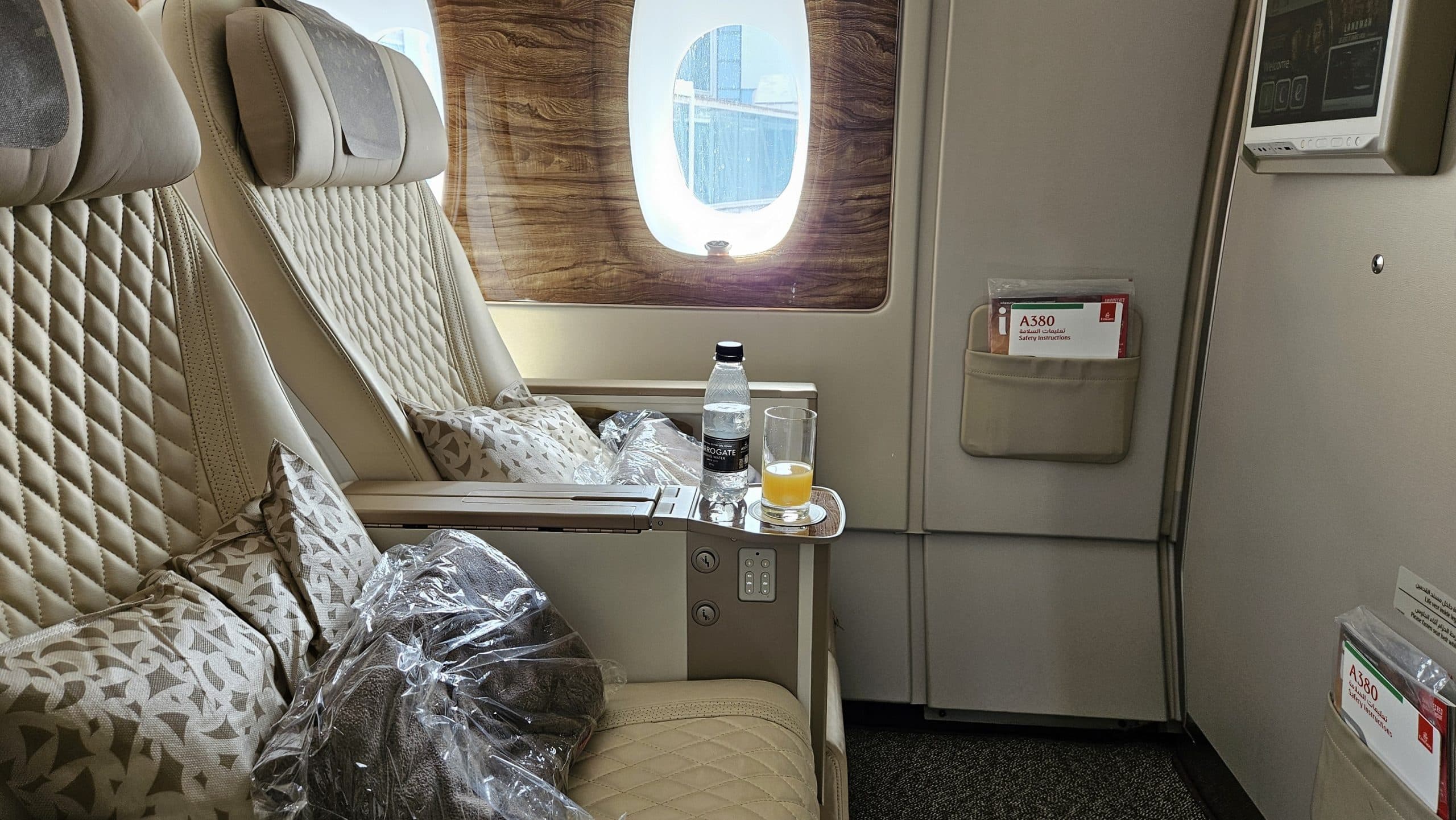
From France, Emirates currently offers Premium Economy on flights from Lyon-Saint Exupéry (one daily A350-900) and Nice-Côte d'Azur (one daily retrofitted A380). It plans to extend this to Paris-Charles de Gaulle (served by three daily flights). In this context, Air Journal's editorial team took advantage of a private trip to Thailand to test the product in real conditions: flying Paris-Bangkok via Dubai, they boarded Premium Economy on the Dubai-Bangkok route, flight EK372, operated by a four-class A380. Boarding at Dubai airport, the Premium Economy cabin is located at the front of the main deck, with 56 seats in a 2-4-2 configuration. The décor sets the tone: cream leather (stain-treated), warm wood finishes, and a sense of space rare for this class. The cabin, relatively new, is clean and bright, with a refined ambiance that clearly distinguishes it from Economy from the first moments. Premium Economy is separated from Economy by a physical space, serving as a crew office and meal preparation storage area, not just a curtain, enhancing the sense of privacy and comfort. Note that this front main deck 2-4-2 configuration applies to four-class A380s; two-class A380s being converted to three-class install Premium Economy on the upper deck in 2-3-2.
The seats, developed specifically for Emirates by German manufacturer Recaro (model PL3530), offer up to 40 inches (101.6 cm) of pitch and 19.5 inches (49.5 cm) of width. This is more generous in length than most competing Premium Economy classes, which typically offer 38 inches. The seat reclines 8 inches (20.3 cm), with adjustable footrests and calf rests, and a sliding headrest with side wings and six positions. In the air, the comfort is verified: legroom is generous, seat width appreciable, and support remains good during the roughly six-hour flight between Dubai and Bangkok. Very tall passengers might find the fixed footrest a bit short; they are advised to choose seat 35D or 35G, at the first row of the center block, which offer unobstructed legroom extending into the aisle.
Service begins at boarding with welcome drinks served in glassware—a touch that sets the tone. This level of care is also explained by the service organization: three crew members, including a supervisor, are dedicated exclusively to the Premium Economy cabin, unlike other airlines where Premium Economy and Economy are served by the same staff. The wine and spirits selection is refined for Premium Economy: Emirates often features Chandon Vintage Brut 2016, presented as a world exclusive for this class, but the wine list varies by route and season. On this flight, the red wine was Château Laroze 2014, a Grand Cru Classé from Saint-Émilion. The meal service itself is a true table service, with proper cutlery and china, elevating the experience beyond typical economy dining.
For aviation training students, this trend toward Premium Economy is significant. It reflects a broader industry shift toward cabin segmentation, which affects aircraft configuration, weight and balance calculations, and emergency procedures. Pilots and ATCs need to understand how different cabin layouts impact passenger flow, crew coordination, and operational decisions. For ATPL students, knowing the specifics of a major carrier like Emirates helps in understanding fleet planning and the commercial pressures that drive aircraft modifications. For ATC students, it's a reminder that airlines are constantly evolving their products, which can affect traffic patterns and airport infrastructure demands. This article provides a concrete example of how a cabin class can shape an airline's strategy, from network planning to onboard service, and why staying informed about such developments is part of professional aviation knowledge.