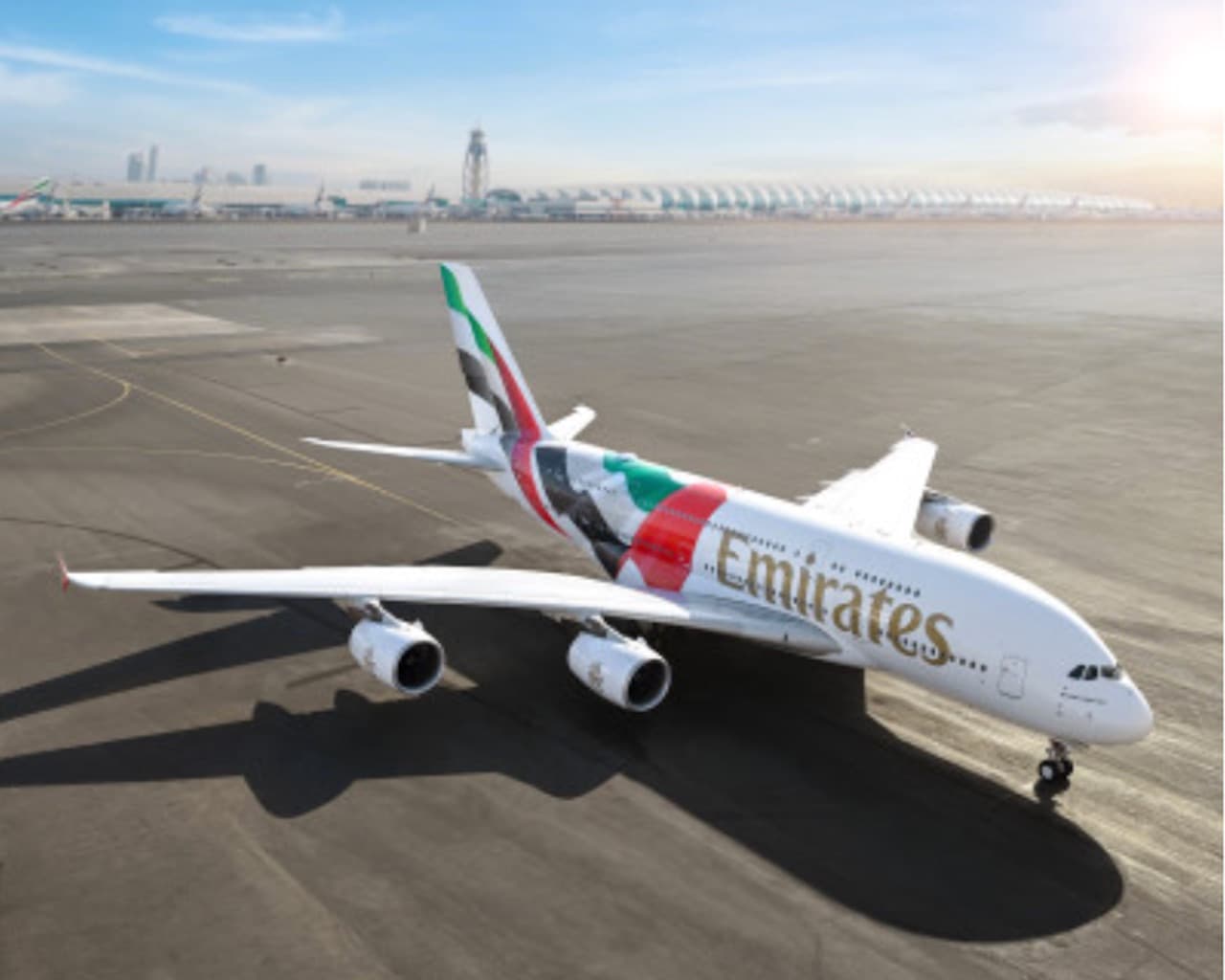
Emirates has announced that from October 25, its daily flight EK512/513 between Dubai and Delhi will be operated by an Airbus A380 in a four-class configuration (First, Business, Premium Economy, and Economy). This makes Delhi the third Indian destination to receive the superjumbo after Mumbai and Bengaluru, where the A380 already serves certain frequencies. The move is part of a broader push to upgrade the passenger experience across the Indian market, a key strategic region for the Dubai-based carrier.
Alongside the A380 deployment, Emirates is rolling out its Premium Economy cabin to six Indian cities: Delhi, Mumbai, Bengaluru, Ahmedabad, Kolkata, and Kochi. The product features cream leather seats with up to 40 inches of pitch, 19.5 inches of width, and 8 inches of recline, arranged in a 2-4-2 layout on the A380's main deck. Passengers also get refined dining with porcelain tableware, a 13.3-inch personal screen, and dedicated amenity kits. By the end of October, Premium Economy will be available on nearly half of Emirates' weekly flights to India, including 22 weekly departures from Mumbai, 12 from Kolkata, and 9 from Ahmedabad.
For ATPL and ATC students, this news is a practical illustration of several key concepts. First, it demonstrates how airlines use fleet assignment to match capacity with demand on high-density routes—the A380 is ideal for Delhi, a major hub with strong traffic flows. Second, the introduction of Premium Economy shows how carriers segment the market to capture revenue from passengers willing to pay more than economy but less than business class. This is a classic example of yield management and product differentiation. Third, the retrofit program for Boeing 777s and the introduction of new A350s highlight the importance of fleet modernization and lifecycle management in aviation.
Emirates currently serves nine Indian cities with 167 weekly flights, all restored to pre-pandemic levels since 2022. The airline is investing over $2 billion in cabin upgrades, including retrofitting more than 120 A380s and 777s, new menus, and enhanced entertainment systems with over 6,500 channels, including Bollywood and regional Indian content. This commitment reflects the intense competition on the India-Gulf routes, where Gulf carriers and Indian airlines vie for a growing base of business travelers, diaspora passengers, and premium leisure clients.
From an ATC perspective, the introduction of the A380 at Delhi requires coordination on ground handling, parking stands, and airspace management, as the superjumbo has specific operational requirements. Students should note how airports adapt infrastructure to accommodate larger aircraft, a topic often covered in airport planning modules. Overall, this development offers a rich case study in commercial aviation strategy, fleet planning, and market analysis—all relevant to ATPL and ATC training.