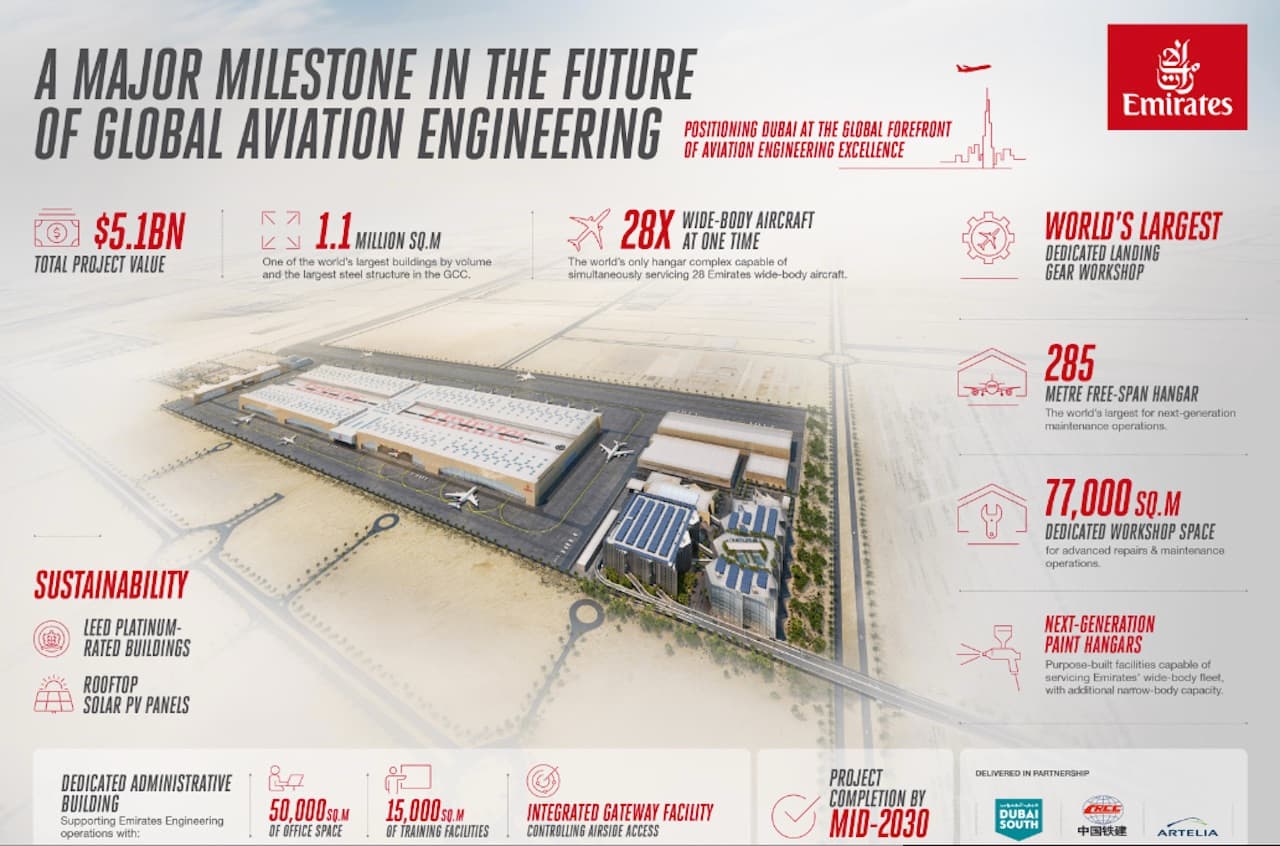
Emirates has officially broken ground on a $5.1 billion aircraft engineering center at Dubai South, near Al Maktoum International Airport (DWC). Promising to be the world's largest MRO (maintenance, repair, and overhaul) facility, it will simultaneously accommodate up to 28 wide-body aircraft. This strategic project is designed to support Emirates' growth and its expanding long-haul fleet, including orders for the Airbus A350 and Boeing 777X.
For ATPL and ATC students, this development is far more than a corporate announcement. It signals a massive shift in the global aviation maintenance landscape. The facility, covering 1.1 million square meters, will include the world's largest free-span hangar (285 meters wide), a dedicated landing gear workshop, 77,000 square meters of technical workshops, and two paint hangars. This concentration of industrial capacity on a single site will create thousands of jobs and training opportunities, directly impacting career paths in aviation maintenance and engineering.
From an ATC perspective, the expansion of Al Maktoum Airport (DWC) into a global hub means increased traffic complexity. Students studying air traffic management should note that Dubai South is being developed as an integrated aviation ecosystem, with the MRO center as a key component. The airport's capacity is expected to eventually surpass Dubai International (DXB), requiring advanced airspace management and coordination skills. Understanding the infrastructure behind such growth is crucial for future controllers.
The project, awarded to China Railway Construction Corporation (CRCC) with Artelia as consultant, also highlights the growing economic ties between the UAE and China. It targets LEED Platinum environmental certification, incorporating solar panels and high energy efficiency standards. Construction is expected to be completed by mid-2030, with the site initially handling heavy maintenance and overflow from Emirates' current center at DXB.
For ATPL students, this means that by the time they are flying for major carriers, they will be operating aircraft maintained in state-of-the-art facilities. The fleet renewal with A350s and 777Xs will require specialized MRO capabilities, and understanding these technical aspects is part of a pilot's broader knowledge. ATC students, meanwhile, should watch how DWC's growth reshapes regional air traffic patterns, potentially affecting training scenarios and exam questions on airport operations and airspace design.