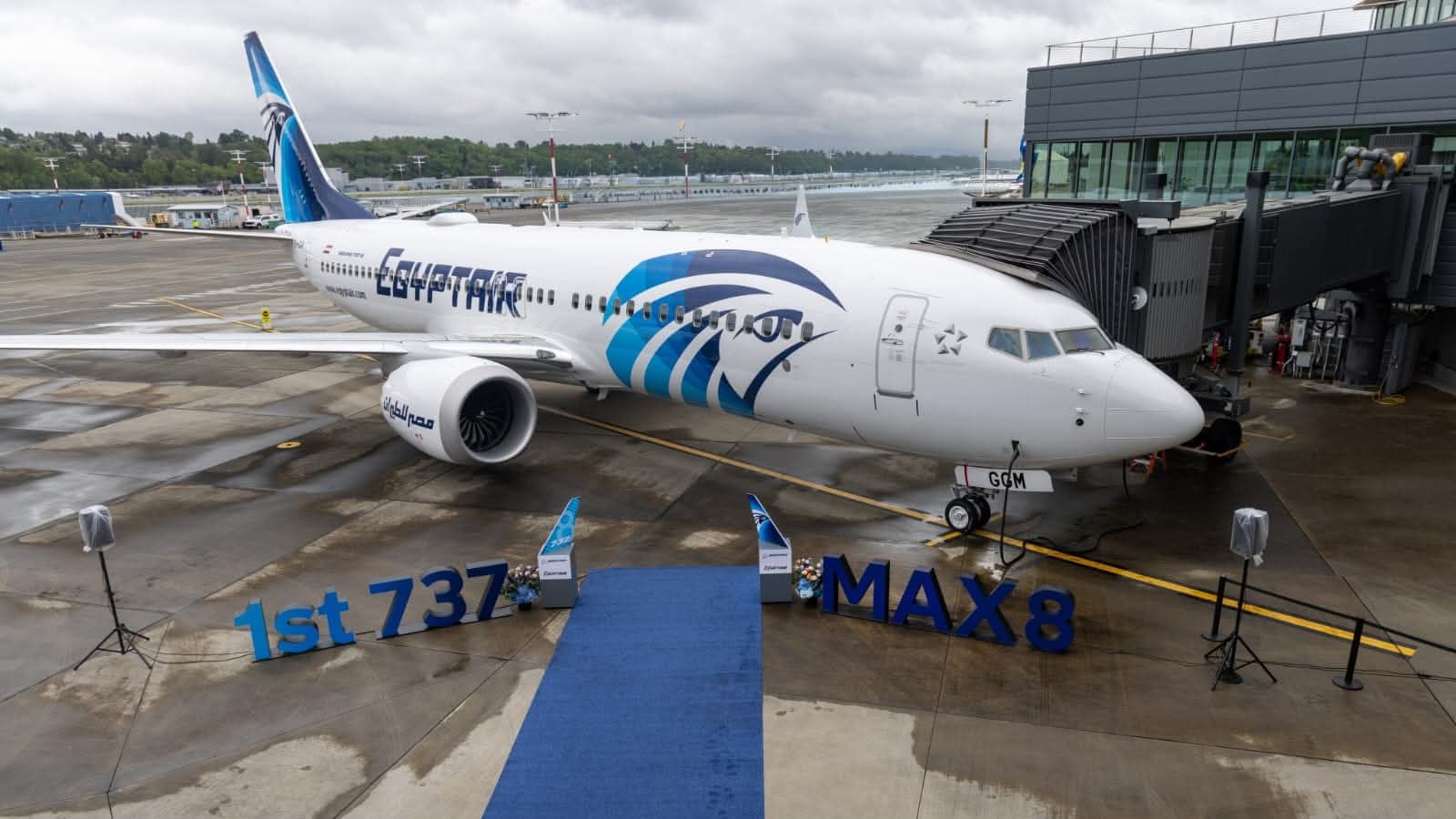
On May 2, 2026, EgyptAir took delivery of its first Boeing 737 MAX 8, registration SU-GGM, at Cairo International Airport after a ferry flight from Seattle via Reykjavik. This marks the entry of the 737 MAX into Egyptian service and the beginning of a fleet renewal program that will see 18 of these aircraft join the national carrier over the coming years. The aircraft is leased from Irish-Japanese lessor SMBC Aviation Capital.
**Why this matters for aviation students**
For ATPL and ATC trainees, this delivery is a textbook example of fleet modernization strategy. EgyptAir currently operates 30 Boeing 737-800s, and the MAX 8 brings a 20% reduction in fuel consumption and CO2 emissions per seat compared to its predecessor. Understanding the operational and economic rationale behind such transitions is crucial for future airline managers and pilots. The MAX 8 shares high commonality with the 737-800, meaning pilots can transition with relatively short differences training—a key concept in airline operations.
**Network and operational impact**
EgyptAir plans to deploy the new MAX 8s on short- and medium-haul routes to Europe and the Middle East, including Paris, Brussels, Istanbul, and Vienna. This fleet addition comes after the airline sold its 12 Airbus A220-300s in early 2024 due to Pratt & Whitney GTF engine issues and capacity mismatch. The fleet now also includes 15 A320neos, 5 Boeing 777s, 8 787-9 Dreamliners, and 2 Airbus A350-900s (with 6 more due in 2026). For ATC students, the introduction of a new aircraft type means updated performance data, wake turbulence categories, and noise profiles—all factors that affect separation standards and airport planning.
**A 60-year partnership continues**
Boeing’s vice president for Africa, Anbessie Yitbarek, highlighted the 60-year partnership with EgyptAir, emphasizing that the MAX offers the efficiency, range, and passenger comfort needed as airlines expand. For ATPL students, this delivery underscores the importance of aircraft performance knowledge: the MAX 8’s range and fuel efficiency directly influence route planning, payload calculations, and operational decision-making. The gradual phase-in of new types also illustrates fleet planning concepts taught in ATPL theory.
**Training implications**
EgyptAir pilots will undergo type rating training on the 737 MAX, which includes differences training from the 737 NG. This is a practical example of how airlines manage pilot qualifications and recurrent training—a topic central to ATPL and ATC curricula. The MAX’s advanced avionics and fly-by-wire spoiler system also introduce new systems knowledge requirements.