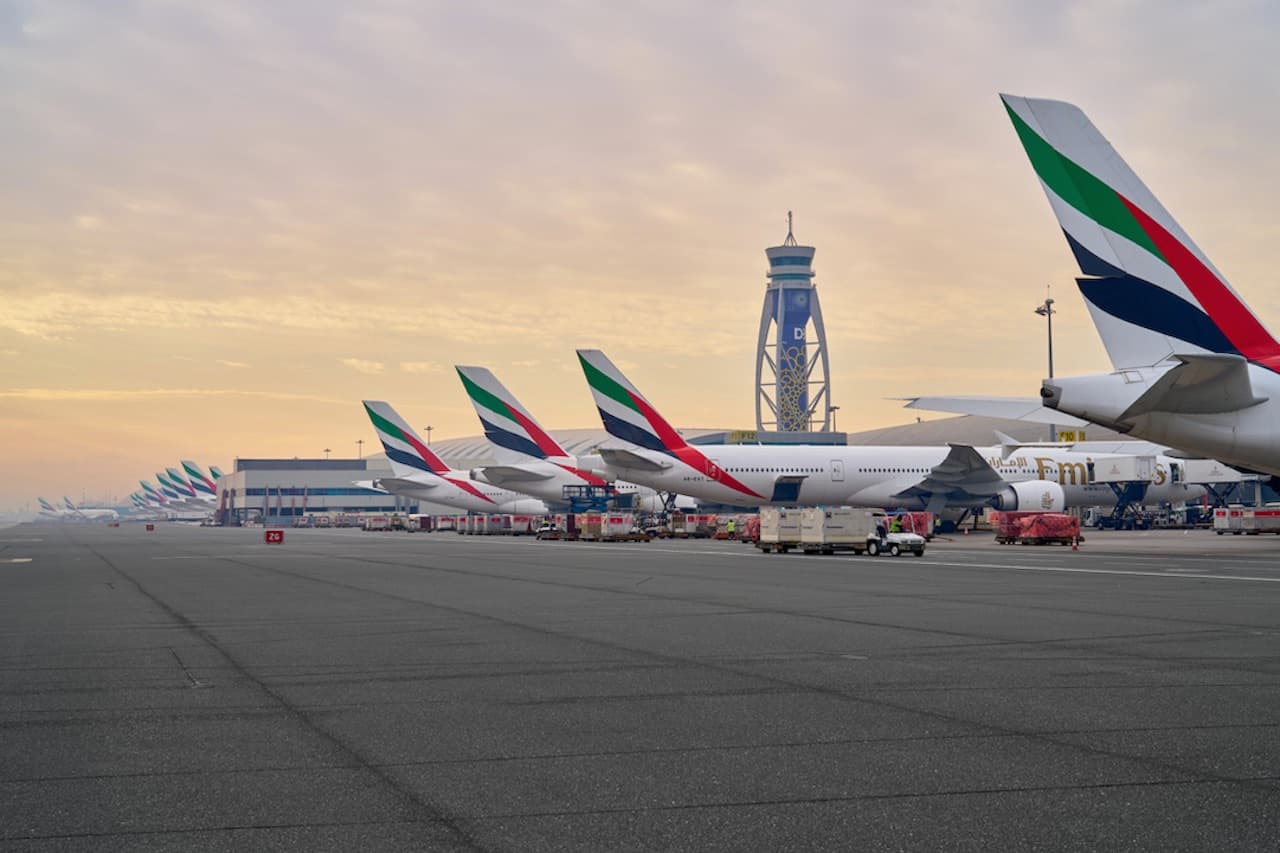
**Dubai International Airport (DXB) has navigated a severe regional airspace crisis without major operational disruption, and is now preparing for a traffic rebound as restrictions over the United Arab Emirates are lifted.** The airport handled 18.6 million passengers in Q1 2026, a 20.6% year-on-year decline, with March alone seeing a 65.7% drop to 2.5 million travelers. Despite these figures, DXB confirmed its role as a critical hub for connecting traffic between Europe, Asia, and Africa, positioning itself to capture the expected demand recovery.
**The crisis began on February 28, 2026, with partial closures of Middle Eastern airspace, forcing carriers to reroute or reduce operations.** DXB remained operational throughout, adapting schedules, passenger flows, and ground operations in real time. By April 30, the airport had safely processed 6 million passengers, over 32,000 aircraft movements, and 213,000 tonnes of essential cargo. This resilience was achieved through close coordination between Dubai Airports, home carriers Emirates and flydubai, international airlines, ground handlers, and air traffic control authorities, united under the "oneDXB" community framework.
**With the lifting of all precautionary measures over UAE airspace, Dubai Airports has entered a new operational recovery phase.** The operator is gradually increasing daily movements and supporting airlines in restoring schedules as neighboring airspace routes reopen. Paul Griffiths, CEO of Dubai Airports, emphasized the unprecedented nature of the event for a major hub like DXB, noting that 22.4 million transfer passengers pass through DXB annually—one-third of all transfer traffic across Gulf hubs. He stressed that maintaining DXB's functionality was crucial for global travel continuity and that the collective response has strengthened the airport's rapid adaptation capabilities.
**For ATPL and ATC students, this case study highlights the complexity of managing a major international hub during airspace disruptions.** Understanding how airspace closures affect flight planning, slot coordination, and passenger flow is essential. The crisis demonstrates the importance of contingency planning, real-time decision-making, and multi-stakeholder collaboration—skills directly relevant to both pilots and controllers. The recovery phase also illustrates how route reconfiguration and capacity management are handled when restrictions are lifted, a scenario that may appear in operational exams or real-world situations.
**The strategic importance of DXB as a transfer hub is underscored by its market share: of the 99.3 million global transfer passengers whose itineraries could transit the Middle East, the region captures about 70%, with DXB alone handling 32% of that flow.** Competitors like Doha, Abu Dhabi, and Riyadh are vying for market share, making DXB's ability to remain operational a strategic advantage. The hub-and-spoke model of Emirates, connecting Europe, Africa, Asia, and Oceania via Dubai, remains central to this positioning. Cargo volumes also suffered, with 399,600 tonnes handled in Q1 (down 22.7%), and aircraft movements fell 20.8% to 88,000. Baggage mishandling rates rose to 3.5 per 1,000 passengers from 1.95 a year earlier, but remained below the global average. This data provides valuable insights into operational metrics that ATPL and ATC students may encounter in performance analysis or incident reviews.