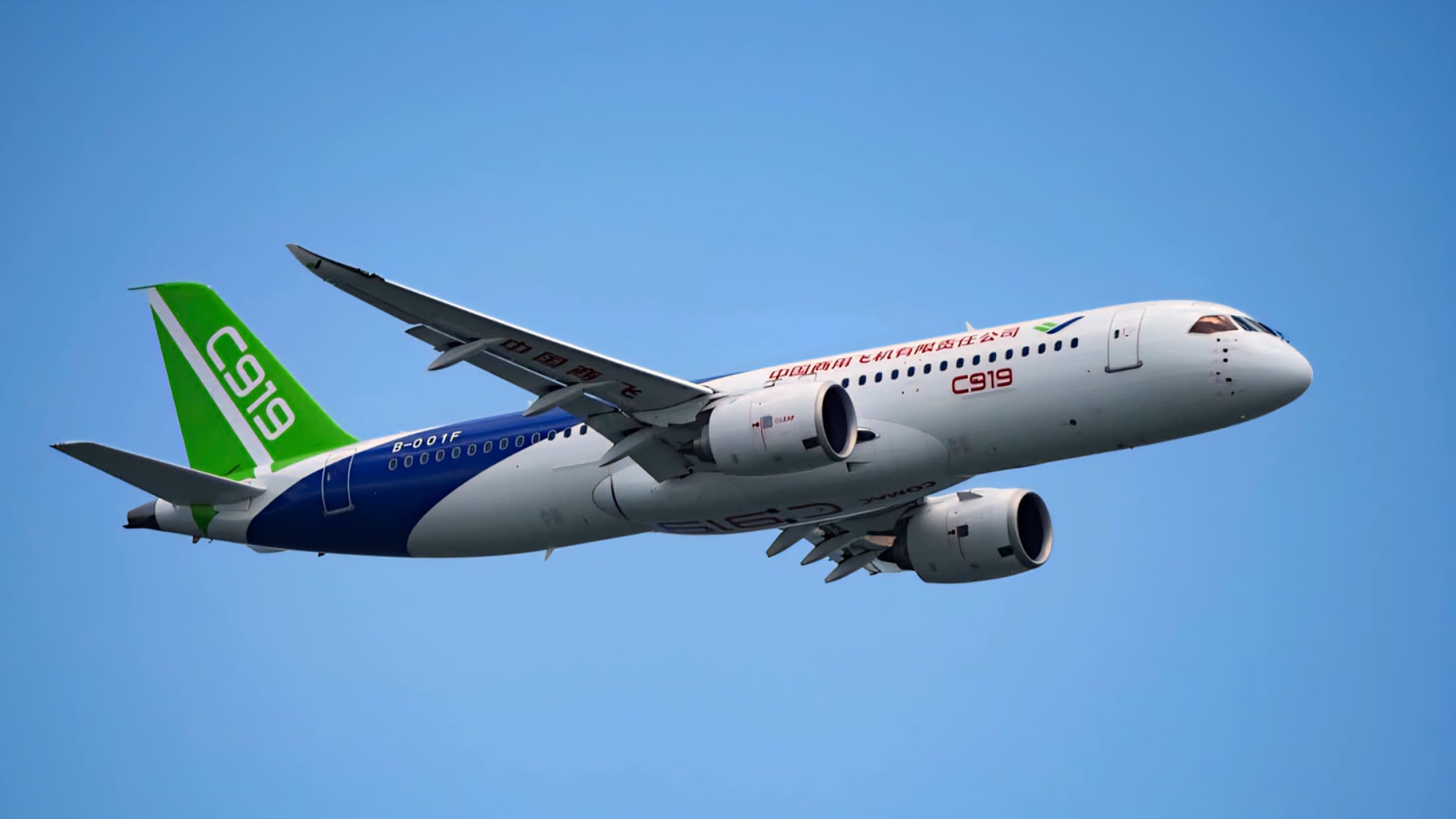
China is intensifying its strategy to protect the C919 airliner program from potential Western sanctions, while simultaneously planning a cabin overhaul to bring its narrowbody closer to the comfort standards of the Boeing 737 MAX and Airbus A320neo. A reference document signed by engineer Zhang Yanzhong, a key figure in the program, advocates for a nearly fully domestic supply chain, while Comac is already working on larger overhead bins, improved air conditioning, and various cabin refinements to appeal to Chinese passengers.
The C919 is the centerpiece of Beijing's strategy to reduce the country's dependence on the Boeing-Airbus duopoly in the 150- to 190-seat narrowbody segment. Certified by China's civil aviation authority in 2022, the aircraft began commercial flights in 2023, primarily with China Eastern, and has since joined the fleets of Air China and China Southern. According to data from China's Ministry of Transport, 37 C919s had been delivered by the end of 2025, serving over 20 cities and carrying approximately 4 million passengers in three years. Comac claims performance close to that of the A320neo and 737 MAX, with a maximum capacity of 168–190 seats depending on configuration, a range of 4,000 to 5,500 km, and a slightly wider fuselage than its competitors, offering some flexibility in cabin comfort.
Three years after the C919 entered service, the novelty effect of China's first narrowbody is fading, and criticism is now focusing on the cabin. According to an anonymous source cited by the South China Morning Post, Comac acknowledges that the passenger experience is one of the aircraft's weak points compared to Western narrowbodies, particularly regarding overhead bin capacity. "Comac has realized it needs to make the C919 as comfortable as possible, now that the novelty effect of the national jet has faded and criticism is emerging about the cabin experience," the source said. Among the improvements under study are larger overhead bins and anti-drip air conditioning nozzles to reduce condensation issues sometimes observed on board. Current C919 overhead bins are smaller than those on the A320neo or 737 MAX, often forcing crews to ask passengers to check in cabin-sized suitcases, a major irritant on high-density domestic Chinese routes. Comac is considering leveraging the slightly wider fuselage to allow suitcases to be stored "on edge," like books on a shelf, rather than flat, which would significantly increase capacity without excessively adding weight.
The manufacturer wants to keep bins positioned lower than on Western aircraft to suit the average height of Chinese passengers and facilitate access to individual controls—reading lights, ventilation adjustments. This approach illustrates Comac's desire to develop ergonomics specific to its domestic market while aiming to offer a perceived comfort level comparable to international standards. Other improvements are mentioned: larger tray tables, thicker and more ergonomic seat backs, and a possible upgrade in comfort equipment. Comac intends to retain certain appreciated features, such as large windows, ambient LED lighting with color gradients, slightly wider center seats, and more generous galleys and lavatories. Customer airlines could also have an expanded catalog of options: charging ports at every seat, individual in-flight entertainment screens with remote controls, or even custom premium mini-cabins for major Chinese airlines or, later, potential foreign operators.
Beyond the cabin, the C919 remains constrained by several structural issues: modest production capacity, engine-related delays, and a lack of certification in Europe or the United States. Comac aimed for a production rate of several dozen C919s per year by 2025, but supply chain pressure and difficulties in stabilizing ramp-up have led to revised targets, with about 25 deliveries planned according to industry sources. The program's core vulnerability lies in the Leap-1C engine, developed by CFM International, a joint venture between American GE Aerospace and French Safran. In 2020, this engine experienced a "supply disruption crisis," resolved thanks to a temporary export license from the U.S. side, highlighting Comac's extreme dependence on a critical component subject to export control regimes. Commercially, the C919 remains confined to the Chinese domestic market and a few Beijing-linked clients, lacking certification from the U.S. FAA or European EASA. Comac has initiated technical dialogue with EASA for type recognition, but the Sino-American trade war, technological tensions, and safety requirements make any progress slow and uncertain. Without Western certification, the aircraft is effectively excluded from the most lucrative markets—Europe, the Americas, and parts of Asia.
For ATPL and ATC students, the C919's evolution is a case study in how geopolitical factors and supply chain dependencies shape aircraft development and certification. Understanding these dynamics is crucial for future pilots and controllers who may encounter the C919 on international routes or in training scenarios, especially as China pushes for global recognition of its aviation standards.