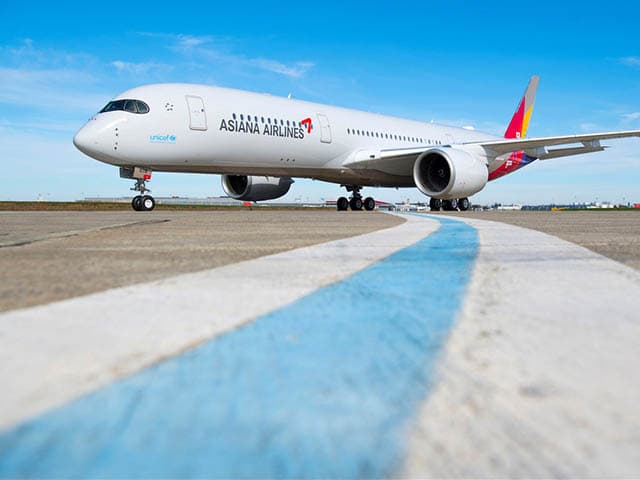
Budapest Airport has experienced significant development with the arrival of Asiana Airlines, which inaugurated a new direct route between Seoul and Budapest on April 3, 2026. This new route complements the existing offer from Korean Air and brings the total number of weekly seats between the two capitals to over 2,000. This expansion illustrates Budapest Airport's strategy to position itself as a major gateway between Central Europe and Asia. Asiana Airlines operates this new route twice a week, with the inaugural flight taking place on April 3, 2026, using an Airbus A350-900, a state-of-the-art aircraft renowned for its energy efficiency and cabin comfort on long-haul flights. The distance between the two cities is approximately 8,130 km, confirming the status of this new service as a true long-haul route. The scheduled flight times allow for optimized connections from Incheon hub to the rest of Asia, meeting the needs of both business and leisure travelers seeking smooth connections to China, Japan, or Southeast Asia. The arrival of Asiana Airlines is part of a landscape already marked by the presence of Korean Air, which has been offering a direct route between Budapest and Seoul for several years. Together, the two airlines now offer over 2,000 weekly seats and almost daily non-stop access between Hungary and South Korea. According to data published by the airport, the South Korean market has become the third long-haul market for Budapest, with nearly 100,000 annual passengers on direct flights and around 50,000 on connecting flights. This new route strengthens economic and cultural ties between Hungary and South Korea and provides more options for business and leisure travelers. For Asiana Airlines, the Hungarian capital becomes the ninth European destination in its network, joining Paris, Frankfurt, Rome, London, Istanbul, Barcelona, Prague, and Milan. The arrival of Asiana consolidates the developing Asian network at Ferenc-Liszt Airport, with eight destinations in the Far East: Beijing, Xi'an, Ningbo, Seoul, Shenzhen, Shanghai, Guangzhou, and Chongqing. This expansion is important for aviation students, as it reflects the growth of international air traffic and the need for pilots and air traffic controllers to understand market dynamics and airline strategies. Knowledge of these trends is essential for future aviation professionals, as it will enable them to better understand the challenges and opportunities in the sector. Finally, the use of state-of-the-art aircraft like the Airbus A350-900 on these long-haul routes highlights the importance of continuous training and skill updates for pilots to master advanced technologies and ensure the safety and efficiency of flights.