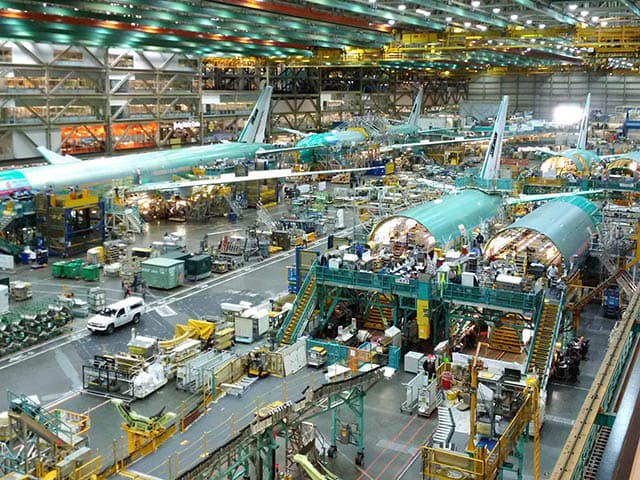
Boeing has officially launched a new 737 MAX assembly line at its Everett facility near Seattle, marking a significant expansion of its single-aisle production capacity. The line, dubbed "North Line," is a replica of the three existing lines at Renton and is housed in what Boeing calls "the largest building by volume in the world." This move comes as the manufacturer aims to increase production from approximately 42 to 47 aircraft per month in the short term, with a target of 52 per month by 2027, and studies a potential ramp-up to 70 per month—a level never before achieved for the 737 program.
The decision to repurpose space at Everett, historically dedicated to wide-body programs like the 747, 767, 777, and 787, reflects a strategic pivot toward single-aisle production. The end of 747 production and the consolidation of 787 assembly in South Carolina freed up vast areas. Boeing emphasizes that the North Line will initially focus on the 737-8, 737-9, and 737-10 variants, using a new "737 Wing Transport Tool" to move partially assembled wings from Renton to Everett for final assembly.
Crucially, the ramp-up is tightly controlled by the Federal Aviation Administration (FAA) following recent safety incidents. Boeing is operating under strict oversight, with the North Line starting in "low rate initial production" (LRIP) mode to allow for extensive quality checks and process adjustments. Jennifer Boland-Masterson, production manager for the Everett line, compared it to running: "You know how to do it, you've done it before, but you need to warm up the muscles. You don't start with a marathon." The first aircraft built at Everett will be used to demonstrate compliance with Boeing's PC700 production certificate, a prerequisite for full integration into the 737 MAX program under FAA supervision.
For ATPL and ATC students, this development is directly relevant. An increase in 737 MAX production means more aircraft entering service worldwide, which will affect fleet planning, pilot demand, and air traffic density. Understanding production rates helps future pilots and controllers anticipate changes in traffic patterns, maintenance schedules, and operational pressures. Moreover, the emphasis on quality control and regulatory oversight underscores the critical importance of safety culture in aviation—a theme that runs through every aspect of ATPL and ATC training.
Boeing's move also intensifies the competitive battle with Airbus on the single-aisle market. Airbus is targeting production rates exceeding 75 A320neo aircraft per month by 2026–2028, while Boeing's long-term ambition of 70 MAX jets per month would bring it closer to parity. For students, this competition shapes the global fleet landscape they will work within, influencing everything from type ratings to airport slot allocation.