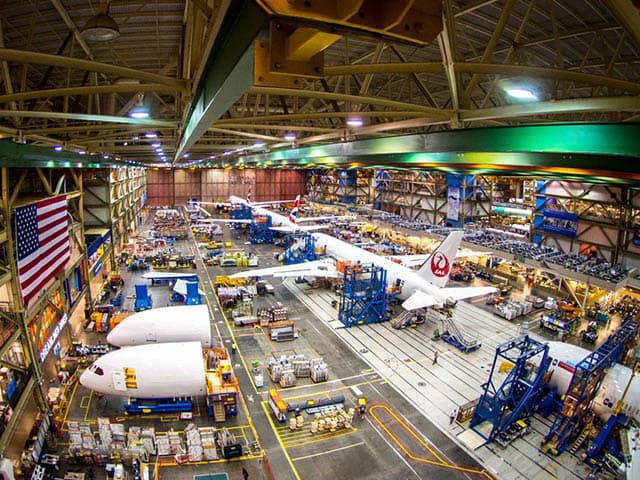
**Boeing's 2026 Commercial Market Outlook: A 20-Year Vision for Global Aviation**
Boeing has released its latest Commercial Market Outlook (CMO), forecasting that the global commercial aircraft fleet will grow by nearly 80% over the next two decades, reaching over 50,000 aircraft by 2045. This expansion is underpinned by an expected doubling of passenger traffic between 2026 and 2045, growing at an average rate of 4% per year. The current fleet stands at approximately 28,000 aircraft, meaning the industry will need to add more than 22,000 net new units just to meet demand, not counting replacements.
**Nearly 44,000 New Deliveries: Monocouloirs Lead the Way**
To support this growth and fleet renewal, Boeing anticipates nearly 44,000 new aircraft deliveries worldwide from 2026 to 2045. The breakdown reveals a strong dominance of single-aisle aircraft: 33,545 narrowbodies, 7,715 widebodies, 1,435 regional jets, and 930 factory-built freighters. Crucially, half of these deliveries will replace older, less efficient aircraft, while the other half will add net capacity. This means that by 2045, less than 10% of the current generation of aircraft will remain in service, underscoring the rapid pace of technological renewal.
**Sustainability and the Role of New Aircraft**
Boeing emphasizes that the introduction of more fuel-efficient models is essential to reconcile traffic growth with environmental goals. Brad McMullen, senior vice president of Commercial Sales and Marketing, stated that modernizing the global fleet is vital for connecting people and economies sustainably. For ATPL and ATC students, this trend highlights the increasing importance of understanding next-generation aircraft performance, fuel efficiency metrics, and the operational implications of a rapidly modernizing fleet.
**Network Expansion and Low-Cost Carrier Growth**
Since 2015, airlines have added approximately 5,500 new city pairs, a 30% increase in global connectivity, with half now served at least daily. Low-cost carriers are expected to grow their fleets by about 4% annually, compared to 3% for legacy carriers. This shift toward point-to-point networks and ultra-low-cost models will affect route planning, airspace design, and ATC workload, making it a key topic for future controllers.
**Emerging Markets and Cargo Resilience**
Emerging markets—China, the Middle East, Latin America, South and Southeast Asia, and Africa—will account for 55% of deliveries, while mature markets take 45%. The cargo segment remains resilient, with dedicated freighter capacity growing 5% since early 2026. Boeing forecasts 3.7% annual cargo traffic growth, requiring over 2,900 new or converted freighters over 20 years. For aviation students, this means understanding both passenger and cargo operations will be critical, as cargo increasingly drives airport infrastructure and slot allocation decisions.