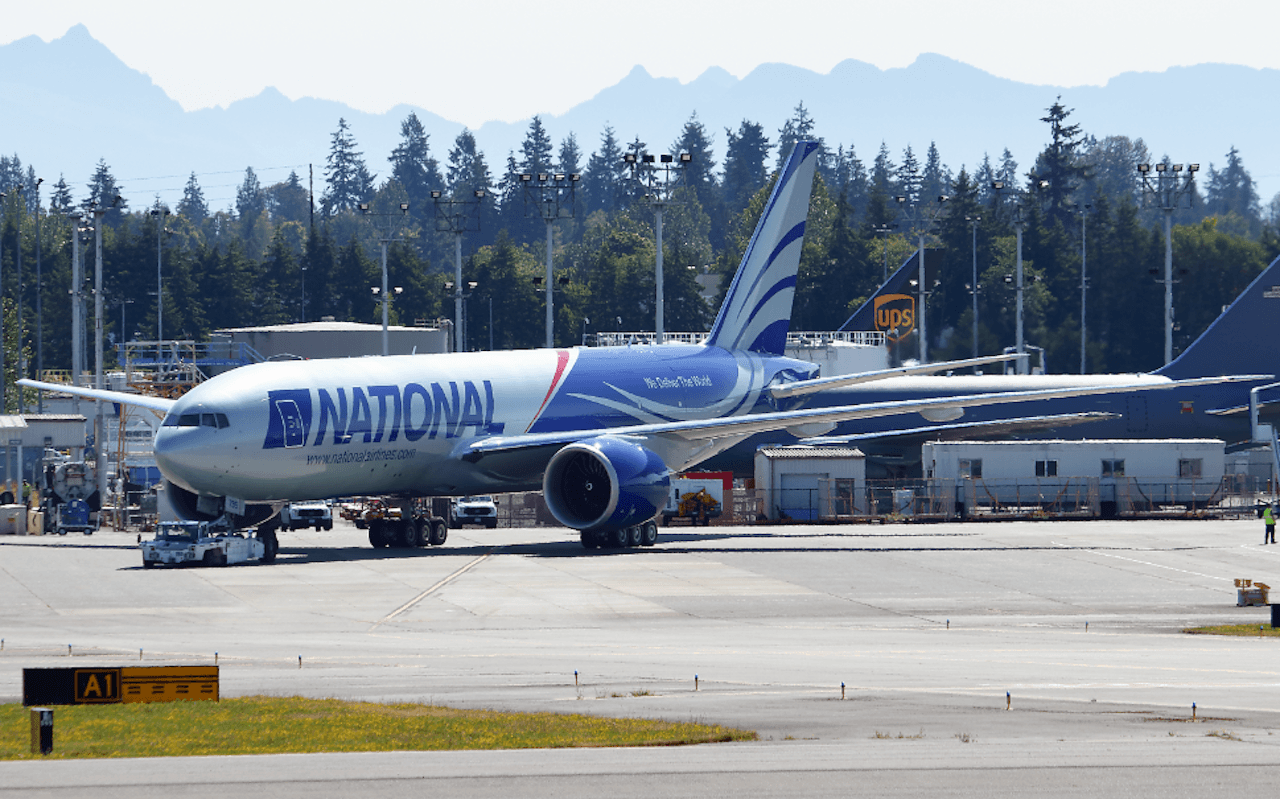
On August 4, a Boeing 777F operated by National Airlines departed Glasgow-Prestwick (PIK) and landed in Melbourne (MEL) after 19 hours and 23 minutes of nonstop flight, covering 9,849 nautical miles (18,240 km). The carrier claims this is the longest commercial flight ever performed by a 777 Freighter, a statement that deserves cautious scrutiny until independently verified. The mission, designated NCR820, was reportedly flown on behalf of Golden Aviation, carrying an urgent aircraft spare part, though the exact cargo weight was not disclosed.
For ATPL students, this flight is a textbook case of aircraft performance and operational planning. The 777F, based on the 777-200LR, has a nominal range of about 5,000 nm with a full payload of 107 tonnes. Covering nearly double that distance requires a severe payload restriction: less cargo allows more fuel within the maximum takeoff weight. This trade-off is fundamental to long-haul operations and is a key concept in the Performance and Flight Planning syllabus. The fact that the actual distance flown exceeded the great-circle distance between the two airports also highlights the impact of weather, winds, and routing constraints on flight time and fuel consumption.
The flight also underscores the economic rationale behind such missions. For time-critical cargo, the value of avoiding a stopover can outweigh the high cost of a dedicated nonstop flight. This is a common scenario in the world of charter and express freight, and it illustrates how commercial pressures shape operational decisions. For ATC students, the flight's popularity on tracking platforms like Flightradar24 shows how public interest can generate attention, but operational decisions remain grounded in safety and efficiency.
Finally, this event comes shortly after National Airlines took delivery of its third 777F, N795CA, which entered service on July 30. The carrier is expanding its long-haul cargo capacity alongside its 747 freighters. For students, this is a reminder that aircraft performance is not just about numbers in a manual—it's about real-world trade-offs that pilots and dispatchers must manage daily. Understanding these principles is crucial for any future career in aviation, whether in the cockpit or on the ground.