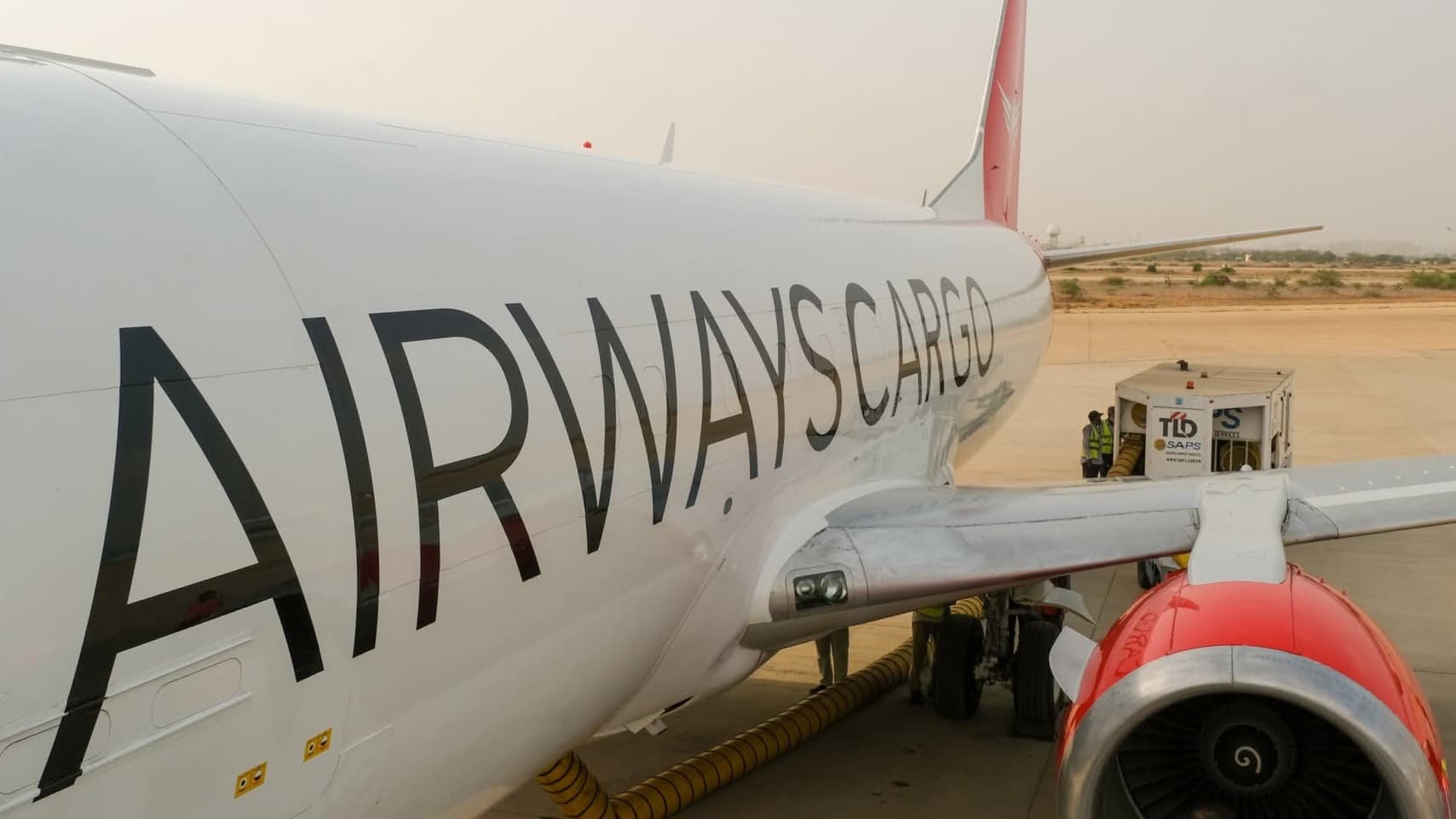
**A Boeing 737-400 cargo aircraft operated by the Pakistani carrier K2 Airways has disappeared over the Arabian Sea, triggering a large-scale search and rescue operation. The aircraft was en route from Sharjah (UAE) to Karachi when it vanished from radar screens on Tuesday evening.**
According to the Pakistan Airports Authority (PAA), the converted freighter was carrying five crew members. The incident occurred approximately 155 nautical miles west of Karachi, within the approach zone of Pakistani airspace. At 21:18 local time, the crew reported a navigation system problem and requested radar guidance from the Karachi Area Control Centre. Three minutes later, radar data showed the aircraft initiating a rapid descent accompanied by a sharp turn, before both radar and radio contact were lost. Preliminary ADS-B data from FlightRadar indicates a loss of altitude, a brief climb, followed by a second, more violent descent, with the last known position at about 1,100 feet above sea level and a descent rate of approximately -22,400 feet per minute.
**The sudden and extreme descent profile has puzzled aviation experts.** Imran Aslam, an aviation expert cited by ARY News, stated that even with an engine failure, an aircraft of this type would normally glide rather than plunge so abruptly. The reported GNSS (Global Navigation Satellite System) issue shortly after takeoff near Sharjah is a significant technical detail, but insufficient alone to explain such a drastic descent. Investigators will need to determine whether this anomaly remained confined to navigation or affected other systems or crew procedures. A safety investigation is expected to be opened by Pakistani authorities, with participation from the U.S. (state of design) and Boeing, once the aircraft is located and flight recorders recovered.
**For ATPL and ATC students, this incident provides a stark, real-world case study on the critical importance of understanding GNSS vulnerabilities and their potential cascading effects on aircraft systems.** The loss of navigation accuracy could lead to spatial disorientation or affect flight management systems. Moreover, the rapid descent profile underscores the need for thorough training on emergency checklists, crew resource management (CRM), and the handling of unusual attitude recoveries. ATC trainees should note the sequence of events: the crew's request for radar guidance, the subsequent loss of contact, and the activation of the search and rescue (SAR) coordination. This scenario emphasizes the need for clear communication and rapid response procedures.
**The search operation involves the Pakistani Navy frigate PNS Zulfiqar, an ATR maritime patrol aircraft, and at least one merchant vessel.** No wreckage or debris has been confirmed yet. K2 Airways, a private cargo carrier based in Karachi, began operations in 2018 but only obtained its AOC for the Boeing 737-400 freighter in 2024-2025. This incident also occurs in a country still recovering from the 2020 Pakistan International Airlines A320 crash near Karachi, which killed 97 people. The current disappearance will undoubtedly renew focus on aviation safety in the region.
**This event is a powerful reminder for aviation students that technical failures, especially those involving navigation systems, can escalate rapidly and require immediate, coordinated responses.** Understanding the interplay between human factors, system design, and emergency procedures is essential for both pilots and controllers.