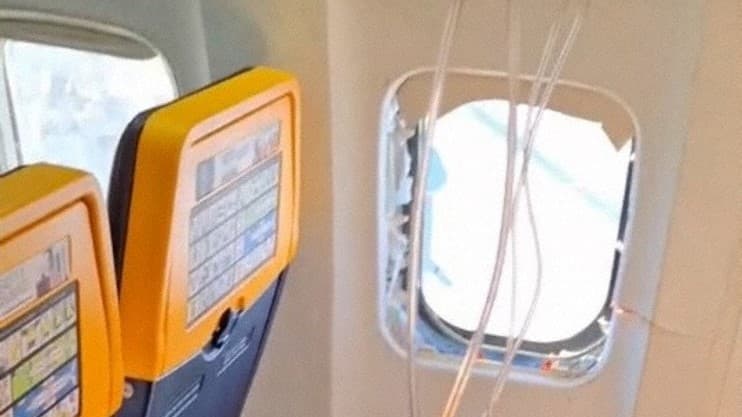
The aviation world is closely watching the NTSB's investigation into the Ryanair Boeing 737-800 incident at Thessaloniki on July 10, where a fan blade failure led to a cabin depressurization and a passenger being partially sucked out of a broken window. The preliminary report has now confirmed that bird remains were found in the right engine, a CFM56-7B, but the NTSB has not yet established a causal link. This development is a critical piece of the puzzle, but as the investigation unfolds, it underscores the complex interplay between bird strikes, engine maintenance, and certification standards.
For ATPL and ATC students, this incident is a textbook case of how a single event can cascade into a major safety emergency. The sequence—fan blade rupture, debris damaging the fuselage, window breakage, rapid decompression, and emergency landing—illustrates the importance of crew coordination and passenger safety procedures. The fact that the engine had four reported bird strike events in the preceding 12 months, with bird remains found in two, raises questions about the adequacy of inspection protocols. The NTSB notes that ultrasonic inspections of the fan blades in November 2025 and May 2026 found no anomalies, which challenges the assumption that routine checks can always detect hidden damage.
The investigation also draws parallels to the 2018 Southwest Airlines Flight 1380 accident, where a fan blade failure on a Boeing 737-700 led to a fatality. While the FAA administrator has downplayed similarities, the aviation community remains vigilant about the potential for engine design or maintenance issues. For students, this highlights the importance of understanding engine certification standards, such as bird strike resistance tests, and the role of regulatory bodies like the NTSB and FAA in ensuring safety.
From an ATC perspective, the incident occurred shortly after takeoff, a phase when bird strikes are most common. Controllers play a vital role in mitigating wildlife hazards by reporting bird activity and coordinating with airport wildlife management. This event serves as a reminder that bird strikes are not just a pilot concern but a shared responsibility across the aviation ecosystem.
As the NTSB continues its metallurgical analysis and reviews flight data, the outcome will likely influence future maintenance practices and certification requirements. For students, staying updated on such investigations is not just academic—it's a window into how safety lessons are learned and applied. The Ryanair incident is a stark reminder that aviation safety is a continuous process, and every investigation adds to the collective knowledge that keeps flying safe.